



Sign In to Your Account
Subscribers have complete access to the archive.
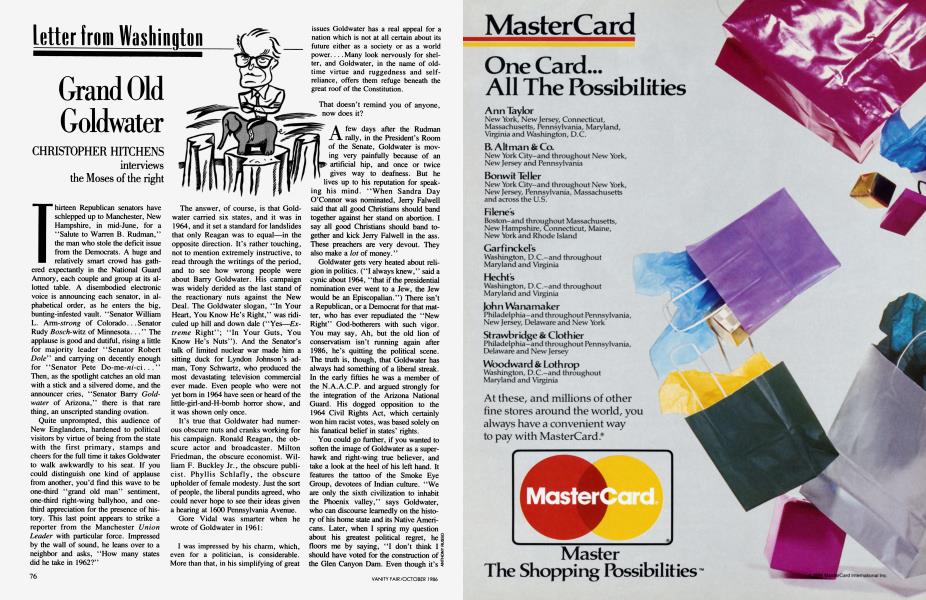
Sign In Not a Subscriber?Join NowThirteen Republican senators have schlepped up to Manchester, New Hampshire, in mid-June, for a "Salute to Warren B. Rudman," the man who stole the deficit issue from the Democrats. A huge and relatively smart crowd has gathered expectantly in the National Guard Armory, each couple and group at its allotted table. A disembodied electronic voice is announcing each senator, in alphabetical order, as he enters the big, bunting-infested vault. "Senator William L. Arm-strong of Colorado... Senator Rudy Bosch-witz of Minnesota..." The applause is good and dutiful, rising a little for majority leader "Senator Robert Dole" and carrying on decently enough for "Senator Pete Do-me-ni-ci. . . " Then, as the spotlight catches an old man with a stick and a silvered dome, and the announcer cries, "Senator Barry Goldwater of Arizona," there is that rare thing, an unscripted standing ovation.
Quite unprompted, this audience of New Englanders, hardened to political visitors by virtue of being from the state with the first primary, stamps and cheers for the full time it takes Goldwater to walk awkwardly to his seat. If you could distinguish one kind of applause from another, you'd find this wave to be one-third "grand old man" sentiment, one-third right-wing ballyhoo, and one-third appreciation for the presence of history. This last point appears to strike a reporter from the Manchester Union Leader with particular force. Impressed by the wall of sound, he leans over to a neighbor and asks, "How many states did he take in 1962?"
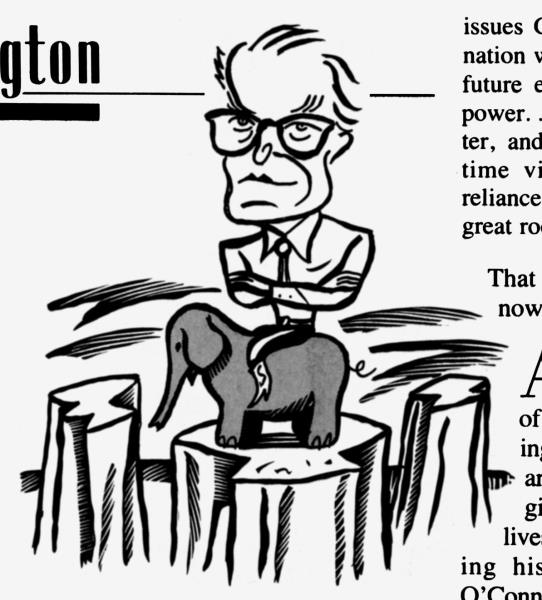
The answer, of course, is that Goldwater carried six states, and it was in 1964, and it set a standard for landslides that only Reagan was to equal—in the opposite direction. It's rather touching, not to mention extremely instructive, to read through the writings of the period, and to see how wrong people were about Barry Goldwater. His campaign was widely derided as the last stand of the reactionary nuts against the New Deal. The Goldwater slogan, "In Your Heart, You Know He's Right," was ridiculed up hill and down dale ("Yes—Extreme Right"; "In Your Guts, You Know He's Nuts"). And the Senator's talk of limited nuclear war made him a sitting duck for Lyndon Johnson's adman, Tony Schwartz, who produced the most devastating television commercial ever made. Even people who were not yet born in 1964 have seen or heard of the little-girl-and-H-bomb horror show, and it was shown only once.
It's true that Goldwater had numerous obscure nuts and cranks working for his campaign. Ronald Reagan, the obscure actor and broadcaster. Milton Friedman, the obscure economist. William F. Buckley Jr., the obscure publicist. Phyllis Schlafly, the obscure upholder of female modesty. Just the sort of people, the liberal pundits agreed, who could never hope to see their ideas given a hearing at 1600 Pennsylvania Avenue.
Gore Vidal was smarter when he wrote of Goldwater in 1961:
I was impressed by his charm, which, even for a politician, is considerable. More than that, in his simplifying of great issues Goldwater has a real appeal for a nation which is not at all certain about its future either as a society or as a world power.... Many look nervously for shelter, and Goldwater, in the name of old-time virtue and ruggedness and self-reliance, offers them refuge beneath the great roof of the Constitution.
That doesn't remind you of anyone, now does it?
A few days after the Rudman rally, in the President's Room of the Senate, Goldwater is moving very painfully because of an artificial hip, and once or twice gives way to deafness. But he lives up to his reputation for speaking his mind. "When Sandra Day O'Connor was nominated, Jerry Falwell said that all good Christians should band together against her stand on abortion. I say all good Christians should band together and kick Jerry Falwell in the ass. These preachers are very devout. They also make a lot of money."
Goldwater gets very heated about religion in politics. ("I always knew," said a cynic about 1964, "that if the presidential nomination ever went to a Jew, the Jew would be an Episcopalian.") There isn't a Republican, or a Democrat for that matter, who has ever repudiated the "New Right" God-botherers with such vigor. You may say, Ah, but the old lion of conservatism isn't running again after 1986, he's quitting the political scene. The truth is, though, that Goldwater has always had something of a liberal streak. In the early fifties he was a member of the N.A.A.C.P. and argued strongly for the integration of the Arizona National Guard. His dogged opposition to the 1964 Civil Rights Act, which certainly won him racist votes, was based solely on his fanatical belief in states' rights.
You could go further, if you wanted to soften the image of Goldwater as a superhawk and right-wing true believer, and take a look at the heel of his left hand. It features the tattoo of the Smoke Eye Group, devotees of Indian culture. "We are only the sixth civilization to inhabit the Phoenix valley," says Goldwater, who can discourse learnedly on the history of his home state and its Native Americans. Later, when I spring my question about his greatest political regret, he floors me by saying, "I don't think I should have voted for the construction of the Glen Canyon Dam. Even though it's created the biggest tourist attraction in my state, I preferred the free-running river. I remember the river." Pinching myself viciously (we don't have all day and at this rate he's coming out like a Friend of the Earth), I ask the Senator if there is anything else he would have done differently. "Nope. Don't like this image politics. It's all opinion polls. You have to stay with your beliefs, with what you started out with."
A close colleague of Goldwater's had suggested that I ask him how he would have won the Vietnam War. I ask him how he would have won the Vietnam War. He looks at me as if I were born yesterday. "Could have been done in two to three weeks." Really? "Of course. We'd just have told the North Vietnamese to surrender and lay off or we'd erase them from the face of the earth." From the face of the earth? "I don't mean nuclear weapons. The air force could have done it in under a month's time with conventional bombing." Irrelevantly, I recall the old joke of the L.B.J. years: "They told me if I voted for Goldwater the country would get into a terrible war in Vietnam. Boy, were they right. I voted for Goldwater, and the country got into a terrible war in Vietnam." And here is this elderly Episcopalian, sitting across from me and talking with evident nostalgia for the lifeless rubble that might have been.
Goldwater really does love the air force, though—more than enough to make it a present of Vietnam. He flew with the Army Air Force from 1941 to 1945, and in his capacity as chairman of the Senate Armed Services Committee he has rarely missed a chance to test-fly a new plane. He's a tiger when it comes to military spending. In New Hampshire, he told the crowd that "next thing you know, all we're going to have is bows and arrows." He has also complained, in all seriousness, that the Democrats "say nicer things about the Soviet Union than about our own military services." But when he thought that Reagan was stupidly risking the Marines in Lebanon, Goldwater was loud in calling for their withdrawal. And he publicly lambasted William Casey of the C.I.A., telling him that he was "pissed off" at the secret mining of Nicaragua's harbors. Along with Goldwater's military faith and admiration for soldiers comes a certain idea of honor.
It's easy to see, even now, how this honesty got Goldwater into trouble. One man who worked on the 1964 campaign says he still wakes up thinking about it. "You couldn't get him to soften the blow. If he wanted to give a speech denouncing Social Security as a step to state tyranny, he'd be sure and give it in front of an audience of retirees in Florida. None of us liked the Tennessee Valley Authority, but he had to attack it in Tennessee. He even criticized the tobacco subsidy in North Carolina." Add to this Goldwater's tendency to the hyperbolic one-liner ("Let's lob one right in the men's room of the Kremlin"; "We'd be better off if we just sawed off the whole Eastern Seaboard and let it float off into the ocean") and you can see what a hard time his handlers had.
He's defensive about the one-liners. He claims, for example, that the joke about the Eastern Seaboard comes from a time when he was in New York and nobody would honor an Arizona check, ''like I came from some underdeveloped country." But the remark became symbolic of the down-home Republican hatred for the eastern establishment in general and New York in particular. Barry Goldwater never had any Teflon capability; his every gaffe hung right round his neck for all to see.
There came a point, back there in 1964, when young Ronald Reagan made a television appeal for the Goldwater campaign. It is still known, in veteran conservative circles, as "The Speech." It set people to thinking that maybe you could have a real conservative candidate who didn't scare people. As John B. Judis points out in "Barry Goldwater's Curious Campaign," his very perceptive study for the Alicia Patterson Foundation, the Senator did have quite a strong showing in the South and a very decent showing in the West. What the conservative movement lacked was "the ethnic Democrats—disillusioned by taxes, crime, civic disorder and busing." When the opportunity to recruit them presented itself, there was a cadre of battle-hardened right-wingers, schooled by the Goldwater campaign, who had prepared for the moment.
Goldwater himself had been too fastidious to do this. On July 24, 1964, as black riots began to erupt in the cities of the North, he actually met with Lyndon Johnson and made a pact to avoid exploiting the subject. No such scruples were to trouble Richard Nixon in his "law and order" campaign. And the Reagan candidacy was to succeed in speaking to blue-collar Democrats about their deepest worries in a way that Goldwater could not have dreamed of.
Today, the Moses of the right looks at the Reaganite promised land with a slight squint. On the one hand, he dislikes the small-town bullies and obscurantists whom the president will not disown. On the other, he says, "Thank God, we now have a commander in chief, our president, who is doing his utmost to provide the nation with those tools [the new weapon systems]." At the Republican convention in Dallas, he wowed the crowd by telling them once more that "extremism in the defense of liberty is no vice." For his final invocation, he toasted Ronald Reagan and said, "In your hearts, you know he's right!" For many people in the hall, this was the culmination of two decades' patient work.
Yet, as we come to the end of our time in the President's Room, Goldwater says, "Political philosophy goes in a circle. I don't think I'll live to see it, but our side will run out of ideas in about fifteen years at the most. The liberals will be back again—maybe not so liberal, but certainly back."
Fifteen years! The liberals had better start now. And instead of molding themselves around each new opinion poll, they might ponder the ironic rewards that come to those who, while in exile and defeat, refuse to water their wine.
Subscribers have complete access to the archive.
Sign In Not a Subscriber?Join Now

