




Sign In to Your Account
Subscribers have complete access to the archive.
Sign In Not a Subscriber?Join NowHot Type
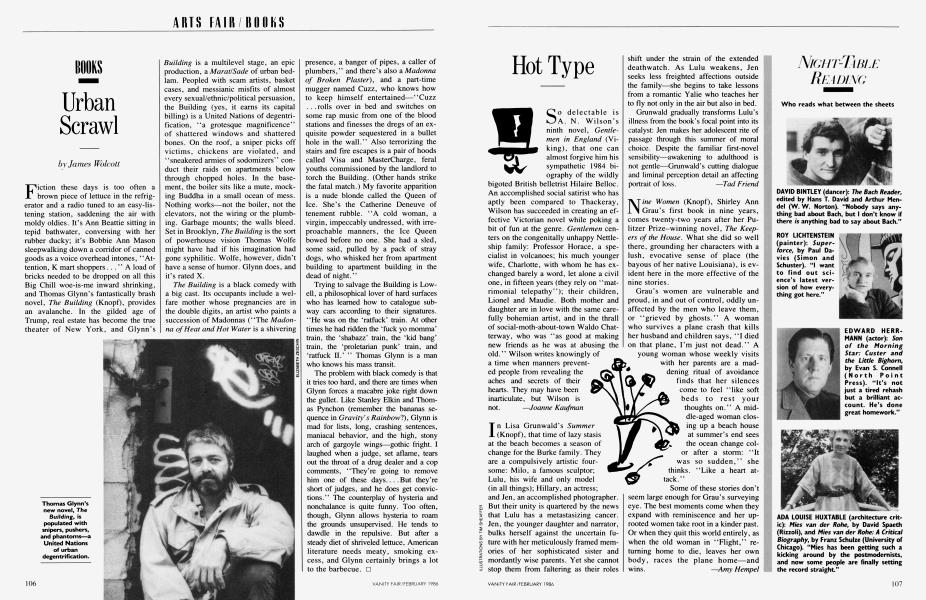
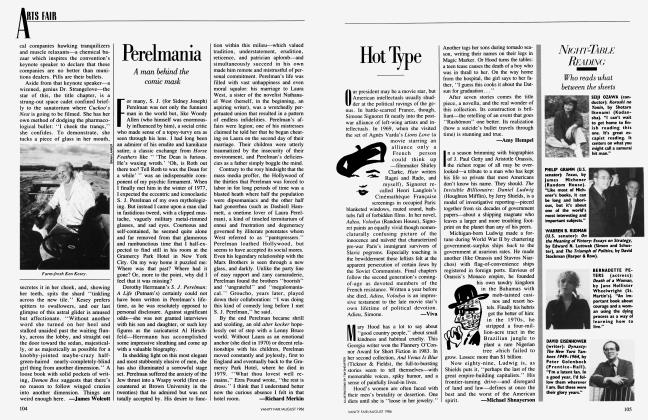
So delectable A. N. Wilson's ninth novel, Gentlemen in England (Viking), that one can almost forgive him his sympathetic 1984 biography of the wildly bigoted British belletrist Hilaire Belloc. An accomplished social satirist who has aptly been compared to Thackeray, Wilson has succeeded in creating an effective Victorian novel while poking a bit of fun at the genre. Gentlemen centers on the congenitally unhappy Nettleship family: Professor Horace, a specialist in volcanoes; his much younger wife, Charlotte, with whom he has exchanged barely a word, let alone a civil one, in fifteen years (they rely on "matrimonial telepathy''); their children, Lionel and Maudie. Both mother and daughter are in love with the same carefully bohemian artist, and in the thrall of social-moth-about-town Waldo Chatterway, who was "as good at making new friends as he was at abusing the old." Wilson writes knowingly of a time when manners prevented people from revealing the aches and secrets of their hearts. They may have been inarticulate, but Wilson is not.
Joanne Kaufman
In Lisa Grunwald's Summer (Knopf), that time of lazy stasis at the beach becomes a season of change for the Burke family. They are a compulsively artistic foursome: Milo, a famous sculptor; Lulu, his wife and only model (in all things); Hillary, an actress; and Jen, an accomplished photographer. But their unity is quartered by the news that Lulu has a metastasizing cancer. Jen, the younger daughter and narrator, bulks herself against the uncertain future with her meticulously framed memories of her sophisticated sister and mordantly wise parents. Yet she cannot stop them from faltering as their roles shift under the strain of the extended deathwatch. As Lulu weakens, Jen seeks less freighted affections outside the family—she begins to take lessons from a romantic Yalie who teaches her to fly not only in the air but also in bed.
Grunwald gradually transforms Lulu's illness from the book's focal point into its catalyst: Jen makes her adolescent rite of passage through this summer of moral choice. Despite the familiar first-novel sensibility—awakening to adulthood is not gentle—Grunwald's cutting dialogue and liminal perception detail an affecting portrait of loss.
Tad Friend
Nine Women (Knopf), Shirley Ann Grau's first book in nine years, comes twenty-two years after her Pulitzer Prize-winning novel, The Keepers of the House. What she did so well there, grounding her characters with a lush, evocative sense of place (the bayous of her native Louisiana), is evident here in the more effective of the nine stories.
Grau's women are vulnerable and proud, in and out of control, oddly unaffected by the men who leave them, or "grieved by ghosts." A woman who survives a plane crash that kills her husband and children says, "I died on that plane, I'm just not dead." A young woman whose weekly visits with her parents are a maddening ritual of avoidance finds that her silences come to feel "like soft beds to rest your thoughts on." A middle-aged woman closing up a beach house at summer's end sees the ocean change color after a storm: "It was so sudden," she thinks. "Like a heart attack."
Some of these stories don't seem large enough for Grau's surveying eye. The best moments come when they expand with reminiscence and her uprooted women take root in a kinder past. Or when they quit this world entirely, as when the old woman in "Flight," returning home to die, leaves her own body, races the plane home—and wins.
Amy Hempel
Subscribers have complete access to the archive.
Sign In Not a Subscriber?Join Now