

Sign In to Your Account
Subscribers have complete access to the archive.
Sign In Not a Subscriber?Join NowViennese Style
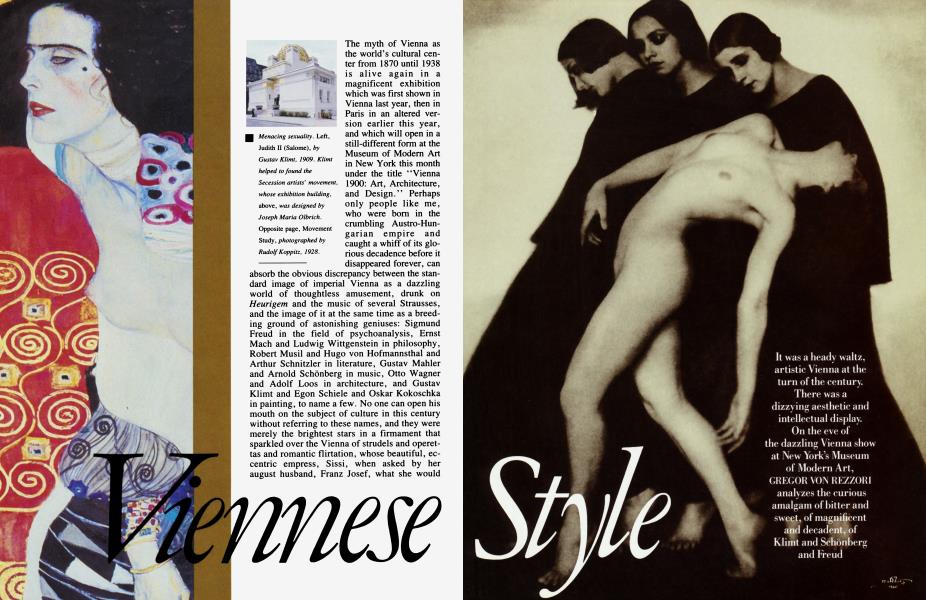
The myth of Vienna as the world's cultural center from 1870 until 1938 is alive again in a magnificent exhibition which was first shown in Vienna last year, then in Paris in an altered version earlier this year, and which will open in a still-different form at the Museum of Modem Art in New York this month under the title "Vienna 1900: Art, Architecture, and Design.'' Perhaps only people like me, who were bom in the crumbling Austro-Hungarian empire and caught a whiff of its glorious decadence before it disappeared forever, can absorb the obvious discrepancy between the standard image of imperial Vienna as a dazzling world of thoughtless amusement, drunk on Heurigem and the music of several Strausses, and the image of it at the same time as a breeding ground of astonishing geniuses: Sigmund Freud in the field of psychoanalysis, Ernst Mach and Ludwig Wittgenstein in philosophy, Robert Musil and Hugo von Hofmannsthal and Arthur Schnitzler in literature, Gustav Mahler and Arnold Schonberg in music, Otto Wagner and Adolf Loos in architecture, and Gustav Klimt and Egon Schiele and Oskar Kokoschka in painting, to name a few. No one can open his mouth on the subject of culture in this century without referring to these names, and they were merely the brightest stars in a firmament that sparkled over the Vienna of strudels and operettas and romantic flirtation, whose beautiful, eccentric empress, Sissi, when asked by her august husband, Franz Josef, what she would like for her name day, answered without hesitation: a fully equipped loony bin.
It was a heady waltz, artistic Vienna at the turn of the century. There was a dizzying aesthetic and intellectual display. On the eve of the dazzling Vienna show at New York's Museum of Modern Art, GREGOR VON REZZORI analyzes the curious amalgam of bitter and sweet, of magnificent and decadent, of Klimt and Schõnberg and Freud
GREGOR VON REZZORI
It took time for the myth of Vienna to gain resurgence. In the early 1950s I happened to be living in Paris, and often in conversations about the art of painting I couldn't help mentioning the name Gustav Klimt. Invariably I received that haughty look with which the French punish a cultural blunder. "Klimt? Non, on n€ connait pas le peintre Klimt!" A few years later, Paris was aglow with one of its marvelous expositions, called "The Sources of the Twentieth Century,'' and Klimt was among the exciting highlights. In addition to a number of his well-preserved paintings, the curators had turned up the charred remains of one of his portraits—a perfect example of his magnificent backgrounds—and they even hung that! Since then, of course, the manufacturers of French postcards have watched Klimt's The Kiss rival Van Gogh's Sunflowers in sales.
Can the sheer physical growth of Vienna in its heyday, its explosion beyond its medieval boundaries by the construction of the Ringstrasse, explain why its architects suddenly started discussing what they were building in deeply philosophical terms? Or why its painters turned overnight into thinkers, expressing states of mind in a psychoanalytic way? Or why its composers took the daredevilish leap to twelve-tone music?
There is an even darker riddle. Can anything explain why this society of such intellectual and artistic and moral awareness woke up one morning and found itself painting the word Jude and Stars of David on Jewish shops and houses? Those inscriptions have proved indelible. They still show through the most beautiful posters for exhibitions of Klimt, and lurk under the jects produced by the Wiener Werkstatte at its height.
Vienna from 1870 to 1938? It was the compost of a rotting world which became a hotbed of cultural brilliance in all areas, from philosophy to scientific research, from music to the figurative arts, right down to the aesthetic design of easy chairs and salad bowls. Perhaps it isn't strange at all that two works by very different Viennese architects of the period—Joseph Maria Olbrich's temple of the arts for the Secession group and Otto Wagner's church for the madmen of Steinhof—look nearly identical.
When Milan Kundera writes that the destiny of Central Europe (by which he obviously means the territory of the former Austro-Hungarian empire) can be taken as an indication of Europe's destiny in general, I can only add: Blessed are the poor in intellect, who live without the burden of the past, who are blindfolded before a future of innumerable unknown possibilities.
Subscribers have complete access to the archive.
Sign In Not a Subscriber?Join Now


