



Sign In to Your Account
Subscribers have complete access to the archive.
Sign In Not a Subscriber?Join NowEditor's Letter
The Great Pretender
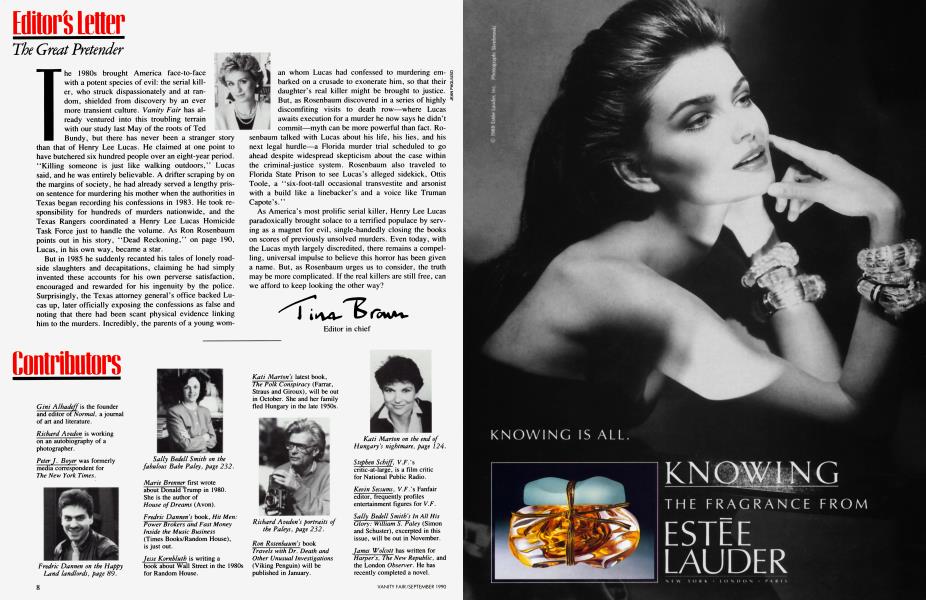
The 1980s brought America face-to-face with a potent species of evil: the serial killer, who struck dispassionately and at random, shielded from discovery by an ever more transient culture. Vanity Fair has already ventured into this troubling terrain with our study last May of the roots of Ted
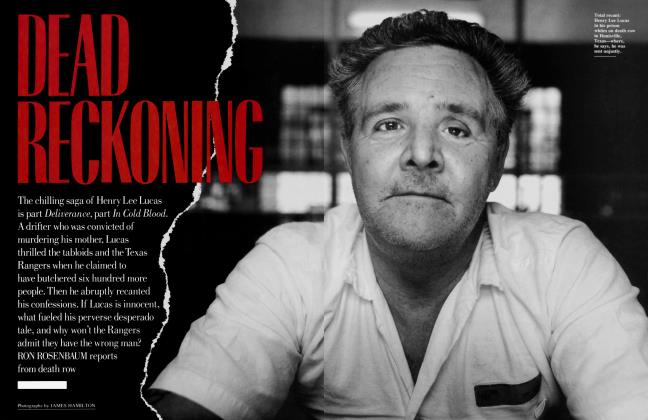
Bundy, but there has never been a stranger story than that of Henry Lee Lucas. He claimed at one point to have butchered six hundred people over an eight-year period. "Killing someone is just like walking outdoors," Lucas said, and he was entirely believable. A drifter scraping by on the margins of society, he had already served a lengthy prison sentence for murdering his mother when the authorities in Texas began recording his confessions in 1983. He took responsibility for hundreds of murders nationwide, and the Texas Rangers coordinated a Henry Lee Lucas Homicide Task Force just to handle the volume. As Ron Rosenbaum points out in his story, "Dead Reckoning," on page 190, Lucas, in his own way, became a star.
But in 1985 he suddenly recanted his tales of lonely roadside slaughters and decapitations, claiming he had simply invented these accounts for his own perverse satisfaction, encouraged and rewarded for his ingenuity by the police. Surprisingly, the Texas attorney general's office backed Lucas up, later officially exposing the confessions as false and noting that there had been scant physical evidence linking him to the murders. Incredibly, the parents of a young wom-
an whom Lucas had confessed to murdering emg barked on a crusade to exonerate him, so that their g daughter's real killer might be brought to justice. | But, as Rosenbaum discovered in a series of highly ⅜ discomfiting visits to death row—where Lucas awaits execution for a murder he now says he didn't commit—myth can be more powerful than fact. Rosenbaum talked with Lucas about his life, his lies, and his next legal hurdle—a Florida murder trial scheduled to go ahead despite widespread skepticism about the case within the criminal-justice system. Rosenbaum also traveled to Florida State Prison to see Lucas's alleged sidekick, Ottis Toole, a "six-foot-tall occasional transvestite and arsonist with a build like a linebacker's and a voice like Truman Capote's."
As America's most prolific serial killer, Henry Lee Lucas paradoxically brought solace to a terrified populace by serving as a magnet for evil, single-handedly closing the books on scores of previously unsolved murders. Even today, with the Lucas myth largely discredited, there remains a compelling, universal impulse to believe this horror has been given a name. But, as Rosenbaum urges us to consider, the truth may be more complicated. If the real killers are still free, can we afford to keep looking the other way?
Editor in chief




Subscribers have complete access to the archive.
Sign In Not a Subscriber?Join Now