

Sign In to Your Account
Subscribers have complete access to the archive.
Sign In Not a Subscriber?Join NowBOB KERREY'S ODYSSEY
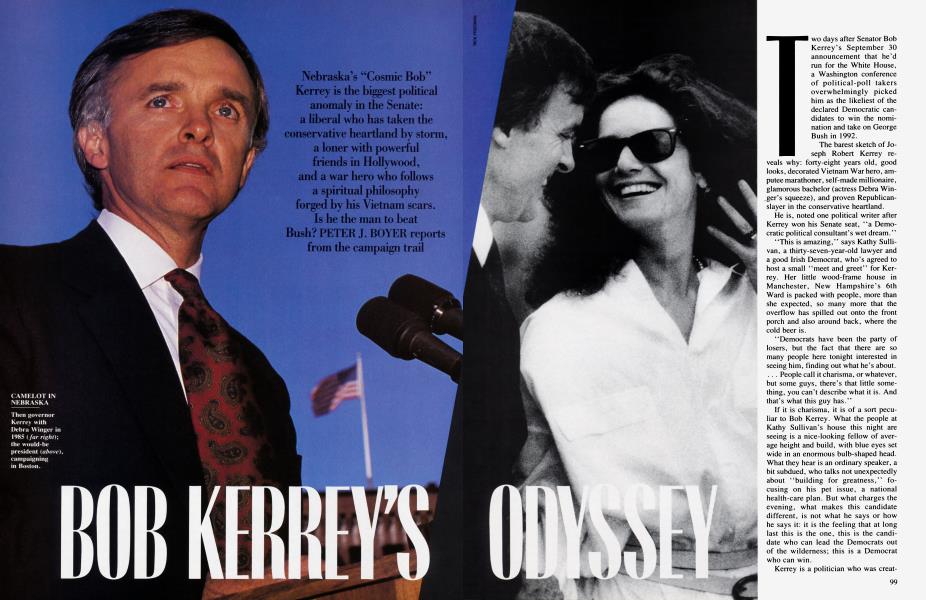
Nebraska's "Cosmic Bob" Kerrey is the biggest political anomaly in the Senate: a liberal who has taken the conservative heartland by storm, a loner with powerful friends in Hollywood, and a war hero who follows a spiritual philosophy forged by his Vietnam scars. Is he the man to beat Bush? PETER J. BOYER reports from the campaign trail
PETER J.BOYER
Two days after Senator Bob Kerrey's September 30 announcement that he'd run for the White House, a Washington conference of political-poll takers overwhelmingly picked him as the likeliest of the declared Democratic can didates to win the nomi nation and take on George Bush in 1992.
The barest sketch of Joseph Robert Kerrey reveals why: forty-eight years old, good looks, decorated Vietnam War hero, amputee marathoner, self-made millionaire, glamorous bachelor (actress Debra Winger's squeeze), and proven Republicanslayer in the conservative heartland.
He is, noted one political writer after Kerrey won his Senate seat, "a Democratic political consultant's wet dream."
"This is amazing," says Kathy Sullivan, a thirty-seven-year-old lawyer and a good Irish Democrat, who's agreed to host a small ''meet and greet" for Kerrey. Her little wood-frame house in Manchester, New Hampshire's 6th Ward is packed with people, more than she expected, so many more that the overflow has spilled out onto the front porch and also around back, where the cold beer is.
''Democrats have been the party of losers, but the fact that there are so many people here tonight interested in seeing him, finding out what he's about.
. . . People call it charisma, or whatever, but some guys, there's that little something, you can't describe what it is. And that's what this guy has."
If it is charisma, it is of a sort peculiar to Bob Kerrey. What the people at Kathy Sullivan's house this night are seeing is a nice-looking fellow of average height and build, with blue eyes set wide in an enormous bulb-shaped head. What they hear is an ordinary speaker, a bit subdued, who talks not unexpectedly about ''building for greatness," focusing on his pet issue, a national health-care plan. But what charges the evening, what makes this candidate different, is not what he says or how he says it: it is the feeling that at long last this is the one, this is the candidate who can lead the Democrats out of the wilderness; this is a Democrat who can win.
Kerrey is a politician who was created by a single transforming event, the Vietnam War. It cost him his innocence and part of a leg, and won him the Medal of Honor; it set him off on a psychic voyage that stood him apart in politics, and now has landed him in a presidential campaign.
Doctors and nurses were around his bed and a chaplain was ready to administer last rites. Kerrey, however, was having a blast.
On the flight from Nebraska to New Hampshire, I asked Kerrey about something he'd said the day before at a campaign speech in Iowa, about surrendering oneself for others in order to be free. It was not standard-issue campaign rhetoric, and I wondered what he had meant, exactly.
"It's the only way of becoming truly free," he replied.
Free from what?
"It's not so much free," Kerrey said, turning in his seat, ''it's just that, at that moment, you are free. I'm not sure that —it's very mystical—but I'm not sure that any of us are permanently free. I'm just conscious that when I give everything to my kids, or to my friends, or, better yet, to somebody I don't even know, and I'm not afraid of losing it all, whether it's my life or my possessions or whatever, that I feel exquisitely free. That's something that I've felt."
Such metaphysical musings are another product of Kerrey's transformation, and reveal a churning spirituality that is as central to the man as those surface qualities that so entice the political professionals. And that is why Bob Kerrey's run for the White House presents an exquisite paradox: an irresistible candidate in a process that abhors exotica.
Part of Kerrey's allure is that he does not behave like a politician. He has a deep personal ambivalence about public life. He unapologetically walked away from the Nebraska governor's office in 1986 despite record popularity ratings and growing national stature, and was drawn into the Senate race only reluctantly two years later. He blames most of our national ills on ''the politicians," and privately sympathizes with the gathering term-limitation fervor, even though it would likely help Republicans most. ''A massive turnover might be refreshing," he says, voicing a sentiment that would give many Democrats massive turnover of the stomach.
A determined unorthodoxy has given Kerrey a reputation for unpredictability, and a portfolio of contradiction: he disdains the term ''liberal," yet his voting record ranks among the most liberal in the Senate; he is skeptical of government, yet his domestic proposals amount to a reprise of the Great Society. He is a bom agonizer, and a public one, with the result that his first conclusion on an issue is by no means certain to be his last.
All of this—the scars of Vietnam, the ambivalence, the rebirth of idealism from disillusionment—makes him a man of his times, to some the apotheosis of a generation.
''Kerrey is potentially the most interesting Democratic politician on the scene," says Democratic pollster and consultant Geoffrey Garin. ''He brings a star quality to politics, [and] he has an interesting story. He is an appealing person, and he sort of has a different approach to politics. For the babyboom-generation voters, he has the potential to be the James Dean of American politics." A tailor-made candidate for the generation that deems itself the most interesting in history.
But in national politics there can be a decided downside to the label ''interesting," which is sometimes another way of saying "screwy" (Exhibit A: former California governor Jerry Brown). Kerrey has been compared to Brown, and his inclination to follow his inner currents sometimes makes him seem, as one Democratic consultant put it, a little "spacey."
' 'That is the true tension of the Kerrey candidacy," Garin says. "There is this fine line. In a lot of ways, Kerrey's performance is the most important part of this. If Kerrey comes off as a serious person, if Kerrey passes the threshold of presidential seriousness, then I think he becomes a very formidable candidate. That's a matter of perception, and we don't know the answer yet, which makes him very interesting. It really will be fascinating to see how he plays out. There's some genuine mystery to it."
Bob Kerrey's inner journey has a destination, a place where he once found a sublime peace and perfect clarity, and he's been trying to get back to it ever since. It is a place right next to death. In March of 1969, Lieutenant (j.g.) Bob Kerrey was lying in a navy-hospital bed in Japan, to which he'd been evacuated after a successful but personally disastrous commando mission in the bay of Nha Trang in Vietnam. Kerrey, the leader of the team, had taken the brunt of an exploding enemy grenade. He was almost completely bandaged, and in writhing pain, particularly in his right leg, which was in a cast, the mangled foot still barely attached. He could feel parts of his shattered limb rattling around in the cast, and in a fog of pain he began to fade toward death. And then it happened. "In an instant, it was all gone," he says. "There was a moment where there was no pain. And it was one of those compressed moments where I could see what I had done the previous day, and I could see what I did the day before that. And all of a sudden I could see my whole life back to age one or two—it just unfolded like an artichoke."
He had the urge to communicate this, to write it down, but he was hardly able to move. His roommate summoned a nurse, and soon doctors and nurses were around his bed and a chaplain was ready to administer last rites. Kerrey, however, was having a blast.
"It was a moment when I could see my whole life, and it was great fun. It was laughable." He saw with particular clarity those moments of falseness, of self-betrayal. "I could see myself doing something that could get me into trouble, an effort to be something that I wasn't, an effort to be something that I didn't feel. I could see myself lying, in order to be one of the guys or to get something done, or whatever. And it was very interesting. It was very exciting.
"It was meeting a part of me—I mean, I could see myself. I could see me: I was standing outside looking not only at me in the bed, but me compressed for a twenty-five-year period. I could see my whole life, and it was like packed into one moment. I've thought about whether it was drugs, but I don't think so. I mean, I'm telling you, I've been medicated up one side of the wall and down the other afterwards, and nothing took pain away like that. Not only was it gone, but none of the drowsiness, none of the desire to go to sleep.
I mean, I was, in the very strict definition of the word, I was awake. I'm telling you, it was a tremendous gift. I've never been presented a gift quite like that. I mean, there is a God, that would come and present somebody like me a gift at that moment."
Kerrey told me this amazing story one morning in Cambridge, Massachusetts, where he had been the featured speaker at Harvard's Kennedy School Institute of Politics the night before. The evening had gone particularly well, Kerrey slipping into a kind of serene self-possession he is able to call upon at key public moments. I asked, Does anything from that hospital experience endure?
"Yes. I've struggled every conscious moment, where I'm able to, to get back to it. It would be my desire to be in that attitude right now. I was very aware of the power of God, and the power of goodness. And I had no fear at all, no difficulty acknowledging not only defects, but deficiencies. I mean, I could see things that I can't see right now."
Can you tap into that moment at will, just push a mental button?
"I can tap into it, but. . .I'm outside of it now, I can't get close to it. I mean, I know it was there, and it helps me. I mean, I know what's possible. I think it might be possible to get to that point again."
It is not exactly a subject that comes up on the campaign trail, or anywhere else for that matter, but people close to Kerrey know about it, and see it as a source of strength. Debra Winger, who had a near-death experience herself as a teenager, sensed it almost from the moment she met Kerrey. "I always refer to it as a club, and I can almost tell within a half-hour of meeting someone if they're in the club, or if they've been at a meeting. He's definitely a member of the club."
But membership, Winger says, requires work—"It can fade, you know, unless you sort of, in a way, keep death alive"—and she worries about Kerrey's finding time on the campaign trail to roam around in "that freedom within."
"As with anything else, it's like a practice. And I think he does practice it, academically, and my argument always is you have to have a moment, you have to have this moment for reflection. And that's what scares me about the way politics are: you're always running and running and running—no truer word has ever been used than 'running' for office. ... I worry about Bob having the time for that reflection."
Back in the political wars in Nebraska, Kerrey's vanquished foes would often puzzle over the hold he had on the people of the Comhusker State. He was a divorced man in a "family values" culture, a Democrat in a place where Republicans usually win. He presided as governor during hard times, said no even to the interest groups who'd supported him, and still, his opponents marveled, the people of Nebraska seemed to love him.
But Ted Kooser, an insurance man and poet in Garland, Nebraska, was not at all surprised by his friend Bob Kerrey's magical sway. Kooser knew about politics and the theory of duende.
Duende is a notion in Spanish culture that life is enriched by an awareness of nearby mortality, that those who know how to hold hands with death live heightened lives. Kooser once read an essay by Federico Garcia Lorca called "Play and the Theory of Duende," which suggested that the great flamenco dancers are great because they dance out to the edge of death, collapse from exhaustion, and then pull back, and that this is the true art. Kooser saw a parallel.
"A part of the concept of duende is that a person who is constantly aware of one's mortality is a different sort of person, has a kind of attraction about them, a kind of magic about them," Kooser says. "I have, from time to time, told Bob that I felt he had duende.
"There is something about some of these people that is tremendously attractive, and compelling, and you feel good being around them. It's a very magical thing. I don't know many who have it. And also a great part of this—you don't want to neglect this part of it—a great part of this spirit is humor. It's very essential. And Bob laughs in a very charming way, and lives with humor. I think that's part of it. It's understanding you're only here this one time, and always this sort of shadow accompanying you."
If he hadn't gone to Vietnam, Bob Kerrey told news anchor Jim Lehrer in 1982, he would have been "a middle-class suburban white boy who had never hurt, who had never suffered, who had never felt any pain, who had never realized that there was suffering and pain outside of my life. And I saw it, felt it, tasted it firsthand. And I know it exists right now as we sit. Even though I may not feel it myself."
Indeed, there was little in the life of a boy growing up in northeast Lincoln in the 1950s to suggest a future of politics or spiritual journeys, not to mention beautiful movie-star girlfriends.
The Kerrey household was a middleclass, Middle America archetype, rooted in the local church and guided by a set of unquestioned values. Kerrey's father, James, was a builder, his mother, Elinor, a homemaker who went back to school only when her seven kids were grown. Theirs was a happy, noisy home, with various relatives and dislocated school chums passing through, and the Kerrey kids, untouched by tragedy or crisis, were graced with a sense that all was well and forever would be. The closest that any came to juvenile delinquency was when one of the boys got caught in a mooning incident.
Kerrey's campaign presents an exquisite paradox: an irresistible candidate in a process that abhors exotica.
Bob, with his flattop and Ricky Nelson grin, was a minor heartthrob at Lincoln Northeast High, and though he was a natural student, he also had a deep devotion to the pursuit of fun. He was a determined athlete, despite his asthma, running track, playing golf, and, although he never starred, earning a letter in football. It was the time of Kennedy and Nixon, Sputnik and 77 Sunset Strip, and the ambitions that formed in the heart of young Bob Kerrey were modest, and eminently attainable: he wanted to become a pharmacist, and to stay in Nebraska.
He was at pharmacy school at the University of Nebraska right there in Lincoln, a beer-sucking frat rat well on his way to a secure future behind a drug counter, when one day, with the arrival of a piece of mail from the U.S. government, everything suddenly changed. The notice to report for a draft physical inspired Kerrey to enroll in graduate school, with its accompanying draft deferment, and when that ended, he was faced with a choice. His asthma might have gotten him out of the service; his pharmacy degree might have at least guaranteed a cozy position in the rear. But a war was on, and there was the call of duty; besides, he'd been partial to the navy ever since reading The Caine Mutiny. A destroyer might be fun.
Kerrey enlisted in the navy, but by the end of Officer Candidate School, when recruiters from the navy's various branches came around to tout their specialties to the incoming officers, the prospect of life on a destroyer seemed less compelling. There was this other group of recruiters, different from the rest, more casual, less regimented, less navy. They were from something called the Underwater Demolition Team, and they were tanned, wore sunglasses, and showed movies adorned by pretty girls in bathing suits. Kerrey volunteered.
That was when Bob Kerrey, the Nebraska pharmacist, learned that he had the stuff to be a cold-eyed killer. At the time, 1968, the navy was quietly developing an offbranch of the U.D.T. called SEALS (for Sea, Air, and Land), an elite guerrilla commando team designed as a counterpoint to the army's Green Berets. The team's name conjured up images of a bunch of navy guys frogging around in wet suits, but, in fact, they got the dirtiest jobs in Vietnam, jobs that even the Green Berets wouldn't touch. One of the SEALS' early operations was in an inhospitable realm in the Mekong Delta called Rung Sat—Vietnamese for Jungle of Death—a no-man's-land of desperadoes and Vietcong. There was no good way to prepare for such warfare (the SEALS had to learn, for example, to operate at night), and Rung Sat became a meat grinder. They took 92 percent casualties, dead or wounded, but they succeeded in cleaning it out.
Kerrey went for SEAL training at the Coronado, California, U.D.T. school— better known as "hack it" school, because its chief purpose was not so much to train its young volunteers as to determine whether they were tough enough to "hack it" in the unpleasantness that awaited in Vietnam. Kerrey remembers the training as being "rigorous," but Gary Parrott, a SEAL buddy who remains one of Kerrey's closest friends, is more detailed in his recollection. "They encouraged you to quit, every day for four and a half months, until the training was over."
The worst, Parrott recalls, was the water training, where the recruits were put through endurance tests in the icy Pacific, without wet suits. "I can remember times they'd put us out there and say, 'We've got too many people in this class. Too many of you guys are pussies! We're gonna put you out in that cold water until five of you quit!' And you'd get hypothermic out there."
Bob Kerrey, it turned out, was a natural student in the ways of ambush war, a demanding science requiring not only the ability to slit an enemy throat, but also the nervy matter of crouching in the bush at night in the enemy's midst, awaiting the right moment. "I was very gung ho," he recalls. "I enjoyed it."
Kerrey arrived in Vietnam in January 1969, had a few successful missions in the Central Highlands, and then came his chance for a big score. An enemy defector revealed that a high-level cadre of North Vietnamese sappers was hiding on an island in the bay of Nha Trang. Kerrey planned an attack, and on the moonless night of March 14 he led a seven-man team to Hon Tre island, scaling a 350-foot cliff in the hope of catching the enemy by surprise. The plan was to split the team in half and catch the enemy in a cross fire, but when somebody bumped into a hammock, alerting a guard, a firefight broke out, lighting up the night—AK-47s and Ml6s firing away at ten feet. A grenade bounced off of a comrade's helmet and exploded at Kerrey's feet, ripping one foot away from his leg. Bleeding profusely, pieces of dirty shrapnel from the homemade grenade embedded in his arms and legs and face, Kerrey directed his outnumbered squad in a counterambush that resulted in the killing or capture of most of the enemy before a medevac helicopter descended and took him away. Someone told him he'd gotten his "million-dollar wound"—a ticket home.
Twenty years after Kerrey left Vietnam, when as a national politician his every move and statement was studied for deeper meaning, it would be said that Bob Kerrey was a captive of his experience in Vietnam and its aftermath. Kerrey would agree. His centerpiece issue—a plan for blanket national health care called Health USA—is framed by his own costly, extensive medical care, provided by the Veterans Administration. His foreign-policy views—his "no" vote on the Gulf War, for example—are informed by his experience in Vietnam. His domestic vision, heavy on social assistance programs, is charged by the compassion he learned from his own suffering and that of those around him at the Philadelphia Naval Hospital during a nine-month stay in 1969. If you want to know about me, he has said, then learn about Philadelphia.
After he was stabilized in Japan, Kerrey was transported to Philadelphia Naval Hospital, a ''trash can," Kerrey calls it, filled with pain and the refuse of the war—young men so recently animated by the bravado of soldiering now languishing without limbs, dignity, or hope. When the doctors made their daily "stump rounds," the patients could judge their place on the schedule by the distance of the agonized screams.
"It was like Alice in Wonderland, a dream, going through the door, and all of a sudden I'm in a different world. I didn't know there were people out there hurting. I knew nothing about pain, suffering. I didn't know anything about being that dependent upon someone else, having to ask for a bedpan, all of the other sorts of things that you had to do in that sort of environment. "
After he came out of surgery that amputated his right leg at mid-calf, Kerrey, the former athlete, looked to his mother at the end of his bed and asked, "How much did they take?" and, trying to lift his spirits, she said, "There is so much left, that's what's important." But confronting the rest of his life as a disfigured cripple, Kerrey was deeply morose, his disillusionment hardening as he listened to radio news reports about Richard Nixon's "peace with honor" pullout from Vietnam. "Nixon wasn't trying to get peace with honor— real honor," Kerrey says. "It was honor for himself. ' '
But Kerrey's roommates remember another side of his stay there, a distinct uplifting of mood from the moment Lieutenant Kerrey was admitted to the amputee ward. In his memoir, Fortunate Son, Lewis B. Puller Jr., an outpatient in the ward when Kerrey arrived, remembers his first meeting with Kerrey, as doctors were deciding at what level to amputate his injured leg:
The morning I entered my old room and discovered Bob, he was listening to an Aretha Franklin tape played several decibels above what the ward rules allowed, and he was trying to take pictures of his mangled leg with an Instamatic camera. He seemed oblivious of pain, and after I introduced myself, he handed me the camera and asked me to snap a few pictures of his leg for the American Legion folks back in his home state of Nebraska. Jim [Crotty, Kerrey's roommate] and I exchanged glances, but neither of us could tell if Bob was delirious or just marching to the beat of a different drum. I took the pictures while Bob joined Aretha in singing "Respect," and I sensed immediately that life on SOQ 12 was about to undergo a rejuvenation.
Kerrey assumed the role of McMurphy in One Flew over the Cuckoo's Nest, enlivening the place with sardonic humor and rebellious pranks. He poured lighter fluid on balsa gliders and sent them flaming out the hospital windows, and when forced to suffer the indignity of having his bowel movements checked every day, he retaliated by stealing a pair of forceps and planting jelly beans in his feces. When the orderly complained, Kerrey threatened to subject the fellow's car keys to the same treatment. One particularly depressing patient, a brain-damaged officer who'd botched a suicide attempt, sat in his wheelchair, uttering only, "Turbulence, turbulence!" A tragic case, but tragedy was the context of the place; the fellow apparently was memorably well endowed, a fact that occasionally prompted Kerrey to remark, "If it were an inch longer, it would be a foot instead of a penis."
But what his roommates remember most of all was Kerrey's seeming indifference toward pain. His wound was, he says, "a dirty wound, and it was a handmade explosive—shrapnel and wood and stuff." In the days after the amputation, Puller and Crotty watched in wonderment as Kerrey resisted taking the painkillers that they'd so desperately needed themselves, and instead asked for a fungo bat to beat back the pain in his phantom limb. "Jim and I were left to conclude sheepishly," Puller writes, "that some people had higher tolerances to pain than others."
The pain was there, though, and Kerrey couldn't walk without bleeding for the first couple of years. There would be many operations—at least one a year for seven years on his leg and hands— and many fittings for new prostheses. "It wasn't until '77 or '78. . .where I was able to begin to do a few things without feeling like I was going to just shut down." But even now, as he stands for hours on end in the grueling campaign process, and runs up to five miles a day, the pain never shows. "There's a base level of pain that keeps you awake," he says with a shrug. "It's nothing horrible."
"He tends to be a bit stoic," says Winger. Gary Parrott says that when Kerrey visits him on Puget Sound they often go for a run, "and we've got to stop, and he pulls that leg off and it's bleeding and he's gotta wrap it back up again, and go."
Continued on page 127
Continued from page 103
As a gung ho SEAL en route to Vietnam, Bob Kerrey went to his polling place and enthusiastically voted for Richard Nixon for president. Two and a half years later, on May 14, 1970, he went to the White House for a Rose Garden ceremony, at which Nixon presented him with the Medal of Honor for his courage at Hon Tre. Kerrey hadn't wanted to accept the medal, but his fellow SEALS urged him to. He observed that the president had bad breath.
Kerrey returned to Lincoln bitter, lost, and angry. Most of all, he was changed. "I saw him as really wounded, not just physically, but really wounded emotionally," recollects Jessie Rasmussen, Kerrey's sister. "I remember two or three of the guys who were in the hospital with him in Philadelphia came back with him at one point and visited, and all their eyes had that deep, almost haunted look. They'd seen things that the rest of us had not seen. They were laughing and having a good time, but there was a sadness in their eyes. I just remember that."
For a time, Kerrey hated everyone: he hated the politicians who'd ruined his life, and he hated the strident, enemy-exalting, anti-war people chanting Ho's name in the streets. He went out to Berkeley for a while, and drifted into Allard Lowenstein's sphere, registering newly enfranchised eighteento twenty-yearolds to vote, before returning to Nebraska and getting a job as a pharmacist.
But his enthusiasm for the druggist's trade belonged to another lifetime, and Kerrey and his brother-in-law Dean Rasmussen determined to go to work for themselves. They thought of combining their trades—Dean managed restaurants— and opening a combination pharmacy-diner. Reason prevailed, and in 1973, they opened Grandmother's Skillet, an Omaha eatery featuring home-style meals and the labor of the proprietors at every level, from kitchen to bar.
It was a struggle—no capital, little experience—but the new partners were determined, putting in eighteen-hour days, seven days a week, and it turned out that Kerrey was pretty good at his new calling. He developed innovative ways of tracking inventory, and when business got slow in the bar, he devised such gimmicks as hiring a bagpiper for "Scotch Night" and dressing up as a matador on "Spanish Night." A tornado blew Grandmother's away in 1975, but they rebuilt, and thrived, adding new restaurants until they'd built a chain.
The restaurants hit big, in part because Kerrey had this way about him, a charm that was particularly useful in the restaurant business. "It's obvious in terms of politics today, but people like to be around him," says Rasmussen. "People like to work for him, people like to work with him. He was good in helping us attract not only good employees and good managers, but also people liked to come into the restaurant and see him, long before he had any interest in politics."
Kerrey and Rasmussen eventually built nine restaurants, employing more than seven hundred people, and they parlayed that success into a lucrative chain of highend health clubs, the Prairie Life Centers. Quietly, and in the muted fashion of the Midwest, which scorns ostentation, the partners got rich. Kerrey is worth more than $1.8 million, and earns at least $225,000 a year from the business.
In April 1974, Kerrey married Beverly Defnall, a Lincoln girl from his youngest sister's class at his old high school. Seven months later, they had their first child, Ben, and almost from the beginning the marriage was strained. Bev, only twenty-two at the time, was home alone with a kid in Omaha, and she had a husband who wouldn't relent on his schedule. Though they had another child, daughter Lindsey, two years later, things didn't mend. They separated, and Bev urged reconciliation at first, but in 1978, declaring the marriage "irretrievably broken," Bob filed for divorce.
Now, with Kerrey out on the campaign trail, his bachelorhood is a fertile source of inquiry, partly because of the Debra Winger factor, partly because unmarried presidential candidates are an oddity. Kids, especially, query the candidate on his marital status. (One South Dakota third-grader asked him, "If my mom divorced my dad, would you marry my mom?" Kerrey deadpanned, "It would be legal.") He allows that "it would probably be better to present a couple to the American people," but people close to him suggest he is a man best suited to bachelorhood.
His sister Jessie imagines that Kerrey would be difficult to live with. "Bob will say that about himself," Jessie says. "A lot of it comes from my father's style—we're very internal people. . . . And sometimes when you're real internally driven, you don't establish real close relationships with people. You don't spill out all those inner feelings with other people. And I think most women like that in their husbands."
Bev agrees that her ex-husband was rather uncommunicative, but notices a change in the years since their split. "I think he'd been through some experiences, like the war, that you don't just sit down and chat about," she says. "But he seems to be getting better and better at that. You know, he writes postcards to his kids, and poems, and things like that. So I think he's done real well, and assimilated what's happened to him in his life. And I think he learned to write it and speak it. I mean, when he speaks in front of people, I think those are inner feelings that he's sharing."
When Kerrey asked his ex-wife to sit with their children on the stage when he announced his candidacy in Lincoln, she agreed, even though she'd never participated in his campaigns before. She says that Kerrey has always been a devoted father, making time in his schedule for his kids even during the campaign. "It's difficult," she says, "but he's always been there, supporting all of us. I'm not like some other women that are raising their children by themselves, because he's always been involved. ... I mean, I know the loneliness, I'm sure he does, too, when you're alone like that. But it's always difficult."
There is about Kerrey a separateness, an insularity, which living alone seems to fit. For the time he spends in Washington, he has an apartment on Pennsylvania Avenue, but in the Memorial Park section of Omaha he owns a two-story house in a middle-class neighborhood filled with kids and bikes and skateboards. And there, he seems oddly out of place: a bachelor in a context of family, his Medal of Honor tucked in a closet by the bedroom, where he sleeps alone.
Jessie, a mother of two, says, "I know that a part of him envies what I have." But she adds, "I think Bob will be very, very careful about entering into a marital relationship again. He doesn't want to cause that kind of pain, either for himself or for his children, or for the woman. I mean, that was not easy, that was a very painful time for all of them, and he would not enter that lightly."
Gary Parrott says that, even after returning to civilian life, former commandos like Kerrey and himself remain "adrenaline junkies." Perhaps that is why Kerrey ran for governor of Nebraska in 1982.
To describe the undertaking as quixotic is to dramatically understate the case. First, Kerrey was a Democrat in a state with 55,000 more Republicans. But he might as well have been a Whig, because almost no one in the state Democratic leadership had any notion who he was (he'd registered as a Democrat for the first time only four years before). And he was taking on an incumbent, which was the main reason no known Democrats were bothering with the race (sound familiar?). Kerrey had been in the restaurant business for a decade, and running for governor, at the very least, promised some thrills. So starting with little capital, no name recognition, and a twenty-five-point deficit in the polls, he launched his campaign.
He relied mostly on family and friends, and he called in the SEALS, many of whom happily dropped what they were doing and came to Nebraska to help. It was not an orthodox campaign. "Nebraska was just a real down-home deal," recalls Parrott. "We got out there talking to the farmers, living with them, and veterans, and got drunk at the V.F.W. halls—we just had a great time. Nobody told us what to do or to watch what we said. We had the time of our lives. It was just like a SEAL operation— campaign all day and drink all night."
Astonishingly, it worked. Luring a significant number of Republican crossovers, Kerrey edged out Governor Charles Thone by 7,233 votes.
And Nebraska loved its bachelor governor, who from the start behaved in ways that the electorate, fed on Republican style, had never seen in a politician. For one thing, he appointed members of the opposition party to key positions on the bench and in his administration. Governor Kerrey would stop by a playground near the capitol and shoot hoops; he'd run in marathons with his prosthesis right there for the world to see; and his constituency-tending often took place in jazz joints and taverns. Barflies in beer joints all over the state had notches on their mugs from Kerrey sightings.
As for achievements, it was a fallow time for an activist governor; agriculture was in crisis and money was tight. Kerrey's term featured some modest achievements (including erasing the state's deficit) and a minor scandal (a business partner of his was involved in a failed S&L, but Kerrey was cleared of conflict-of-interest allegations). Mostly, Bob Kerrey's term as governor was known for Debra Winger.
The throaty, vivacious actress, never accused of monkish self-denial in Hollywood's fast lane, came to staid Nebraska to shoot Terms of Endearment in 1983. And stayed.
Kerrey met Winger at one of those hokey events that state film commissions arrange for visiting movie crews, and liked what he saw. "And then he rode out to the set on a bicycle," says Pat Kingsley, a publicist who worked on the movie, and is now a friend and adviser of Kerrey's. "That's what he would do, ride out to the set on a bicycle, and he had drinks with Debra, and they had dinner, and so forth."
"And so forth" turned out to be one of the hot political romances of the decade— "probably the love of his life," Bev recently said.
"They were a natural, Debra and Bob, as corny as that sounds," says Jessie. That first meeting "was one of those blind-date things, and you went, 'Ohhh, this is gonna be awful.' And 1 remember Bob talking to Dean the very next morning and talking about how bright and fun she was and having so much more substance than what movie stars are supposed to have. People say that about politicians too."
Kerrey eventually moved Winger into the governor's mansion with him, a risky following of the heart in a family-values state, but it was love. It turned out that Nebraskans loved Debra too. The Omaha World-Herald actually took a poll probing Comhuskers on the matter, and 76 percent approved. "More people favor Debra Winger's living in the governor's mansion than approve of my living there," Kerrey cracked.
Plain, square, unvoluptuous Nebraska had its own Camelot. It was a high time for Winger and Kerrey, and did much to raise Kerrey's national profile.
"Oh! Yes, a blast, yeah," says Winger now. "I mean, with a lot of serious work going on for him and a lot of serious thoughts and feelings and everything, but, yes, we had, we had—it's never been too difficult for us to have a good time. That's always been a very strong point."
Bev had remarried and moved to Texas, but Kerrey's kids came and spent the summer with Bob and Debra, who entertained them royally—serious shopping outings, horseback riding, and the like.
But it was a demanding, fishbowl life, too, and the strains eventually forced a parting. "I always had trouble with why do I, by default, have to accept the fishbowl," Winger says. "I can accept it for him. . . . But if I had an answer, my life wouldn't be so puzzling."
The breakup was messy, painful. Winger went off and married Timothy Hutton, and Kerrey surprisingly decided against running for a second term, going out to California to teach a class on Vietnam at U.C. Santa Barbara.
"I think what happened in that breakup is him saying, T have a commitment elsewhere to do other things,' " Jessie says. "He wanted me to try to talk to Debra to try and help explain who he was. She didn't fully understand his commitment to that job. She expected him to be able to go off on trips and whatever, she thought it would be great fun to line 'em up, and he could not do that.
"I think it was a point when he realized something about himself. I don't think it was as simple as saying, 'I realize how much I have to give up to be in the public eye: I have to give up this private life, and this breakup made me realize that.' That isn't really what happened. I think there were things that were going on at the same time that made him take a look at himself and say, 'Is this the direction I want to go?' Both in terms of the relationship as well as being governor."
Kerrey himself says that leaving the governor's office was ''a smart thing to do. That was a commitment, a superior commitment to living and knowing, and it was an absolutely right decision to do."
As for the breakup with Winger: ''I'm not sure. I don't feel as good about [that]."
Winger has not been a presence in Kerrey's presidential campaign, but after her divorce from Hutton, she and Kerrey renewed their relationship—as friends, or more, depending upon interpretation. ''The relationship continues," Winger says. ''It's just that the fact that there was a certain lack of conformity was, in a way, the thing that was a freedom, because nobody could ever figure it out. It didn't fit into any of those categories, and we didn't give them any clues. But it was also the difficulty, and is the difficulty in many relationships. But, yeah, it's the real thing. . .real and deep, and remains an important aspect of—I trust—each of our lives."
When she hears reports that she and Kerrey are supposed to be through, Winger bristles. "I don't see it that way," she says. ''1 haven't heard a fat lady sing. You know, maybe over my grave, but I doubt it."
Winger was with Kerrey this year when he became a victim of one of the more bizarre episodes in petty crime: his foot was stolen. He'd left his good foot—the prosthesis that he used for running—in his gym bag in his car, and when the bag was stolen, the foot was taken, too.
"I was enraged," she says. "I mean, here's an example of how different we are. I mean, I was so enraged, and I was convinced for a week—I would not let go of the fact—that somebody was going to return it. I didn't care how low their life was, how much despair they were in; when they found what they'd stolen, I just knew they were gonna leave it. . .on a bench, or it would be returned. Oh, I was devastated. They looked and threw it out! And it was the only one that fit right. It was really something that brought me great despair. And he sort of saw it as 'Oh, well.' The best line was we hoped a headline didn't come out saying, SENATOR KERREY LOSES HIS LEG. . .AGAIN."
If among politicians Bob Kerrey seems to be a work in progress, it is because American politics is so accustomed to seeing the finished product—ready answers, arrived at in cool calculation. Kerrey works from the belly, and the head follows, and it is often a sinuous path. He acts on impulse, he changes his mind, he admits error—but always at the direction of an inner compass, rather than the expectations of the political class, to which he remains steadfastly indifferent.
The Inside the Beltway instinct about such a politician is extreme caution, to say the least. The New Republic published a profile of Kerrey at the end of his first year in the Senate expressing annoyance over his apparent indifference to membership in the club. ''He might simply walk away again if it all becomes too 'unreal,' or if he feels he is compromising his beliefs," the article said. ''That speaks well of Kerrey as a human being. But it leaves you wondering about him as a politician." Leslie Gelb, sizing up the 1992 Democratic presidential field in The New York Times, columnized that ''Bob Kerrey's message is high on personal drama, and very low on substance," a crystallization of the conventional wisdom. But "substance" in Washington is whatever has been agreed upon and conferred by the political class, the folks who brought you "The Clarence Thomas-Anita Hill Show."
Last January, Bob Kerrey's head told him that it was a bad idea to run for president. "I'm not running, and I don't want to be president," he said. In August, his gut told him to run. After seeing President Bush soft-shoe on the first day of the Soviet coup, suggesting that the U.S. might be able to work with the new Soviet "leaders," Kerrey was so riled that he called an adviser and said he would run, and, what's more, he'd announce his candidacy in half an hour. The adviser talked him into waiting a month in order to get an organization in place.
When the Senate was debating the hotbutton issue of flag burning, Kerrey at first joined the president and the vast majority of his colleagues on the bandwagon denouncing a Supreme Court decision that the act was a protected form of political expression. Then he went home on the Fourth of July break and did something possibly unique: he actually read the Court's decision, decided he'd been wrong, and publicly changed his mind. His inflamed speech on the Senate floor, in which he recalled his Vietnam experience ("I do not remember giving the safety of our flag anywhere near the thought that I gave the safety of my men"), was definitive Kerrey—open, raw emotion, a point of view forged by personal experience. And it had the effect of inspiring other senators to follow their consciences, rather than the polls.
It's not exactly Mr. Smith Goes to Washington, but many consider Kerrey as being as close to an old-fashioned and effective seeker of truth as the Capitol has seen in a while.
On the presidential-campaign trail, where notes are kept and compared over the long haul, Kerrey's inner wrestling can be seen as an inconsistency reflecting intellectual uncertainty. When he was down in Jackson, Mississippi, for the Jefferson-Jackson Day dinner last year, he mused that it might be a good idea to eliminate the top-heavy Department of Education; it was a casual thought that went largely unremarked upon, until he entered the presidential race. Now he's already had to backtrack on it. "A presidential campaign," Republican strategist Ed Rollins has noted, "is a bad place to think aloud."
Sometimes, though, Kerrey is simply uninformed, as when, on a swing through New Hampshire, he was asked a direct question about the Seabrook nuclear power plant, and didn't know the specifics of the controversy. It could be argued that his response was a refreshing alternative to the usual vamping, but Seabrook has been an issue presidential candidates have had to address in New England for years, and the papers wrote about Kerrey's ignorance unflatteringly. When he was in Los Angeles a week later for a fund-raiser, a veteran California Democrat took him aside and advised, "Don't let another Seabrook happen in this campaign."
And sometimes the evolving politician gets caught en route between destinations. His Persian Gulf vote was cast by the Vietnam-colored Kerrey, who believed most American intervention is futile. While he stands by that vote—which may in the end prove to have been the right one—he has acknowledged that Vietnam has influenced him a little too much. He now says that asking Americans to fight overseas is justified if it is "for somebody's freedom. It's gonna have to be for a cause."
While he was no supporter of the Reagan-Bush defense buildup, he is a bornagain believer in the Cold War's containment theory. He pointedly describes George Bush as a "child of the Cold War" who still has "one foot in the Cold War," but he also now enthusiastically endorses Ronald Reagan's assessment of the Soviet Union as "the evil empire"—a bit of rhetoric whose denigration was required Democratic dogma for eight years. Of course, most Democratic senators probably agree, these days, in light of events. But Kerrey comes out and says that visits to Congress by Vaclav Havel and Lech Walesa brought about an outright awakening in him. "There is no question that there has been a revelation when I see Vaclav Havel come before a joint session of Congress. I don't want to work with the government that might be imprisoning Vietnam's Vaclav Havel."
Some suggest it's an inconsistent point of view for a former anti-war protester ("If I had to go into the military now feeling the way I do," he. said back then, "I would go to jail first"). But Kerrey is typically blunt. "They should be sympathetic that I was a twenty-five-year-old, ground-pounded SEAL with a leg blown off." The government of Vietnam, he now says as he watches the Bush administration edge toward normalization with Hanoi, "is imprisoning people, they are abusing people's rights.
. . . Communism will not survive in Vietnam." Then could he imagine, hypothetically, a justifiable Vietnam War? "If we put out an appeal to the people of Vietnam that we're with them, we're solid with them, and we believe in their freedom right now, we don't have to go to war."
Perhaps it was the newer Kerrey who told a Los Angeles group that "I don't think a Democratic agenda ought to simply say, 'We're going to make cuts here in defenses and slop it all over into social programs,' or that we of necessity have to have a tax increase." But then, he does have a tax increase (5 percent) in his health-care proposal, and how would he pay for all those social programs—job training, prenatal care, at-home care, Head Start, and so on—that he talks about? A hint: he told that same L.A. crowd that he would cut defense spending in the next ten years by 40 to 50 percent.
Kerrey seeks advice from a broad range of friends in diverse fields, from agent Michael Ovitz to Harvard child psychiatrist Robert Coles, and fellow Nebraskan Warren Buffett is his most influential economic adviser (among other notions, Buffett has gotten Kerrey interested in a consumption tax, to encourage productive investment, rather than indebted spending). But the most notable influence in the Kerrey campaign is probably that of his friend Gary Hart.
There are several former Hart staffers in the Kerrey camp, including senior adviser Billy Shore. Kerrey was annoyed to hear that Newsweek had listed Hart as one of his political heroes—but only because he hadn't told them that. "Any politician doesn't immediately come to mind" as a "hero," Kerrey said, characteristically.
But instead of distancing himself from Hart, for fear of a ruboff from the Donna Rice taint, Kerrey happily acknowledges tapping into an underused asset, whose disgrace was perhaps undue. "He's as good as we've got right now on foreign policy," he said one evening in New Hampshire, a place where Hart's own ambitions were once tested, before he was brought down by the Monkey Business. "He's been to the Soviet Union an awful lot; he knows the detail of life over there and what's possible. . . . [He] was out in front on military reform, and understands that as well. No, I think he's a reliable source. Just as Richard Nixon's a reliable source. And Gary Hart by no means was disgraced in the manner that Richard Nixon was. He simply made an error and decided to get out of the race, and that collapsed him in a way that was surprising, given the nature of the event. But it in no way damaged, at least in my mind, his credibility. Not with me."
"I think it's very, very magnanimous of him, the way he speaks of Gary Hart," says Winger, who is, of course, another of Kerrey's advisers. "And, you know, not that it's not true. But somebody else in his position, it wouldn't be hard to imagine them not wanting to be associated."
Despite the pool of talent Kerrey draws on, some watching his campaign have suggested that the addition of a strong top policy adviser might help his issues seem more fully formulated, an impression he'll need to make when he comes up against Bill Clinton, the Arkansas governor, who has prepared for the national stage like the A student he is. Clinton comes off as a fellow who needs a U-Haul truck to carry his policy proposals around; sometimes it seems that Kerrey keeps his in a coin purse.
At the Harvard event, for example, Kerrey used the forum to detail his Health USA proposal, and to illuminate the broad thinking behind it: that if Americans don't have to worry about their medical costs, they can develop skills, find work, and productivity will soar. It went over well enough, but when students began asking him questions about other concerns— from the AIDS crisis to urban blight—his answer was, essentially, My health-care plan will take care of all that.
On the other hand, a national healthcare plan is a big-league issue perfectly suited to Kerrey's style: politics drawn from personal experience. At every stop in his campaign, he tells those gathered what he told students at the University of Iowa: "One of the things I'll talk about a great deal in this campaign is health care. It comes as a consequence of direct personal experience. I came back from the war in Vietnam in 1969. . . . Anytime I need health care I go to the Veterans Administration to get it. I know I can go to the V.A., and because of that certainty, I worry about my job training, I worry about my own ability to extract the income I want. I worry about other things, not about whether I'll be able to pay the bill."
There may be people who work for Kerrey in Nebraska who wish that if he is going to rely on personal experience to formulate health-care policy he would look through the other end of the telescope and see himself not as a patient but as an employer. The nine restaurants that Kerrey and Dean Rasmussen own and operate are non-union shops—most restaurants in Nebraska are non-union—that do not provide fully paid health-care coverage for their seven hundred or so employees.
When I asked Kerrey what kind of health coverage his employees had through work, he said, "I don't know," and noted that he'd not been active in the business since 1982, when he became governor. He said that it was possible that some, or many, of his employees weren't covered, because his insurance company would not allow him to include part-time workers and still get the group insurance rate.
But isn't part-time status inherent in many of those jobs?
"Sure."
Can't you as the employer address that somehow?
"Not and get a group rate from my insurance company."
So when you speak with poignancy of Americans' working without insurance or facing welfare, you may in fact be talking about people who work for you?
"Yeah."
I asked Rasmussen, who operates the restaurants, about the matter and he said, "We have a health plan available for our people, you bet." What he means is that some of Grandmother's workers are able to buy into the company health plan if they qualify, and that the company may or may not help pay for it, based on a series of criteria, including hours worked and length of employment. But Rasmussen would not say which or how many workers qualified, how many participated, and how much the company contributed.
"It's really varied—that's why I can't give you a straight answer," Rasmussen said. ''We've got several waitresses, some of the cooks—some of the stores have a lot of them, some a few of them— who have chosen to be part of the plan."
Jenny Brown, vice president of the tiny Hotel Employees, Restaurant Employees, and Bartenders Union Local 264, in Omaha, says that Grandmother's employees "have medical plans available if workers want to pay for it out of their own pockets. ' ' She notes that "very few are on the plan, because very few can afford to come up with $121 a month for medical benefits."
The next time I saw Kerrey, he said that he'd looked into it and found that the company's payroll cost on employees' health insurance averaged 3 percent. If Jenny Brown's guess that monthly participation costs $121 is correct, that means that a cook or a waitress making $8 an hour (a very liberal supposition) is spending 15 percent or more of his or her takehome pay on insurance. Kerrey acknowledges that he and Dean would be forced to pay more than they do now if his Health USA became law. While it's true that the restaurant business is a business of thin margins, it is also true that Kerrey and Rasmussen are millionaires, and that one of them is running for president on the compassion ticket.
There were moments early in the campaign when people listening to Kerrey's message thought he was a touch too compassionate—and that he was misdirecting it toward George Bush. At every stop, Kerrey would tell the crowd that "the enemy isn't George Bush. The enemy is not the president. The enemy is our own pessimism about our ability to make a difference."
Indeed, there was a growing sense of wonderment as to just why this candidate, so known for heartfelt passion and emotional politics, came across as an earnest civics instructor on the hustings. Unwelcome memories of Michael Dukakis's wimpy tum-the-other-cheek response to the Bush attack in '88 began to resonate loudly.
But as time passed, the adrenaline began to kick in, and Kerrey's rhetoric fired up. At a fund-raiser cocktail party in Los Angeles hosted by Sally Field, and attended by a mix of show-business people, politicians, and money folk—liberals all— Kerrey brought out the stick and laid into Bush.
"George Bush has been successful as a politician because he's done two things in his life, and in this campaign I will expose it," Kerrey said. "He's been successful at putting together a coalition of people who are against things in America. Recently, Duke"—and he fairly spit the word out as the crowd gave a collective "Ugh!" in response—"David Duke, finished second in the Louisiana governorship. In the Republican Party, Dan Quayle and President Bush are trying to distance themselves from David Duke. Well, they've been watering that tree for the last twenty-four years with hatred and divisive rhetoric, talking about quotas, talking about race as if this nation should not strive to provide equal opportunity for all of us! And now that tree has borne the fruit of David Duke, and in this campaign we'll make sure that Americans understand that if your policy is based upon hatred that hatred indeed is what you'll yield."
The Hollywood bunch loved it, and it was plain that Kerrey enjoyed revving the engines. At the time, Mario Cuomo, whose fire-breathing ability is universally conceded, was still mulling his own candidacy, and Kerrey said he would welcome the challenge. "If I can't beat Mario Cuomo," he said, "I can't beat George Bush."
It may come only in bursts, but Bob Kerrey has proved he has political magic.
On the night of his Senate victory, in 1988, he stepped onto the stage of the Peony Park ballroom in Omaha and did something that might have ended his national career before it started. He thanked his supporters, three thousand strong, and then dedicated a song to his buddies from the SEALS.
He sang it. All four verses of "And the Band Played 'Waltzing Matilda,' " a sad, soulful Australian ballad about a World War I soldier who gets his legs blown off at Gallipoli.
It was an extraordinary moment in the age of safe, soulless politics, and a telling testament to Kerrey's instinct. Few politicians would have dared such a gesture, if for no other reason than fear of the hideous result if the move fell flat. (One dull speech at the '88 convention was enough for some people to write off Bill Clinton's national future.) Not only did Kerrey pull it off, he had everybody in the place sobbing. A TV reporter had to gulp back the tears to sign off from her report after Kerrey, a cappella and slightly off-key, sang the words:
Then a big Turkey shell knocked me ass over head
And when I awoke in my hospital bed
I saw what it had done
And I wished I were dead.
Never knew there were worse things than dyin'....
No more Waltzing Matilda for me.
That scene is part of a videotape handed out to reporters covering Kerrey's campaign, as if to let them know that behind the sometimes stilted speeches and the innate distance, there's wildfire ablaze. And long before the presidential campaign, that tape made the rounds of Democratic Party leaders, convincing many that anyone who'd dare a stunt like that, and who could pull off the moment, had something special, something rare among politicians.
But something well known to flamenco greats everywhere.
Subscribers have complete access to the archive.
Sign In Not a Subscriber?Join Now


