


Sign In to Your Account
Subscribers have complete access to the archive.
Sign In Not a Subscriber?Join NowTHE WHITE STUFF
A guide to the best of the excellent late-vintage white-Burgundy bargains
JOEL L. FLEISHMAN
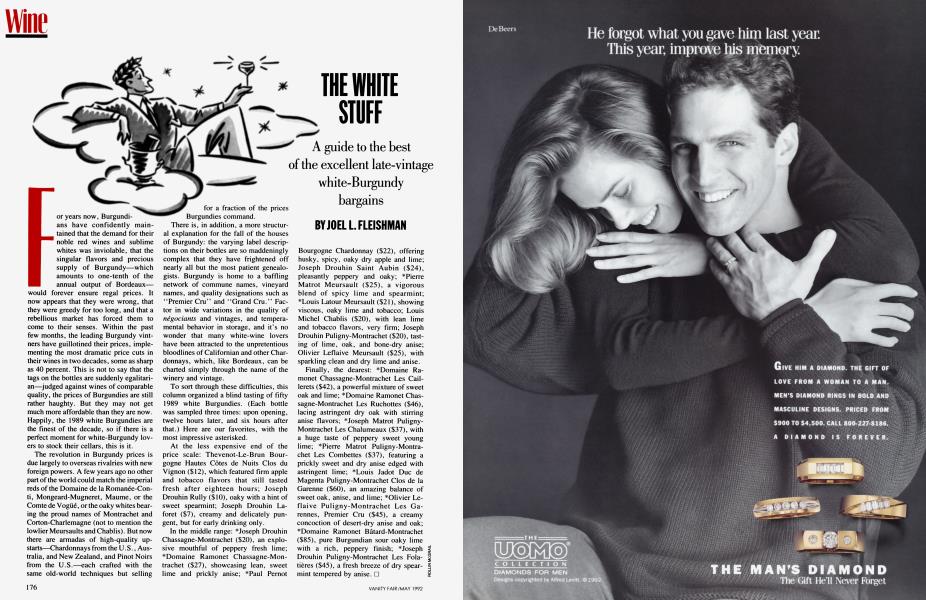
or years now, Burgundi ans have confidently maintained that the demand for their noble red wines and sublime whites was inviolable, that the singular flavors and precious supply of Burgundy—which amounts to one-tenth of the annual output of Bordeaux— would forever ensure regal prices. It now appears that they were wrong, that they were greedy for too long, and that a rebellious market has forced them to come to their senses. Within the past few months, the leading Burgundy vintners have guillotined their prices, implementing the most dramatic price cuts in their wines in two decades, some as sharp as 40 percent. This is not to say that the tags on the bottles are suddenly egalitarian—judged against wines of comparable quality, the prices of Burgundies are still rather haughty. But they may not get much more affordable than they are now. Happily, the 1989 white Burgundies are the finest of the decade, so if there is a perfect moment for white-Burgundy lovers to stock their cellars, this is it.
The revolution in Burgundy prices is due largely to overseas rivalries with new foreign powers. A few years ago no other part of the world could match the imperial reds of the Domaine de la Romanee-Conti, Mongeard-Mugneret, Maume, or the Comte de Vogue, or the oaky whites bearing the proud names of Montrachet and Corton-Charlemagne (not to mention the lowlier Meursaults and Chablis). But now there are armadas of high-quality upstarts—Chardonnays from the U.S., Australia, and New Zealand, and Pinot Noirs from the U.S.—each crafted with the same old-world techniques but selling
for a fraction of the prices Burgundies command.
There is, in addition, a more structural explanation for the fall of the houses of Burgundy: the varying label descriptions on their bottles are so maddeningly complex that they have frightened off nearly all but the most patient genealogists. Burgundy is home to a baffling network of commune names, vineyard names, and quality designations such as "Premier Cru" and "Grand Cru." Factor in wide variations in the quality of negotiants and vintages, and temperamental behavior in storage, and it's no wonder that many white-wine lovers have been attracted to the unpretentious bloodlines of Californian and other Chardonnays, which, like Bordeaux, can be charted simply through the name of the winery and vintage.
To sort through these difficulties, this column organized a blind tasting of fifty 1989 white Burgundies. (Each bottle was sampled three times: upon opening, twelve hours later, and six hours after that.) Here are our favorites, with the most impressive asterisked.
At the less expensive end of the price scale: Thevenot-Le-Brun Bourgogne Hautes Cotes de Nuits Clos du Vignon ($12), which featured firm apple and tobacco flavors that still tasted fresh after eighteen hours; Joseph Drouhin Rully ($10), oaky with a hint of sweet spearmint; Joseph Drouhin Laforet ($7), creamy and delicately pungent, but for early drinking only.
In the middle range: *Joseph Drouhin Chassagne-Montrachet ($20), an explosive mouthful of peppery fresh lime; *Domaine Ramonet Chassagne-Montrachet ($27), showcasing lean, sweet lime and prickly anise; *Paul Pemot Bourgogne Chardonnay ($22), offering husky, spicy, oaky dry apple and lime; Joseph Drouhin Saint Aubin ($24), pleasantly peppery and oaky; * Pierre Matrot Meursault ($25), a vigorous blend of spicy lime and spearmint; *Louis Latour Meursault ($21), showing viscous, oaky lime and tobacco; Louis Michel Chablis ($20), with lean lime and tobacco flavors, very firm; Joseph Drouhin Puligny-Montrachet ($20), tasting of lime, oak, and bone-dry anise; Olivier Leflaive Meursault ($25), with sparkling clean and dry lime and anise.
Finally, the dearest: *Domaine Ramonet Chassagne-Montrachet Les Caillerets ($42), a powerful mixture of sweet oak and lime; *Domaine Ramonet Chassagne-Montrachet Les Ruchottes ($46), lacing astringent dry oak with stirring anise flavors; ^Joseph Matrot PulignyMontrachet Les Chalumeaux ($37), with a huge taste of peppery sweet young lime; *Pierre Matrot Puligny-Montrachet Les Combettes ($37), featuring a prickly sweet and dry anise edged with astringent lime; *Louis Jadot Due de Magenta Puligny-Montrachet Clos de la Garenne ($60), an amazing balance of sweet oak, anise, and lime; *OHvier Leflaive Puligny-Montrachet Les Garennes, Premier Cru ($45), a creamy concoction of desert-dry anise and oak; *Domaine Ramonet Batard-Montrachet ($85), pure Burgundian sour oaky lime with a rich, peppery finish; *Joseph Drouhin Puligny-Montrachet Les Folatieres ($45), a fresh breeze of dry spearmint tempered by anise.
Wine
Subscribers have complete access to the archive.
Sign In Not a Subscriber?Join Now