Sign In to Your Account
Subscribers have complete access to the archive.
Sign In Not a Subscriber?Join NowEditor's Letter
Who Dunne It?
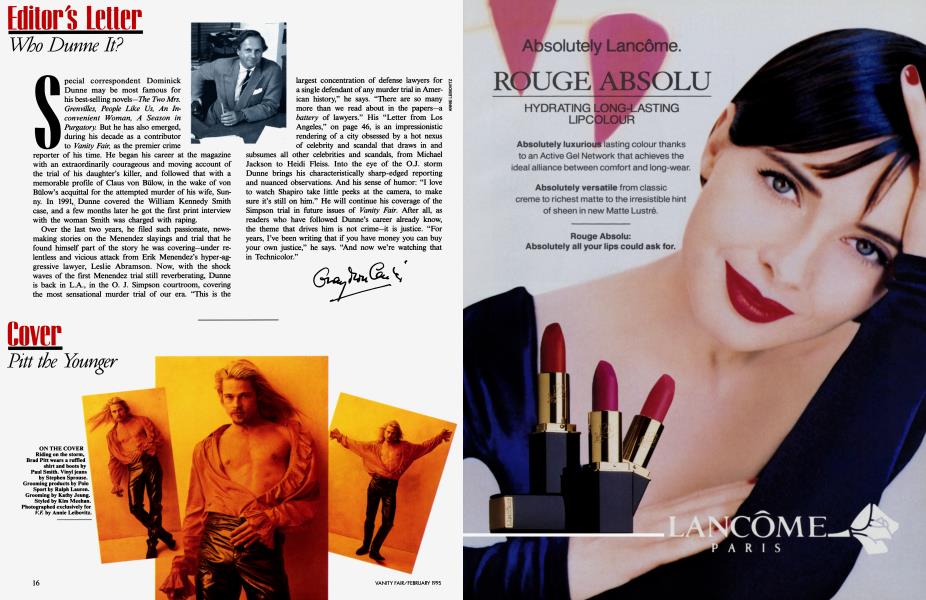
Special correspondent Dominick Dunne may be most famous for his best-selling novels—The Two Mrs. Grenvilles, People Like Us, An Inconvenient Woman, A Season in Purgatory. But he has also emerged, during his decade as a contributor to Vanity Fair, as the premier crime reporter of his time. He began his career at the magazine with an extraordinarily courageous and moving account of the trial of his daughter's killer, and followed that with a memorable profile of Claus von Bulow, in the wake of von Bülow's acquittal for the attempted murder of his wife, Sunny. In 1991, Dunne covered the William Kennedy Smith case, and a few months later he got the first print interview with the woman Smith was charged with raping.
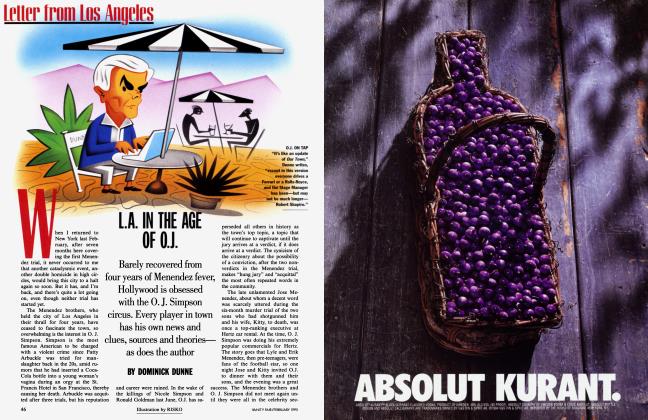
Over the last two years, he filed such passionate, newsmaking stories on the Menendez slayings and trial that he found himself part of the story he was covering—under relentless and vicious attack from Erik Menendez's hyper-aggressive lawyer, Leslie Abramson. Now, with the shock waves of the first Menendez trial still reverberating, Dunne is back in L.A., in the O. J. Simpson courtroom, covering the most sensational murder trial of our era. "This is the largest concentration of defense lawyers for a single defendant of any murder trial in American history," he says. "There are so many more than we read about in the papers—a battery of lawyers." His "Letter from Los Angeles," on page 46, is an impressionistic rendering of a city obsessed by a hot nexus of celebrity and scandal that draws in and subsumes all other celebrities and scandals, from Michael Jackson to Heidi Fleiss. Into the eye of the O.J. storm Dunne brings his characteristically sharp-edged reporting and nuanced observations. And his sense of humor: "I love to watch Shapiro take little peeks at the camera, to make sure it's still on him." He will continue his coverage of the Simpson trial in future issues of Vanity Fair. After all, as readers who have followed Dunne's career already know, the theme that drives him is not crime—it is justice. "For years, I've been writing that if you have money you can buy your own justice," he says. "And now we're watching that in Technicolor."
Subscribers have complete access to the archive.
Sign In Not a Subscriber?Join Now