




Sign In to Your Account
Subscribers have complete access to the archive.
Sign In Not a Subscriber?Join NowA QUESTION OF CHARACTER
There is more to character, historians argue, than whether or not a candidate keeps his pants on
Politics
JIM LEHRER
In the words of one president of the United States, "I've been here three years and three days, and I can tell you without hesitation: being president of this country is entirely about character." The president was Andrew Shepherd. The words were spoken by Michael Douglas, the actor who portrayed him in the recent movie The American President. Shepherd was talking about the character it takes to make tough decisions such as sending bombers off on dangerous missions to kill people. But out here in the real, non-movie world, the so-called character issue has become a code phrase for sleeping around.
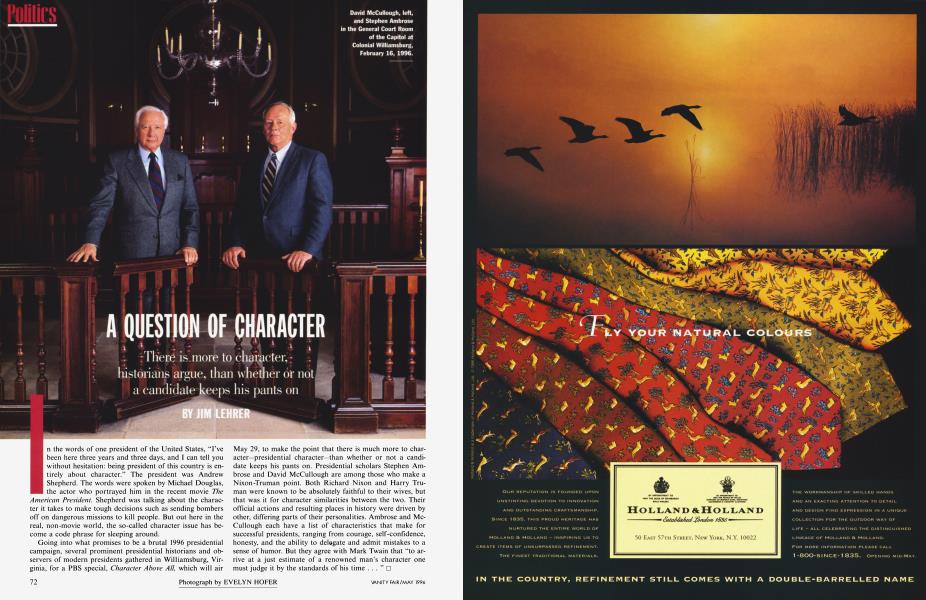
Going into what promises to be a brutal 1996 presidential campaign, several prominent presidential historians and observers of modern presidents gathered in Williamsburg, Virginia, for a PBS special, Character Above All, which will air May 29, to make the point that there is much more to character-presidential character—than whether or not a candidate keeps his pants on. Presidential scholars Stephen Ambrose and David McCullough are among those who make a Nixon-Truman point. Both Richard Nixon and Harry Truman were known to be absolutely faithful to their wives, but that was it for character similarities between the two. Their official actions and resulting places in history were driven by other, differing parts of their personalities. Ambrose and McCullough each have a list of characteristics that make for successful presidents, ranging from courage, self-confidence, honesty, and the ability to delegate and admit mistakes to a sense of humor. But they agree with Mark Twain that "to arrive at a just estimate of a renowned man's character one must judge it by the standards of his time . . . "
Subscribers have complete access to the archive.
Sign In Not a Subscriber?Join Now