Sign In to Your Account
Subscribers have complete access to the archive.
Sign In Not a Subscriber?Join NowSCHOOL FOR GLAMOUR
JENNET CONANT
Long the runt of the Ivy League, Brown University has become a magnet for the children of A-list New Yorkers, Hollywood stars, Wall Street tycoons, and European jet-setters. What's behind the explosion of BMWs and Chanel jackets on its once quiet campus?
Letter from
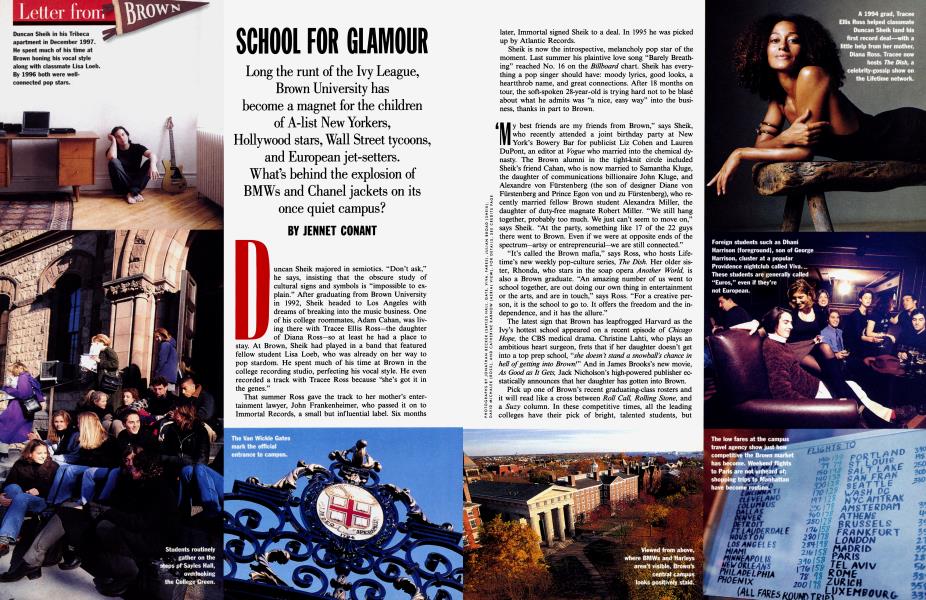
Duncan Sheik majored in semiotics. "Don't ask," he says, insisting that the obscure study of cultural signs and symbols is "impossible to explain." After graduating from Brown University in 1992, Sheik headed to Los Angeles with dreams of breaking into the music business. One of his college roommates, Adam Cahan, was living there with Tracee Ellis Ross—the daughter of Diana Ross—so at least he had a place to stay. At Brown, Sheik had played in a band that featured fellow student Lisa Loeb, who was already on her way to pop stardom. He spent much of his time at Brown in the college recording studio, perfecting his vocal style. He even recorded a track with Tracee Ross because "she's got it in the genes."
That summer Ross gave the track to her mother's entertainment lawyer, John Frankenheimer, who passed it on to Immortal Records, a small but influential label. Six months later, Immortal signed Sheik to a deal. In 1995 he was picked up by Atlantic Records.
Sheik is now the introspective, melancholy pop star of the moment. Last summer his plaintive love song "Barely Breathing" reached No. 16 on the Billboard chart. Sheik has everything a pop singer should have: moody lyrics, good looks, a heartthrob name, and great connections. After 18 months on tour, the soft-spoken 28-year-old is trying hard not to be blase about what he admits was "a nice, easy way" into the business, thanks in part to Brown.
'My best friends are my friends from Brown," says Sheik, who recently attended a joint birthday party at New York's Bowery Bar for publicist Liz Cohen and Lauren DuPont, an editor at Vogue who married into the chemical dynasty. The Brown alumni in the tight-knit circle included Sheik's friend Cahan, who is now married to Samantha Kluge, the daughter of communications billionaire John Kluge, and Alexandre von Fiirstenberg (the son of designer Diane von Fiirstenberg and Prince Egon von und zu Fiirstenberg), who recently married fellow Brown student Alexandra Miller, the daughter of duty-free magnate Robert Miller. "We still hang together, probably too much. We just can't seem to move on," says Sheik. "At the party, something like 17 of the 22 guys there went to Brown. Even if we were at opposite ends of the spectrum—artsy or entrepreneurial—we are still connected."
"It's called the Brown mafia," says Ross, who hosts Lifetime's new weekly pop-culture series, The Dish. Her older sister, Rhonda, who stars in the soap opera Another World, is also a Brown graduate. "An amazing number of us went to school together, are out doing our own thing in entertainment or the arts, and are in touch," says Ross. "For a creative person, it is the school to go to. It offers the freedom and the independence, and it has the allure."
The latest sign that Brown has leapfrogged Harvard as the Ivy's hottest school appeared on a recent episode of Chicago Hope, the CBS medical drama. Christine Lahti, who plays an ambitious heart surgeon, frets that if her daughter doesn't get into a top prep school, "she doesn't stand a snowball's chance in hell of getting into Brownr And in James Brooks's new movie, As Good as It Gets, Jack Nicholson's high-powered publisher ecstatically announces that her daughter has gotten into Brown.
Pick up one of Brown's recent graduating-class rosters and it will read like a cross between Roll Call, Rolling Stone, and a Suzy column. In these competitive times, all the leading colleges have their pick of bright, talented students, but Brown seems to be selecting from a particularly rarefied pool.
Traditionally, the Ivy League—started as a regional athletic association—sought to attract the scions of blueblood families, scholars, and athletes. Founded in 1764, Brown soon became known as "that quiet, earnest institution up in Providence," according to one alum. It graduated John D. Rockefeller Jr., S. J. Perelman, and Ted Turner, who was expelled in 1960 for "fraternizing" with a woman in his dorm room. But for most of its history, Brown struggled to keep up with its bigger, wealthier rivals: Harvard, Yale, and Princeton. By the 1970s, with its puny endowment, apathetic alumni, and controversial New Curriculum—which eliminated nearly all required courses and introduced a decidedly relaxed grading system—it was regarded as a lesser academic institution: the "back door" to the Ivies.
That's all changed. Over the last decade, Brown has become one of the most desirable colleges in the country; it's the destination of choice for privileged youth from old money, new money, and European royalty—a celebrity mecca that vies with Aspen and St. Barts for its quotient of beautiful young things. While most Ivy League schools have a sprinkling of famous faces at graduation, Brown's commencement ceremonies seem like old home week for aging 60s icons. When Jane Fonda arrived to watch her stepdaughter, Nathalie Vadim (her father is director Roger Vadim), march through the Van Wickle Gates, she spent most of the preliminaries catching up with Carly Simon, who was there to see her daughter, Sarah Taylor, whom she had during her marriage to James Taylor. (Fonda's daughter, Vanessa Vadim, also went to Brown.)
"So your dad was president and your family is on the Forbes Four Hundred list," says Brown's Steve Oliveira. "That's nice—get in line."
The school has been home to the children of three famous designers: Calvin Klein's daughter, Marci; Ralph Lauren's son Andrew; and Carolina Herrera's daughter Patricia. Two Beatles' children also attended Brown—Ringo's stepdaughter, Francesca Gregorini, famous for speeding around campus on a black Harley while wearing a leopard-print mini, and George Harrison's son, Dhani. Itzhak Perlman's daughters Leora and Navah are recent graduates. And then there is the constant wave of Hollywood children, including Marlon Brando's daughter Petra; Max von Sydow's son Henrik; Louis Malle's son, Cuote; and Kate Capshaw's daughter Jessica, who is now a senior.
The school has also drawn assorted royalty, including King Hussein's son Prince Feisal, whose Jordan address was listed in the student directory as "Royal Palace, Amman," and Princess Alexandra, who was listed alphabetically—under G for Greece.
It also attracts the children of Wall Street magnates, from Saul Steinberg's son Julian to two of Henry Kravis's children, Robert and Harrison. (In 1992, Kravis endowed a $2 million chair in the memory of Harrison, who died in an automobile accident after his freshman year.) And Fiat heir Giovanni Agnelli, who died of cancer in December, was also a Brown graduate. Because of its proximity to Newport, Brown is a magnet for Rhode Island society and retired European aristocrats, most notably Cosima von Biilow, whose father, Claus von Biilow, was tried for the attempted murder of his wife, Sunny, in Providence.
CONTINUED ON PAGE 63
CONTINUED FROM PAGE 58
Today, Brown is perhaps best known as the alma mater of John Kennedy Jr., who is the most famous in a long line of political progeny: Bill Mondale, the son of the 1984 presidential candidate; Laura and Donna Zaccaro, daughters of Mondale's running mate, Geraldine Ferraro; and Kara Dukakis, daughter of the 1988 presidential candidate. Three of Robert F. Kennedy's children—Kerry, Rory, and Doug—attended Brown. So did Amy Carter. But despite its liberal stripe, Brown has lured the children of two recent Republican presidential candidates: Roberta Forbes, daughter of Steve Forbes, and Kathryn Alexander, daughter of Lamar Alexander.
"People like John [Kennedy] come here because they can maintain a certain level of anonymity," says Steve Oliveira, Brown's acting director of development. "They are treated like everyone else. That is so refreshing. That's the beauty of the place—it is egalitarian. So your dad was president. Your family is on the Forbes Four Hundred list and they're billionaires. That's nice—get in line."
Much of the credit for Brown's ascendancy is due to outgoing president Vartan Gregorian, a bom showman and fund-raiser who left last summer to run the Carnegie Corporation. Known around campus as "Gregarious Gregorian," thegoateed, Plato-quoting Armenian more than doubled Brown's endowment—to more than $800 million—during his eight years in Providence. In each of the last two years the university received more than 15,000 applications—the most in its history. It accepts students from the top 2 percent of the pool.
In the 1980s, Gregorian revitalized the beleaguered New York Public Library by raising millions of dollars from rich patrons such as Brooke Astor, former Time Inc. chairman Andrew Heiskell, and Jacqueline Kennedy Onassis, as well as Wall Street figures, foundations, and corporations.
With Brown's annual tuition and expenses now surpassing $29,000, Gregorian implemented the same fund-raising techniques in Providence, where he was faced with physical and financial disrepair, and soaring costs that were eating away at the university's endowment—the smallest in the Ivy League. In return, more than one wealthy patron has asked for a little favor. At Brown, one of the few schools in the Ivy League that do not have completely need-blind admissions, the president can reserve a few places for V.I.P.'s.
"My approach to Brown was very simple," Gregorian says. "Excellence has a price tag. You have to pay for that. You have to invest in Brown's future." But it is impossible to see such an extraordinary number of affluent students flock to Providence without wondering how they all earned a place at the university, and if perhaps they are an integral part of Gregorian's strategy to keep Brown in the black. Patricia Herrera, who graduated in 1996, was floored by the row of sports cars parked on the street in front of the library. "It was Porsche, Porsche, BMW, Porsche, BMW, Ferrari, Porsche," she recalls. "I thought, What's going on here?"
Gregorian dismisses the notion that Brown has a disproportionate number of celebrity students. "It has certainly not been by design by me," he says, adding that he has turned away many children of wealthy and powerful parents. "But there is a bias toward the rich that their children must be dumb. Sometimes you can be the son or daughter of a rich person, and you can be privileged to have the best education, and you have also taken advantage of it."
"I've always wondered how much it costs to get into Brown," says Meryl Blackman, an independent education adviser with M&M Educational Advisors. "My impression is under the Gregorian years a number of kids were taken because parents either promised—or would be expected—to make a sizable contribution to the school. That's how one raises the endowment. It was a smart move."
There's no sign that Brown's trendiness will dissipate anytime soon; indeed, the school gets more popular every year. "They have 15 years of graduates who have gravitated toward high-profile, glamorous professions in the media, publishing, show business, and music," says Newsweek education editor Barbara Kantrowitz, who also edits the Kaplan/Newsweek How to Get Into College guide. "There is this network out there, and this incredible word of mouth."
Naturally, students will tell you they were drawn to the school less by its fabulous alumni than by its flexible curriculum. Rhode Island was founded in 1636 as a haven from political and religious persecution; Brown, which sits atop a hill that overlooks Providence, has become the pre-eminent school for those seeing a freer edusive to the demands of students—the hip Ivy.
The rebel spirit dates back to 1968, when students Elliot Maxwell and Ira Magaziner— President Clinton's former point man on health-care reform— wrote a 400-page critique of the core curriculum, arguing that studying the great works of Western civilization advocated "a particular culture." The Brown administration agreed, thus laying the groundwork for "multicultural ism" 20 years before most other colleges caught on.
"There were desperste Americens who would affect French and Italian accents," says one alum. "It got to be like the cast of Upstairs, Downstairs."
Brown students no longer have to deal with tedious core courses such as mathematics and languages; the curriculum allows students to create their own interdisciplinary concentrations (the connection between modern art and dance, for example) instead of traditional majors. It also allows experimentation without fear of failure. Students take courses either "ABC/no credit," in which C is the lowest mark that can be recorded on the transcript, or "satisfactory/no credit," a pass-fail system with a bonus: failing grades are expunged from the record. (The latter is known as taking a course for a "snack," and a popular T-shirt on campus bears the slogan "Take Life S/NC.") Not surprisingly, the curriculum is a hit with students—so much so that in 1993 the Washington Monthly reported that Ivy-bound high-school seniors called Brown "the four-year vacation school."
Which was precisely what Esmond Harmsworth was looking for. The son of British newspaper baron Lord Rothermere and Mary Murchison of the Texas oil family, he grew up in London, New York, Palm Beach, and Newport. He could have gone to college anywhere. But after five years at Eton, the rigid British prep school, Brown sounded like fun. "There were all these people from all over the world," Harmsworth recalls, noting that foreign students were called "Euros" even if they weren't European. "Lots of people came into the dining hall in ascots or would drive up and down campus in expensive convertibles all day long. People got more English than the English. There were desperate Americans who would affect French and Italian accents. After a while, it got to be like the cast of Upstairs, Downstairs."
For both Euros and rich American students, perhaps the best part of campus life is that it's off-campus, where those with enough money live in private houses and apartments. Many students move into Center Place, an apartment complex which features a swimming pool, a gym, and private parking—for $1,700 a month. "The last thing you want to do is sit in a dorm room after 10 years of boarding school," says Hugh Warrender, another Etonian, who graduated in 1990.
When Vartan Gregorian took over, in 1989, the university began recruiting at prestigious boarding schools in Europe, Greece, Hong Kong, Japan, and Kathmandu. Arabella Ferrari and Arietta Livanos came to Brown from the posh Aiglon school in Switzerland. "Whether they were looking for rich international students to aid their endowment or looking for richness in diversity, I don't know," says Carlos Mejia, an Etonian who was in the class of 1990 and now works for a Latin-American venture-capital fund. "But some effort was made to go after wealthy individuals. Look who's there—the sons and daughters of so-and-so. Especially the Swiss schools, which are not known for children who are especially bright as much as socially connected."
"Sometimes it seemed like there weren't that many normal Americans," says Lisa McFadden, class of '93, the daughter of George McFadden and socialite Topsy Taylor (and the niece of designer Mary McFadden). "There was the grunge group, which were the sort of mellow Doc Martens types; the 'semios,' cerebral semiotics and philosophy majors; the theater crowd; and the preppy/jock crowd. Then there was the whole Euro scene."
For New Yorkers such as McFadden and her friend Serena Boardman, Brown offered a welcome alternative to other New England campuses, with their L. L. Bean boots and Fair Isle sweaters. At Brown, you'll see plenty of tweed blazers, Chanel jackets, clove cigarettes, even tne occasional Hermes bag sitting on a lunch tray next to the beef Stroganoff. "It really broadened my cultural background," says McFadden, who plans to join her boyfriend in Athens, where she already has a half-dozen close friends from college.
"There was certainly more double-cheek kissing going on at Brown than at any other Ivy League school," says Jim Brodsky, who graduated in 1990 and now works in the fashion industry. "You'd be sitting on the Blue Room steps, overlooking the main green in the springtime when everyone's suntanning, and you'd see someone in bare feet wearing a little ankle bracelet and kicking a Hacky Sack next to someone in a Versace shirt and stiletto sandals, next to someone in jeans and a black motorcycle jacket. And there was always a protest going on about a cause no one cares about. It was wonderful."
Everyone generally mixes easily together, except during the elaborate lunchtime social scene at the Sharpe Refectory, nicknamed "the Ratty." "You can tell someone's clique by where they sat in the Ratty," Brodsky says. "It's very like Mortimer's." The Euros, who tend to bond with the affluent New York private-school crowd, keep to themselves in the dark smoking section known as "the cave." And they wouldn't be caught dead in the dining hall at any other time of day. "I don't know anyone who ate dinner on campus after sophomore year," says Alison Appel, a 1992 graduate who now works in motion-picture development for Disney. Instead, students ferret out the dozens of superb Italian restaurants and pizza parlors in Providence, as well as Chinese and Indonesian joints which don't have liquor licenses. "We'd stop at a seedy liquor store on the way," says Appel.
Brodsky concedes that there was a lot of excess at Brown during the 1980s. "People did not deprive themselves just because they were in college," he says, describing elaborate stereo systems, expensive sports cars, exquisitely furnished student houses, and excursions to New York's Frederic Fekkai for haircuts. He recalls one friend who, taking a weekend trip to Paris, treated a classmate to a round-trip ticket on the Concorde and three nights at the Meurice.
The excess has continued unabated. Brown students whose mothers are New York interior decorators have been known to enliven Brown's infamously shabby dorm rooms with custom paint jobs, curtains, and Oriental rugs. One freshman had his desk and shelves refinished because he found them too dreary.^" A student painted his room an eggshell shade because he didn't like white-white. And since students are not allowed to alter their dorm rooms, transgressors routinely pay to have the rooms repainted at the end of the school year. "Brown gives you enough rope to hang yourself," says Jonathan Groff, who was in John Kennedy's class, and who is now the head writer for Late Night with Conan O'Brien. "It's not for everybody. It's an ideal place for a certain type of student—someone who is very self-directed. If you're not that kind of person, you can waste a lot of time there."
"There was always a protest going on about a cause no one cares about," says 1990 alum Jim Brodsky.
The party ritual at Brown tends to begin earlier in the week and get much wilder than at most Ivy League colleges. The action often starts on Wednesday nights, when groups of students pile into cars and head for Club Nicole in Boston. "You'd party from 11 to 2 and be back by 2:40, 3 at the latest," says McFadden. "If you had an 11-o'clock class the next day, you'd be fine." Thursday is Funk Night, a college-wide dance party sponsored by the Underground, the campus bar. Since it is illegal to serve alcohol in Rhode Island after one A.M., students often break up into "after-parties" at off-campus houses; the parties last well into Friday morning, or, as Brodsky recalls, "until the police come to turn down the music."
On Friday and Saturday nights, there are the usual fraternity parties and keggers. Off-campus, the Euros often host dinner parties or rent out neighborhood restaurants for the night and throw wild bashes with mixed drinks and live bands. Students occasionally book houses in Newport or on Block Island and throw weekend-long parties. Alex von Fiirstenberg and a group of friends once rented a warehouse in downtown Providence and turned it into a nightclub with a D.J. and a full bar. "They invited 400 people," says a student. "It went on until three or four in the morning. People who were too trashed to make it back up the hill stayed at the Biltmore for the night."
There are also infamous annual parties such as the Naked Party, which is exactly what it purports to be, and Campus Dance, in which alumni return for yet another bacchanalian night. In 1993, John Kennedy Jr. showed up with Daryl Hannah. "One spring weekend, a group of guys took over a house. On Friday, they put out a bowl filled with ecstasy; on Saturday night, they put out a bowl filled with mushrooms," recalls a 1996 graduate. "People partied until five in the morning and then everybody went for breakfast at Ruby's [a local diner], and then some of the boys went for 'legs and eggs'"—a reference to a local strip club called the Foxy Lady, which gained a measure of infamy in 1994, when Brown student Heidi Mattson revealed in a book, Ivy League Stripper, that she had funded her undergraduate education by table-dancing.
The notorious stories are true—stories about Brown students who take every course pass-fail, as the lead singer for the Debutantes reportedly did one year, and Euros who spend most of their time driving BMWs, a popular campus pastime. But these students are not the norm. By all accounts, the caliber of Brown's students has risen consistently.
"There are really two Browns," says one alum. "There is the Brown full of smart, serious students, and then there is this whole parallel universe of Beautiful People who live in a world of great apartments, great parties, and buzz around campus all day on Vespas. They all major in art history, take photography classes at RISD [the Rhode Island School of Design], and walk around carrying portfolios, trying to look cool."
'It's definitely about a certain kind of extroversion," says Rufus Griscom, who is trying to explain why such a disproportionate number of Brown graduates have veered toward highprofile fields, from music and entertainment to the Internet. Together with his girlfriend, Genevieve Field, Griscom recently started an on-line magazine called Nerve (www.nervemag.com), which features pictures of naked women and erotica by writers such as Pulitzer Prize-winner Robert Olen Butler, Naomi Wolf, and Joycelyn Elders, who wrote a piece on masturbation. It has become one of the hottest on-line magazines, and there's talk of a print version and a book. Last fall Time called the partners "the cyber Ryan O'Neal and Ali MacGraw."
Griscom, 30, believes the loose eclecticism of the college attracts students with an entrepreneurial spirit. Because of the forgiving grading system, he says, Brown breeds the notion that students should not be afraid to fail or try new things. Witness Griscom's senior thesis, on pornographic photography in the midto late 19th century and the scandal surrounding Manet's Olympia.
"There was definitely an anti-Establishment sentiment," says Griscom, whose brother and sister also attended Brown, and whose uncle was married to socialite Nina Griscom. "At the other schools I visited, people were book-smart and educated, but more subdued and weaned."
Doug Liman, the 31-year-old director of the cult film Swingers, credits Brown for his creative and "spiritual awakening." "I learned so much there," says Liman, the son of the late New York lawyer Arthur Liman. "I feel like my life started freshman year. I'm not talking about just my career, I'm talking about me as a person. Who I am. Not to knock the faculty, but most of what I learned, I learned from my fellow students."
While still at Brown, Liman started a college cable-television station and secured a $300,000 grant from the CBS Foundation to found the National Association of College Broadcasters. In 1989, Liman invited Ted Turner to address the station's annual conference, and Turner accepted. It was the first time he'd returned to Brown since he'd been tossed out in 1960. In 1989, Turner received an honorary degree in place of his bachelor's degree; he subsequently announced a $25 million gift to the university.
Liman says that all of his friends from the Brown cable-TV station have gone on to top jobs in Hollywood: David Bartis is now senior vice president of prime-time series at NBC Studios, Elysa Koplovitz is head of development at MTV Films, and Maggie Malina is vice president of production at Pacific Western Productions. "All of my friends are charting their own routes," he says. "I'm sure all of their parents, like mine, were really upset that we weren't following a standard route. That is, until I became a success. My father went to Harvard. He didn't go to Brown, so he didn't understand we'd been liberated from doing things conventionally."
'There is the Brown ful of smart, serious students," says an alum. "Then there are the Beautiful People who buzz around campus all day on Vespas."
"I think it's that when you are around great people it makes you better," says actress Laura Linney (Primal Fear), a theater-arts major who graduated in 1986. "I was always overwhelmed by my classmates and how creative they were." In Hollywood, she bumps into close friends all the time and proudly runs down a list of Brown alums, including actress Julie Warner, production designer Mark Friedberg (The Ice Storm), screenwriter Chris Brancato (Hoodlum), and actorplaywright Tim Blake Nelson, who will appear in Terrence Malick's The Thin Red Line. "People talk about the Brown mafia," she says, "but it's really true in terms of keeping in touch and being supportive."
Nowhere is the Brown network more apparent than in the music industry, which is virtually overrun with alumni from WBRU, the Brown radio station—a full-fledged, 50,000-watt commercial operation run by students. "It was a very unusual opportunity because we got real-life experience in the business," says Patti Galluzzi, senior vice president of music and talent at MTV, who planned to go to medical school and worked at the radio station just for fun. But at the end of her senior year she was offered the job of program director, and she stayed on at the station another year. That job led her to MTV.
Galluzzi's office at MTV looks like a CD library, with all sorts of gimmicky concert promotionals cluttering the shelves. There's a lava lamp by her desk, a couple of surfboards leaning against the wall, and a Nirvana banner hanging from the ceiling. Suspended above her head is a gray zeppelin advertising the band Led Zeppelin. Galluzzi hired Stephen Hill, a close friend from Brown, to be MTV's director of music programming.
Alison Stewart, a former MTV news reporter, got her first break from George Bradt, a segment producer at the network and a Brown alum, who told her about the opening. "The Brown music connection is like the Harvard comedy connection," says Stewart, now a correspondent on the CBS newsmagazine Public Eye with Bryant Gumbel. "It's the brain trust." Stewart recently wrote an article for Swing magazine on "the Brown Music Mafia," listing more than 25 alumni in the business, including Atlantic Records executive Craig Kallman, singer Mary Chapin Carpenter, and Lisa Loeb, whose earnest single "Stay" went to No. 1 in 1994.
"It was so exciting getting to school that first week and realizing you have so much in common with so many people," recalls Loeb, who was tom between Brown and Harvard. "So I went for a second interview and I was talking to the guy from Harvard. I told him I wanted to go someplace academically challenging, and I wanted to have fun. And he said, 'It sounds like you should go to Brown.'"
Subscribers have complete access to the archive.
Sign In Not a Subscriber?Join Now


