

Sign In to Your Account
Subscribers have complete access to the archive.
Sign In Not a Subscriber?Join NowPOWER SUITS
As he waits for American citizenship, the author finds himself involved in two legal actions, helping defend both his adopted country and his native Britain against their own governments. He may be a fervent supporter of the war against our enemies, but the Constitution should not be a casualty
CHRISTOPHER HITCHENS
Because I am a supporter of the armed struggle against the forces of al-Qaeda, the Taliban, and Saddam Hussein, I quite often get asked if I have become a Republican in my declining years. Never mind for now the many reactionary Republicans, from Brent Scowcroft to Patrick J. Buchanan, who are my enemies in this argument: the fact is that I have been a republican all my life. Not in the sense that I favor the re-unification of Ireland— though I certainly do—but in the sense of being opposed to all forms of monarchy and absolutism. I moved to the United States a quarter of a century ago, partly to escape the British royal family (whose publicity alas followed me across the Atlantic) and partly because it was much easier to be an independent writer in a country that had a written constitution and a codified Bill of Rights. After the barbaric assault on American civil society that took place on September 11, 2001,1 resolved to stop cheating on my dues and applied to become a citizen, and although my paperwork seems to have vanished into the hideous maelstrom that goes by the name "Homeland Security," I consider myself to be standing in line to take a formal oath to defend that constitution against all enemies foreign and domestic.
In January of this year I found myself involved in two legal actions, one in my country of adoption and another in my country of birth, both directed at arbitrary power. In the first instance, I was contacted by Anthony Romero, the director of the American Civil Liberties Union. He asked if I would agree to become a plaintiff in a suit against the National Security Agency (N.S.A.) and by implication against the Justice Department. It had been disclosed that the N.S.A. was engaging in widespread warrantless surveillance of American citizens. It seemed obvious to me (and the suit alleges) that this violated the First and Fourth Amendments to the Constitution, in that it hampered the confidentiality with which reporters and scholars and lawyers must work, in the Middle East and western Asia, and in that it was an unreasonable invasion of privacy rights. The First Amendment is how I make my living. But it is precious to me in other ways, in that it stands against any infringement of free expression. So I said yes.
I then had to fill out a questionnaire about my travels to, and contacts in, such countries as Iran, Iraq, Afghanistan, Pakistan, and Indonesia, all of which I have covered for this magazine in the past few years. One of the questions asked if I was in contact with any person or group that the United States government could regard as being associated with terrorists. I would have paused at this anyway. Most of those with whom I exchange e-mail or phone traffic in Iraq and Afghanistan are dedicated to defeating the forces of bin Ladenism. But then there was this other little matter I'd gotten myself involved with.
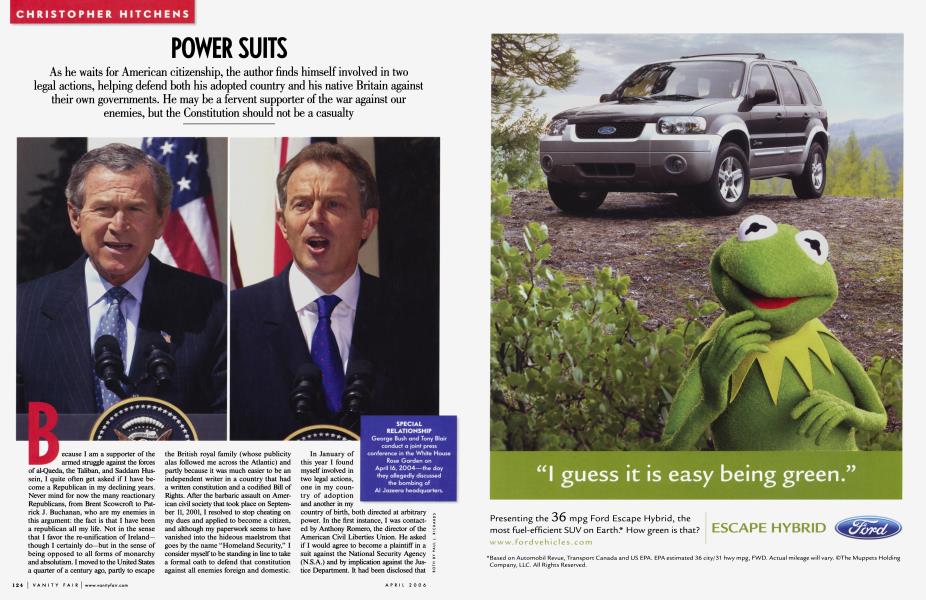
Two men were about to step into a dock in a London court: one of them, named David Keogh, is a former official in Prime Minister Tony Blair's Cabinet Office, and the other, named Leo O'Connor, is an alleged recipient of a document from Keogh. What the document is said to show is this: that on April 16, 2004, President George Bush proposed bombing the A1 Jazeera network headquarters, in Qatar, and was talked out of it only by Tony Blair. Now, I have visited those same offices and have friends there, and I sometimes appear on A1 Jazeera chat shows. So it seemed that, by one definition at least, I did have contact with suspected-terrorist targets. I had given some help in Washington to a team of British reporters at the London Daily Mirror, which broke the story, and also exchanged information with a celebrated British lawyer, Geoffrey Robertson, who had drafted a Freedom of Information request in London, on behalf of A1 Jazeera, in order to get a look at the relevant memo.
Both these actions have quite momentous implications. In the case of the first, our lawsuit alleges that President Bush has flat out broken the law: the 1978 Foreign Intelligence Surveillance Act (FISA), which set out "the exclusive means by which electronic surveillance ... and the interception of domestic wire, oral and electronic communications may be conducted." (My italics.) These "exclusive means" do not include the words "by secret presidential fiat." In the second case, if the allegation is true, it means that a very important center of communications, in a neutral country friendly to the United States (and host of the U.S. Central Command), would have been blitzed. I've tried to imagine the possible effect of that in the Arab world, but can't quite manage to do so. Let's just say that it would have put a large and smoldering hole in Karen Hughes's "make nice" diplomacy. It would furthermore have raised the suspicion that the American bombing of A1 Jazeera's Baghdad office, in 2003, which killed a reporter, had not been a regrettable accident.
WE HAVE FILED OUR SUIT [IN] THE COURT THAT FIRST HELD THAT WARRANTLESS WIRETAPPING OF AMERICANS FOR NATIONAL-SECURITY PURPOSES WAS UNCONSTITUTIONAL.
In a way, I am already flirting with lawbreaking by ventilating these questions. Since we filed our suit, the Bush administration has issued a "white paper," and has agreed to hearings on Capitol Hill about the propriety of using the N.S.A. against Americans. But this was not at all the first response to the revelation of the surveillance program. It was angrily announced by the White House that whoever disclosed it had violated the law and was giving aid and comfort to the enemy. A criminal inquiry has been set in motion to uncover the source of the leak. Meanwhile, in Britain, the Crown Prosecution wants to delay proceedings against Keogh and O'Connor while it seeks endorsement of a secret venue from Blair's foreign secretary, Jack Straw. (British law features an Official Secrets Act, allowing the government to decide that even public information is secret, which in the U.S. would be a violation of the First Amendment. Another reason, it occurred to me, why I had changed countries to begin with.) In other words, do bear in mind, dear reader, that you were not even supposed to know about these arguments in the first place!
Let us be scrupulous and put the opposite case. Things have changed since 1978, when FISA became law. The distinction between "overseas" and "at home" has been eroded by trans-national jihadist groups. The forces of law and order must be able to move very swiftly. The Justice Department white paper argues that Congress did permit the president to order warrantless surveillance when after 9/11 it granted him the Authorization for Use of Military Force (A.U.M.F.). In ruling on the Yaser Esam Hamdi case, which was that of an "enemy combatant," the Supreme Court found that the A.U.M.F. included detention in "narrow circumstances" as a "fundamental incident of waging war." The Justice Department now wants to say that electronic surveillance is also a "fundamental incident." Oh, and Abraham Lincoln suspended habeas corpus during the Civil War.
Well, the fact remains that the A.U.M.F. doesn't say a word about surveillance. And is it not the Republican Party which makes a fetish of "original intent," and opposes the discovery of hidden or novel interpretations of existing laws? Furthermore, Congress amended FISA after it passed the A.U.M.F. Thus, it can't be argued that Congress intended that the A.U.M.F. supersede or override FISA. It can't be argued even if, as its critics say when they are finally forced to discuss the matter, FISA is itself unconstitutional. If Bush feels that the act unbalances the separation of powers by granting too much authority to Congress, he must ask for it to be repealed or amended, or request that the Supreme Court strike it down. Meanwhile, it is the law of the land and he is bound by oath to uphold and obey it. And if the Supreme Court is to be cited, then remember what it said in June 2004, when the administration wanted to hold "enemy combatants" without a hearing. It ruled that "a state of war is not a blank check for the President." In dreams begin responsibilities, and in wars begin the temptation for the rulers to arrogate extraordinary powers to themselves.
Bush once appointed an attorney general, John Ashcroft, who knew so little about the United States Constitution that he announced that, in America, "we have no king but Jesus." That moronic statement was exactly two words too long.
As for the Hamdi case, involving an actual combatant and the "fundamental incident of waging war," if warrantless electronic spying on Americans is now to be defined as such a fundamental incident, then it is difficult if not impossible to say what could not be. Warrantless searches of offices and homes? Prior censorship of the press? This is where the Lincoln analogy becomes more relevant. Honest Abe did try unilaterally to suspend the writ of habeas corpus. But the chief justice ruled that only Congress could suspend habeas corpus, and Lincoln was forced to submit the matter to Capitol Hill. I have never heard it argued that this repressive measure actually shortened the war or hastened the Emancipation Proclamation, but it may have had the psychological effect of showing that the Union would use any weapon at its disposal. The thing to keep your eye on is this: we have already been "at war" with our nonstate enemy for as long as the Civil War went on. We are endlessly told it will be a lengthy struggle. All the more important, then, that we know what our rights and responsibilities are. The administration tries to dissolve this thought by saying, in effect, "It's an emergency. Be afraid. Trust us."
What sinister poppycock. Our intelligence "community," with its multi-billiondollar secret budget, left us under open skies on 9/11. The only born-and-raised American who had infiltrated the Taliban was John Walker Lindh of Marin County. George Tenet's reaction to hearing of the Twin Towers in conflagration was to say that he wondered if it had anything to do with that guy in the flight-training school in Minnesota. For this, Bush gave him a Presidential Medal of Freedom. When the C.I.A. wasn't generating junk intelligence over Iraq, it was leaking hostile propaganda to discredit the whole idea of "regime change" in that country. These people are not even accountable to Bush: when he "authorized" the warrantless surveillance in late 2001 he found that the N.S.A. had already started doing it without anyone's permission. The F.B.I., on which tons of the resulting raw material was dumped, has stated that it was mostly useless and time-wasting. It also must say something if an organization whose headquarters building still bears the name of J. Edgar Hoover (who wiretapped Martin Luther King Jr. and tried to scare him into committing suicide) has asked the question: Is this even legal? To this and other concerns, General Michael Hayden, former director of the N.S.A., has blandly responded, "I can say unequivocally that we have got information through this program that would not otherwise have been available." Well, presumably. That could also be said if we all had to empty our BlackBerrys into his capacious lap.
GIVE THIS POWER OR
THIS RIGHT TO ANY ONE PRESIDENT AND YOU GIVE IT,
INDEFINITELY AND UNACCOUNTABLY, TO THEM ALL.
If you get yourself involved in a civilliberty lawsuit, you will invariably find that you have teamed up with people you don't like. I became a supporter of the A.C.L.U. three decades ago, when it lost a good chunk of its membership by defending the First Amendment right of the American Nazi Party to hold a parade in the Jewish suburb of Skokie, Illinois. I told Anthony Romero that he could sign me up for the suit but that I was curious to know who the other plaintiffs might be. The National Association of Criminal Defense Lawyers: fine. Members of this group complain that warrantless eavesdropping destroys attorneyclient privilege and makes it almost impossible to represent defendants in far-off locations without flying to see them in person each time. The Council on American-Islamic Relations: yuck. These people produce rationalizations for Muslim fundamentalism and were the advocates for the demented crooner Yusuf Islam (formerly Cat Stevens), who has incited the murder of Salman Rushdie. Still, how mad and pathetic of Homeland Security to divert a whole transatlantic flight just because the crooner was on board. Professors Larry Diamond and Barnett Rubin, of Stanford and of New York University, respectively: good company to be in. Diamond was a member of the transitional authority in Iraq, before he quit in disillusionment, and Rubin remains an invaluable adviser to the United Nations and the government in Afghanistan. These two men have done more to fight the foe than George Tenet ever did, but they now find that old friends and contacts are reluctant to speak freely on the phone or in e-mail. This is important to me too, and to you, because though my own contribution has been slight it is reporters like John Bums and Peter Bergen who have come up with far more valuable advance intelligence about al-Qaeda than the C.I.A. or N.S.A. ever has. Put a chilling effect on the investigative work of men like that and you endanger national security. At our press conference, on January 17, the 300th birthday of Benjamin Franklin, I said that this was a sad but appropriate way to commemorate the man who (a) was the presiding spirit at the Constitutional Convention and (b) elucidated the emancipating power of electricity.
Another distinguished co-plaintiff is James Bamford, whose books on the N.S.A., The Puzzle Palace and Body of Secrets, are the main public resource for knowledge of a gigantic agency which for a long time was not even known to exist. Thanks to Bamford and others, we now know that the N.S.A. was used to spy on American civilians throughout the Vietnam War, in order to try to prove that the anti-war and civil-rights movements were being manipulated by foreign powers. Black Panthers and Quakers were targeted without distinction, and the first writer to touch upon the fact—David Kahn, author of The Codebreakers—was himself placed under an extensive watch. It was this wholesale abuse of power that led to the Senate hearings convened by Senator Frank Church, of Idaho, that contributed to the proposed impeachment of Richard Nixon, and that led to the passage of FISA in the first place. The federal court in which we have filed our suit—in the Eastern District of Michigan—is the court that first held in 1972 that warrantless wiretapping of Americans for national-security purposes was unconstitutional. This ruling against Nixon was later upheld by the Supreme Court. One wonders if a Bushdominated Court will do the same, but when my neoconservative friends complain about my undermining of the "wartime president," I have my answer ready: give this power or this right to any one president and you give it, indefinitely and unaccountably, to them all. The surveillance spreads like weeds, and there is no way to know if it is of you, or to get yourself taken off the watch list. Apparently even John Ashcroft could see this elementary point: I've heard from a friend of mine that he was opposed to a national ID card because he didn't want a future President Clinton to have that much power. In all the recent arguments over the Patriot Act and the "nationalsecurity state," one has often seen senior liberal Democrats take a powder, or join enthusiastically in the aggrandizement of police power (as they did when Bill Clinton rammed through the panicky Antiterrorism and Effective Death Penalty Act of 1996 after the Oklahoma City atrocity), whereas certain prominent conservatives, such as Grover Norquist and former congressman Bob Barr, have been consistently libertarian. As I was getting ready to sign on for the A.C.L.U. suit, I had dinner with both of those gentlemen in the interval of a conference of the National Rifle Association. Well, Bob Barr now speaks on tour for the A.C.L.U. as well, so if the fans of the Second Amendment can be mobilized to defend the First and Fourth ones, that's absolutely fine by me.
And what of the War on Terror as it applies to A1 Jazeera? Stopped by a Daily Mirror reporter outside a Virginia church on January 8, Colin Powell (who accompanied Bush on April 16, 2004) said, "You're asking me about a twoyear-old meeting that I don't remember." (When contacted by Vanity Fair, Powell responded, "My quote does not confirm that I was at the meeting where such a thing may have been discussed. I was at the Blair visit on 16 April, but not necessarily [at] every conversation they had that day. I don't have memcons to recover all this, but I never took seriously any such idea nor did the President.") This falls some way short of a strong denial. One might think that such a conversation would either (a) stick in the mind if it had occurred or (b) appear so unimaginable that it could be roundly and affirmatively said not to have happened at all. The first response to the Freedom of Information request, on 10 Downing Street writing paper, confirmed that the Cabinet Office "holds information which is relevant to your request," concerning "memos or notes that record President Bush's discussions with the Prime Minister about the bombing of the Al-Jazeera television station in Qatar." It then goes on to say that disclosure of the said information "would, or would be likely to, prejudice relations between the United Kingdom and any other state." The Cabinet Office has the right under law to refuse to discuss the matter at all, on grounds of national security, so it is peculiar that it should implicitly confirm the story in a letter. And, of course, if there's nothing to it, or if the president was only making a joke in very poor taste and the transcribers misunderstood, then we'll all climb down. But in that case why are two British citizens facing a trial, which the government wants to conduct in camera?
When I wanted a picture to illustrate this article, I went with a photographer to the turnoff in Virginia where a large public sign points traffic to the GEORGE BUSH CENTER
FOR INTELLIGENCE: CIA. We managed to take a few shots before six police cars turned up, and large men kept their hands on their holsters while ordering us to keep our hands in plain sight. It was only with difficulty that we persuaded them they had no right to confiscate the film. We were on public land, on the Potomac Heritage Trail, under the blue skies of America and protected by the great roof of the Constitution, and were next to a sign which millions of motorists pass every year. And what was going unwatched while six carloads of troopers wasted taxpayer money in this way? In my experience, countries where undisguised photographers attract police attention are countries where the citizen is the property of the state. The duty of a true republican is to resist the banana republic, and perhaps some bananas Republicans, as well as bananas Democrats, so that the Bill of Rights survives this war as it has survived the previous ones. When Attorney General Alberto Gonzales made an appearance at Georgetown University Law Center on January 24, a group of students got up to unfurl a banner which read, THOSE WHO WOULD SACRIFICE LIBERTY FOR SECURITY DESERVE NEITHER. And, I might add, will get neither. The words are taken from Benjamin Franklin.
THESE LEGAL ACTIONS HAVE
QUITE MOMENTOUS IMPLICATIONS. THE FIRST ALLEGES THAT BUSH HAS FLAT OUT BROKEN THE LAW.
Subscribers have complete access to the archive.
Sign In Not a Subscriber?Join Now


