Sign In to Your Account
Subscribers have complete access to the archive.
Sign In Not a Subscriber?Join NowVIDAL'S LAST LAUGH
Spotlight
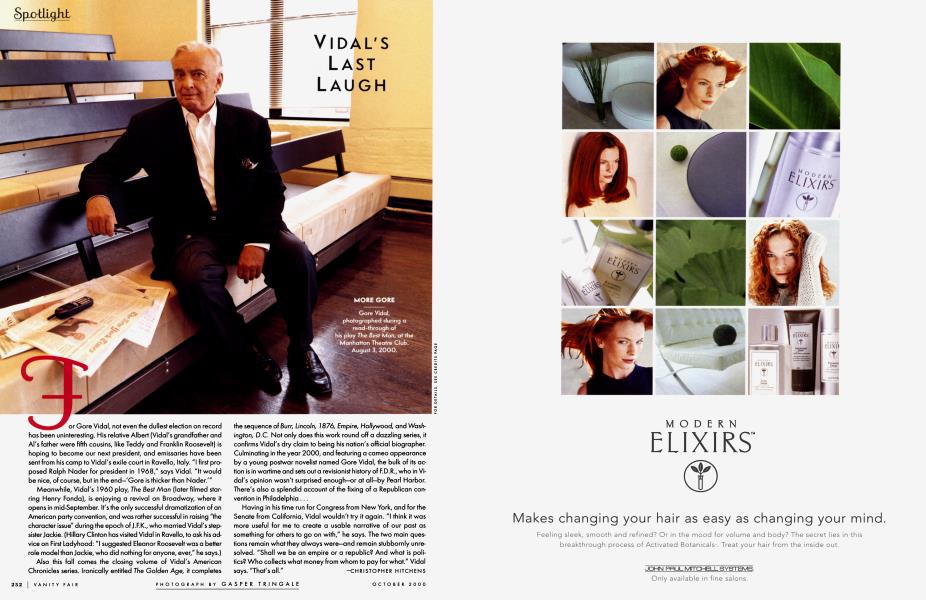
FOR DETAILS, SEE CREDITS PAGE
For Gore Vidal, not even the dullest election on record has been uninteresting. His relative Albert (Vidal's grandfather and Al's father were fifth cousins, like Teddy and Franklin Roosevelt) is hoping to become our next president, and emissaries have been sent from his camp to Vidal's exile court in Ravello, Italy. "I first proposed Ralph Nader for president in 1968," says Vidal. "It would be nice, of course, but in the end—'Gore is thicker than Nader.'"
Meanwhile, Vidal's 1960 play, The Best Man (later filmed starring Henry Fonda), is enjoying a revival on Broadway, where it opens in mid-September. It's the only successful dramatization of an American party convention, and was rather successful in raising "the character issue" during the epoch of J.F.K., who married Vidal's stepsister Jackie. (Hillary Clinton has visited Vidal in Ravello, to ask his advice on First Ladyhood: "I suggested Eleanor Roosevelt was a better role model than Jackie, who did nothing for anyone, ever," he says.)
Also this fall comes the closing volume of Vidal's American Chronicles series. Ironically entitled The Golden Age, it completes the sequence of Burr, Lincoln, 1876, Empire, Hollywood, and Washington, D.C. Not only does this work round off a dazzling series, it confirms Vidal's dry claim to being his nation's official biographer. Culminating in the year 2000, and featuring a cameo appearance by a young postwar novelist named Gore Vidal, the bulk of its action is in wartime and sets out a revisionist history of F.D.R., who in Vidal's opinion wasn't surprised enough—or at all—by Pearl Harbor. There's also a splendid account of the fixing of a Republican convention in Philadelphia...
Having in his time run for Congress from New York, and for the Senate from California, Vidal wouldn't try it again. "I think it was more useful for me to create a usable narrative of our past as something for others to go on with," he says. The two main questions remain what they always were—and remain stubbornly unresolved. "Shall we be an empire or a republic? And what is politics? Who collects what money from whom to pay for what." Vidal says. "That'sall."
CHRISTOPHER HITCHENS
Subscribers have complete access to the archive.
Sign In Not a Subscriber?Join Now