Sign In to Your Account
Subscribers have complete access to the archive.
Sign In Not a Subscriber?Join NowLetter from Italy
ALAIN ELKANN
The Rome-Milan Axis
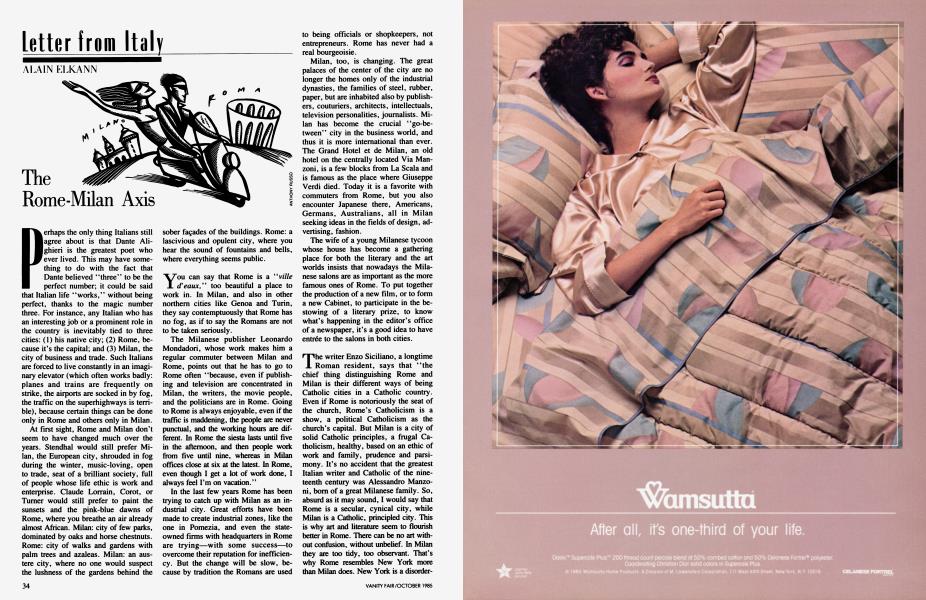
perhaps the only thing Italians still agree about is that Dante Alighieri is the greatest poet who ever lived. This may have something to do with the fact that Dante believed "three" to be the perfect number; it could be said that Italian life "works," without being perfect, thanks to the magic number three. For instance, any Italian who has an interesting job or a prominent role in the country is inevitably tied to three cities: (1) his native city; (2) Rome, because it's the capital; and (3) Milan, the city of business and trade. Such Italians are forced to live constantly in an imaginary elevator (which often works badly: planes and trains are frequently on strike, the airports are socked in by fog, the traffic on the superhighways is terrible), because certain things can be done only in Rome and others only in Milan.
At first sight, Rome and Milan don't seem to have changed much over the years. Stendhal would still prefer Milan, the European city, shrouded in fog during the winter, music-loving, open to trade, seat of a brilliant society, full of people whose life ethic is work and enterprise. Claude Lorrain, Corot, or Turner would still prefer to paint the sunsets and the pink-blue dawns of Rome, where you breathe an air already almost African. Milan: city of few paries, dominated by oaks and horse chestnuts. Rome: city of walks and gardens with palm trees and azaleas. Milan: an austere city, where no one would suspect the lushness of the gardens behind the sober facades of the buildings. Rome: a lascivious and opulent city, where you hear the sound of fountains and bells, where everything seems public.
You can say that Rome is a "ville d'eaux," too beautiful a place to work in. In Milan, and also in other northern cities like Genoa and Turin, they say contemptuously that Rome has no fog, as if to say the Romans are not to be taken seriously.
The Milanese publisher Leonardo Mondadori, whose work makes him a regular commuter between Milan and Rome, points out that he has to go to Rome often "because, even if publishing and television are concentrated in Milan, the writers, the movie people, and the politicians are in Rome. Going to Rome is always enjoyable, even if the traffic is maddening, the people are never punctual, and the working hours are different. In Rome the siesta lasts until five in the afternoon, and then people work from five until nine, whereas in Milan offices close at six at the latest. In Rome, even though I get a lot of work done, I always feel I'm on vacation."
In the last few years Rome has been trying to catch up with Milan as an industrial city. Great efforts have been made to create industrial zones, like the one in Pomezia, and even the stateowned firms with headquarters in Rome are trying—with some success—to overcome their reputation for inefficiency. But the change will be slow, because by tradition the Romans are used to being officials or shopkeepers, not entrepreneurs. Rome has never had a real bourgeoisie.
Milan, too, is changing. The great palaces of the center of the city are no longer the homes only of the industrial dynasties, the families of steel, rubber, paper, but are inhabited also by publishers, couturiers, architects, intellectuals, television personalities, journalists. Milan has become the crucial "go-between" city in the business world, and thus it is more international than ever. The Grand Hotel et de Milan, an old hotel on the centrally located Via Manzoni, is a few blocks from La Scala and is famous as the place where Giuseppe Verdi died. Today it is a favorite with commuters from Rome, but you also encounter Japanese there, Americans, Germans, Australians, all in Milan seeking ideas in the fields of design, advertising, fashion.
The wife of a young Milanese tycoon whose house has become a gathering place for both the literary and the art worlds insists that nowadays the Milanese salons are as important as the more famous ones of Rome. To put together the production of a new film, or to form a new Cabinet, to participate in the bestowing of a literary prize, to know what's happening in the editor's office of a newspaper, it's a good idea to have entree to the salons in both cities.
The writer Enzo Siciliano, a longtime Roman resident, says that "the chief thing distinguishing Rome and Milan is their different ways of being Catholic cities in a Catholic country. Even if Rome is notoriously the seat of the church, Rome's Catholicism is a show, a political Catholicism as the church's capital. But Milan is a city of solid Catholic principles, a frugal Catholicism, healthy, based on an ethic of work and family, prudence and parsimony. It's no accident that the greatest Italian writer and Catholic of the nineteenth century was Alessandro Manzoni, bom of a great Milanese family. So, absurd as it may sound, I would say that Rome is a secular, cynical city, while Milan is a Catholic, principled city. This is why art and literature seem to flourish better in Rome. There can be no art without confusion, without unbelief. In Milan they are too tidy, too observant. That's why Rome resembles New York more than Milan does. New York is a disorderly city, chaotic, full of contradictions, not based on good common sense."
The historian Giordano Bruno Guerri, author of a recent best-selling life of Saint Maria Goretti, like many Tuscans has chosen to live in Milan, and has moved his wife, the Roman writer Gaia de Beaumont, to his adopted city. "What I think,'" Guerri says, "is that Rome and Milan are equally unpleasant cities, both incomplete, and yet for some strange historical reason they complete each other. Milan is industry and economy; Rome is beauty and political power. Milan, our only international city, offers security; Rome is all making do. Both are necessary. If they were to merge, the result would be a new Paris." Guerri insists that in Italy nobody feels content in either of these cities, and this is why Italians are attached to the third point of the triangle, the hometown.
Only when an Italian is abroad, especially in Paris, London, or New York, does he feel simply Italian. In Paris, at various roundtables organized by the Centre Pompidou and other institutions, you can find adoptive Milanese like Gae Aulenti, Vittorio Gregotti, Giorgio Strehler, Umberto Eco, with adoptive Romans like Alberto Moravia, Leonardo Sciascia, Paolo Portoghesi, Bernardo Bertolucci, Marcello Mastroianni. Here they all feel just Italian, the way that many ex-terrorists do, in the political asylum granted by Mitterrand. Other Italians, mostly painters, have lofts in New York and are enjoying an American success—artists like Francesco Clemente and Sandro Chia, who were launched in Italy by a "Roman" dealer from Turin, Gian Enzo Sperone, a friend of Leo Castelli's.
But to get back to the triangle: even though we are talking about the RomeMilan axis, the provinces cannot be overlooked. You can't say that Turin, Genoa, Verona, Padua, Parma, Venice, Florence, Bologna, Naples, Palermo, etc. are provincial cities. These cities— like many others—were all capitals of grand duchies and republics, principalities and kingdoms; today they don't just have great masterpieces, churches, and palaces, they are also important industrial realities. While medium-size industries have shifted toward the Marches and the Veneto region, Turin, after all, has the Fiat colossus, which is expanding into publishing and the art world. Already an important partner in the Rizzoli publishing group, Fiat recently bought Palazzo Grassi in Venice, with plans to transform it into the Italian equivalent of the Beaubourg or MoMA. And from Los Angeles they have brought the former Beaubourg curator Pontus Hulten, who has a host of plans, including an inaugural show devoted to futurism.
But in Bologna too, Eugenio Riccomini is preparing a great Morandi show; in Venice, at the Palazzo Venier dei Leoni, the Guggenheim Foundation is more active than ever. And the list could go on, from one city to another, with the paradoxical observation that, of them all, the least active when it comes to art exhibitions are Rome and Milan.
In both these cities they talk about fashion shows for the new collections. But where are these showings more important, in Rome or Milan? Which are more choreographic? Those of Giorgio Armani in the basement theater of his ateher-palazzo in Milan? Or Valentino's shows of high fashion on a summer night in a Roman piazza? Is the Milanese school of architecture more advanced than the Roman? Is the Roman literary magazine Nuovi Argomenti, edited by Alberto Moravia, Leonardo Sciascia, and Enzo Siciliano (and, until his death, Pier Paolo Pasolini), more significant than the avant-garde Milanese review, Alfabeta, whose editors include Umberto Eco?
The Rome-Milan axis also witnesses great battles among industrialists, with Carlo De Benedetti and Giovanni Agnelli as protagonists; the two tycoons of Turin fight to see who can buy more firms, who can outstrip the other in France and the U.S. Both Giovanni Agnelli and Carlo De Benedetti have houses near Milan and in Rome.
What about political power?
Today the prime minister, Bettino Craxi (Socialist), is a Milanese of Sicilian origin who lives in Rome. No one could be more Roman than the indomitable Giulio Andreotti, minister in almost every Cabinet since the end of the war. The Republican Giovanni Spadolini (former prime minister), a Florentine who lives in Rome but recently stood for election in Milan, declared that real political power in Italy will belong to the man who controls the city of Saint Ambrose, Manzoni, and La Scala.
In Rome you eat fettuccine and artichokes "alia Giudia" at Pipemo in the old ghetto, or mozzarella, puntarelle (a special salad), chicory, and young lamb at Fortunato al Pantheon, or at Nino near Piazza di Spagna, and at II Matriciano. These are the restaurants where you run into political figures and leading actors. In Milan you eat a salad of artichokes and Parmesan, spring risotto, and delicate salads of crab and avocado at Bice, a Tuscan restaurant, where you run into the leaders of fashion, publishing, advertising. After the theater you eat a pizza at Santa Lucia. Journalists seem to prefer II Rigolo.
In Rome, commuters on a certain level stay at the Hotel d'lnghilterra, the Plaza, the Gregoriana, or the Raphael (once Craxi's home away from home); in Milan, besides the Grand Hotel et de Milan, it's the Cavour or the Manzoni. There are those who keep their family and home in Rome but work in Milan; those who teach in Messina, have a home in Milan, but are consultants to an important Roman bank. Others live in Brussels or Paris, but their girlfriend is in Naples. One could be the mayor of a small Tuscan town, a senator from Turin, and live in Rome and the rest of the world. But among all of these Italians there is a certain sense of solidarity. It isn't just the solidarity of pizza and minestrone and spaghetti—there are deep gastronomic divisions among Italians. If Milan is the extreme frontier of a European Italy, and Rome is the beginning of an African Italy, there is a distillation of these two Italys, spiced with all the provincial cities, large and small. For a certain air du temps is formed, a certain way of living, a certain way of having an Italian style.
Translated from the Italian by William Weaver
Subscribers have complete access to the archive.
Sign In Not a Subscriber?Join Now


