

Sign In to Your Account
Subscribers have complete access to the archive.
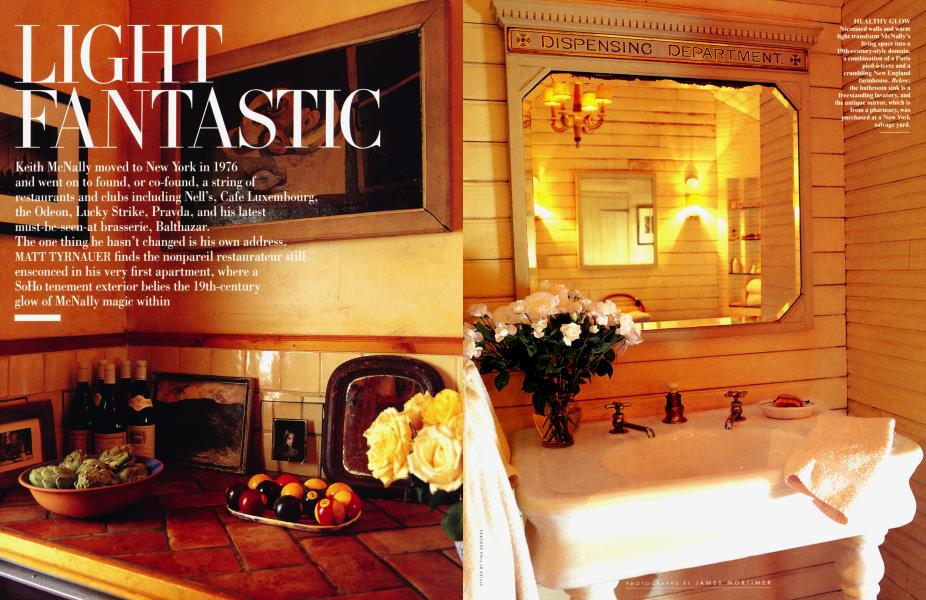
Sign In Not a Subscriber?Join NowKeith McNally moved to New York in 1976 and went on to found, or co-found, a string of restaurants and clubs including Nell’s, Cafe Luxembourg, the Odeon, Lucky Strike, Pravda, and his latest must-be-seen-at brasserie, Balthazar. The one thing he hasn’t changed is his own address. MATT TYRNAUER finds the nonpareil restaurateur still ensconced in his very first apartment, where a SoHo tenement exterior belies the 19th-century glow of McNally magic within
Keith McNally moved to New York in 1976 and went on to found, or co-found, a string of restaurants and clubs including Nell’s, Cafe Luxembourg, the Odeon, Lucky Strike, Pravda, and his latest must-be-seen-at brasserie, Balthazar. The one thing he hasn’t changed is his own address. MATT TYRNAUER finds the nonpareil restaurateur still ensconced in his very first apartment, where a SoHo tenement exterior belies the 19th-century glow of McNally magic within
The city’s new restaurant laws notwithstanding, Keith McNally is New York’s most successful purveyor of rooms that appear smoke-filled. The Odeon, which he and his brother Brian helped launch in 1980, continues to attract the black-leather-and-sunglasses set—the artists, models, and aspirants who stalk through Manhattan’s ever fashionable Tribeca neighborhood. Then there is Balthazar, McNally’s newest creation, which is so popular that patrons should book now for Memorial Day. But despite all of his success, McNally has not sunk his lunch money into the kind of apartment that big-name people engage the disciples of Sister Parish and Le Corbusier to conceptualize. He has, in fact, lived in the same red-brick tenement building on the quiet western edge of SoHo for 20 years now, ever since the days when he was employed as an oyster shucker at the now defunct restaurant One Fifth.
“I moved into my apartment in 1976 or ’77. When did Elvis die? I moved in that year,” says McNally. A boyish 46, he is handsome enough to be an actor —which he was as a teenager in London, where he appeared with John Gielgud in the West End production of Alan Bennett’s play Forty Years On in 1968. Yet he was ambivalent about an acting career and headed to New York. “I've held on to this place because I was told when I moved to New York you should always keep your first apartment. And while I’ve considered moving, and looked at other apartments, nothing ever seems as nice as this one.”
To reach McNally’s fanciful 1,100-square-foot, six-room hideaway, you must face four flights of fluorescent-lit, rubber-treaded stairs. “There used to be a lot of rats outside,” he admits, “but I haven’t seen them for a while.”
In no way does the drabness of the climb to apartment No. 25 prepare you for the gold-hued, Parisian-inspired charms of McNally’s space, which he designed himself over the last 20 years. (He has also designed or helped create all of the restaurants and clubs he has been involved in.) “I’m a very bad drawer,” he declares in his East End staccato. “I draw on napkins, and then I discuss it with someone, and then we build it. I’m very insecure, but I get so caught up in the details. For a restaurant I’ll ask the postman what he thinks of the zinc bar. For this apartment I drag in the guy who’s out in the hall slipping Chinese menus under the door and ask him if he thinks it works.”
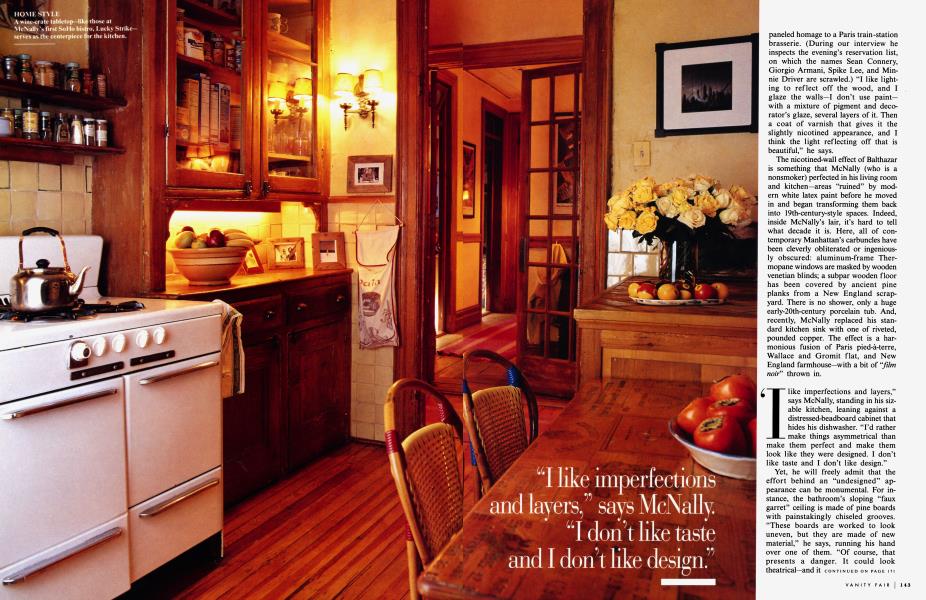
“I like imperfections and layers,” says McNally “I don’t like taste and I don’t like design.”
In addition to Balthazar, McNally owns the downtown Russian Constructivist–inspired supper club Pravda (its bar is managed by his brother Peter), and the SoHo bistro Lucky Strike, which looks like a Paris restaurant in a 1930s Brassaï photograph. (In the 1980s he helped start, but is no longer associated with, the club Nell’s and Cafe Luxembourg, on the Upper West Side.) Anyone who has set foot in these establishments will immediately recognize the strong, consistent McNally aesthetic.
Rule one: Everything, to paraphrase Noël Coward, is a question of lighting.
“I think that there has to be some sort of warmth to the light, but I don’t like it to be precious,” McNally tells me one afternoon while sitting in the amber glow of Balthazar’s dining room, a 4,000-square-foot, wood-paneled homage to a Paris train-station brasserie. (During our interview he inspects the evening’s reservation list, on which the names Sean Connery, Giorgio Armani, Spike Lee, and Minnie Driver are scrawled.) “I like lighting to reflect off the wood, and I glaze the walls—I don’t use paint— with a mixture of pigment and decorator’s glaze, several layers of it. Then a coat of varnish that gives it the slightly nicotined appearance, and I think the light reflecting off that is beautiful,” he says.
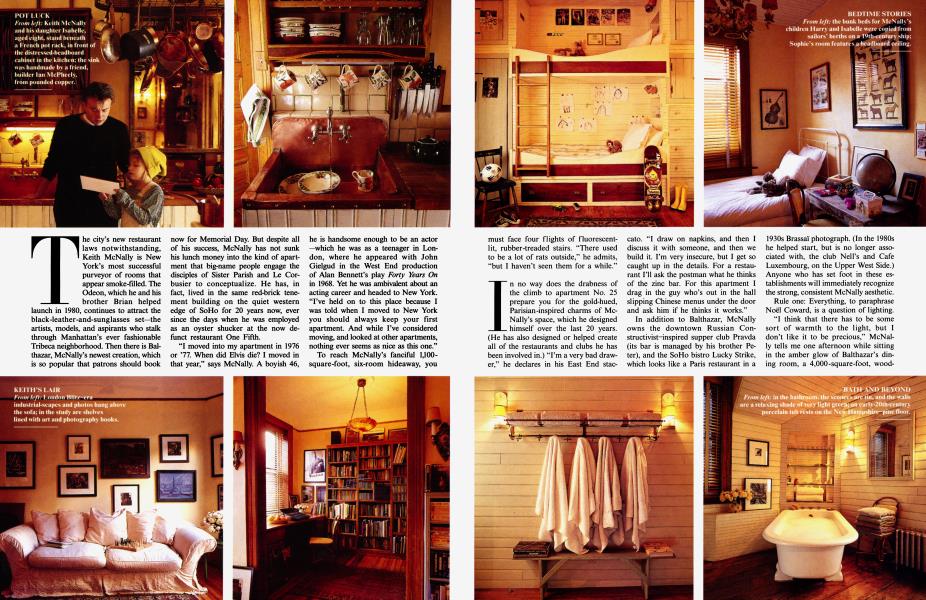
The nicotined-wall effect of Balthazar is something that McNally (who is a nonsmoker) perfected in his living room and kitchen—areas “ruined” by modern white latex paint before he moved in and began transforming them back into 19th-century-style spaces. Indeed, inside McNally’s lair, it’s hard to tell what decade it is. Here, all of contemporary Manhattan’s carbuncles have been cleverly obliterated or ingeniously obscured: aluminum-frame Thermopane windows are masked by wooden Venetian blinds; a subpar wooden floor has been covered by ancient pine planks from a New England scrapyard. There is no shower, only a huge early-20th-century porcelain tub. And, recently, McNally replaced his standard kitchen sink with one of riveted, pounded copper. The effect is a harmonious fusion of Paris pied-à-terre, Wallace and Gromit flat, and New England farmhouse—with a bit of “film noir” thrown in.
“I like imperfections and layers,” says McNally, standing in his sizable kitchen, leaning against a distressed-beadboard cabinet that hides his dishwasher. “I’d rather make things asymmetrical than make them perfect and make them look like they were designed. I don’t like taste and I don’t like design.”
Yet, he will freely admit that the effort behind an “undesigned” appearance can be monumental. For instance, the bathroom’s sloping “faux garret” ceiling is made of pine boards with painstakingly chiseled grooves. “These boards are worked to look uneven, but they are made of new material,” he says, running his hand over one of them. “Of course, that presents a danger. It could look theatrical—and it mustn’t.” (Among McNally’s favorite bathroom features is a brown water stain that is currently developing on the ceiling above the tub: “I don’t know where that came from,” he says, “but I like it!”)
Four years ago, in the wake of his divorce from restaurateur Lynn Wagenknecht (now majority owner of Odeon, Cafe Luxembourg, and Nell’s, and half-owner of Bodega), McNally broke through a wall and took over apartment No. 24, effectively doubling his living space. (And quadrupling his rent, which is now $2,000, way up from $500. The original figure was $250 in 1977.) “Adding on to the apartment was some sort of soul-searching for me after my divorce,” he says. “It helped me reconstruct my life.” McNally now has a total of three bedrooms, two of which are used by his children—Harry, 13, Sophie, 12, and Isabelle, 8—who divide their time between parents. The kids’ rooms are carefully “undesigned” to match the rest of the place: the walls are glazed and nicotined to imperfection, and the lighting is rosy, emanating from brass parchment-shaded sconces. In the largest bedroom—shared by Harry and Isabelle—there are bunk beds, which McNally had copied from sailors’ berths he saw on a 19th-century ship in Mystic, Connecticut. To add character, he coated the wood with milk paint, a substance that crackles soon after application.
Almost everything in McNally’s apartment that is not custom-crafted has been gathered over the years at flea markets: well-worn Persian and Turkish rugs, antique mirrors, dressers, old pine doors, 50s-era lamps—even his collection of dark-hued mid-20th-century paintings, which are displayed on the walls of the living room and kitchen. (McNally also takes his Jeep Cherokee up to the antiques shows in Brimfield, Massachusetts, where he shops for a 1910 Martha’s Vineyard house he bought in 1992.) “I go to Paris a lot,” he says, “to the flea markets at Clignancourt and Vanves. I like looking at pictures and paintings at flea markets as much as anything else. A lot of my paintings are English . . . done during the Blitz. I like German Expressionism. I like clusters of buildings . . . industrial landscapes. I’ve got a few pictures which seem to be out of an F. W. Murnau film, with buildings collapsing.” (The reference to German cinema is not surprising; McNally has directed two independent films: the second, Far from Berlin, was filmed in Germany and the first, End of the Night, was shown at Cannes in 1990.)
For all the layers, textures, and antiques in McNally’s rooms, there is a kind of Edward Hopper minimalism to the place. Wall sconces, of which there are 20, nearly outnumber the pieces of furniture. In the living room the only place to sit is a large white couch (“from Shabby Chic, I’m ashamed to say”), and the TV set facing the couch is plunked down on a tiny rattan café chair. And you can’t get more spare than the 8-by-10-foot master bedroom, which has only a mattress, box spring, and two dressers.
But if there were any more furniture there wouldn’t be room to move around. “I am somewhat embarrassed by how small my apartment is,” McNally confides. “But you know this building was, at one time, filled with Italian immigrants. And I met an old man who actually grew up here, and he said that a family of 10 once lived in just a part of my tiny space.”
Subscribers have complete access to the archive.
Sign In Not a Subscriber?Join Now


