

Sign In to Your Account
Subscribers have complete access to the archive.
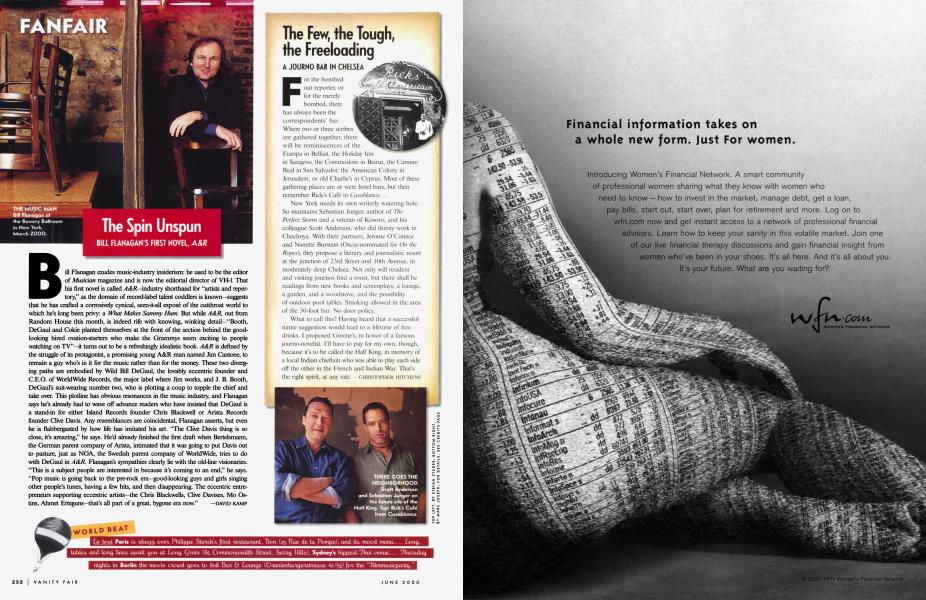
Sign In Not a Subscriber?Join NowBill Flanagan exudes music-industry insiderism: he used to be the editor of Musician magazine and is now the editorial director of VH-1. That his first novel is called A&R—industry shorthand for “artists and repertory,” as the domain of record-label talent coddlers is known—suggests that he has crafted a corrosively cynical, seen-it-all expose of the cutthroat world to which he’s long been privy: a What Makes Sammy Hum. But while A&R, out from Random House this month, is indeed rife with knowing, winking detail—“Booth, DeGaul and Cokie planted themselves at the front of the section behind the good-looking hired ovation-starters who make the Grammys seem exciting to people watching on TV”—it turns out to be a refreshingly idealistic book. A&R is defined by the struggle of its protagonist, a promising young A&R man named Jim Cantone, to remain a guy who’s in it for the music rather than for the money. These two diverging paths are embodied by Wild Bill DeGaul, the lovably eccentric founder and C.E.O. of WorldWide Records, the major label where Jim works, and J. B. Booth, DeGaul’s suit-wearing number two, who is plotting a coup to topple the chief and take over. This plotline has obvious resonances in the music industry, and Flanagan says he’s already had to wave off advance readers who have insisted that DeGaul is a stand-in for either Island Records founder Chris Blackwell or Arista Records founder Clive Davis. Any resemblances are coincidental, Flanagan asserts, but even he is flabbergasted by how life has imitated his art. “The Clive Davis thing is so close, it’s amazing,” he says. He’d already finished the first draft when Bertelsmann, the German parent company of Arista, intimated that it was going to put Davis out to pasture, just as NOA, the Swedish parent company of WorldWide, tries to do with DeGaul in A&R. Flanagan’s sympathies clearly lie with the old-line visionaries. “This is a subject people are interested in because it’s coming to an end,” he says. “Pop music is going back to the pre-rock era—good-looking guys and girls singing other people’s tunes, having a few hits, and then disappearing. The eccentric entrepreneurs supporting eccentric artists—the Chris Blackwells, Clive Davises, Mo Ostins, Ahmet Erteguns—that’s all part of a great, bygone era now.”



Subscribers have complete access to the archive.
Sign In Not a Subscriber?Join Now