
Sign In to Your Account
Subscribers have complete access to the archive.
Sign In Not a Subscriber?Join NowCENSORI UNCENSORED
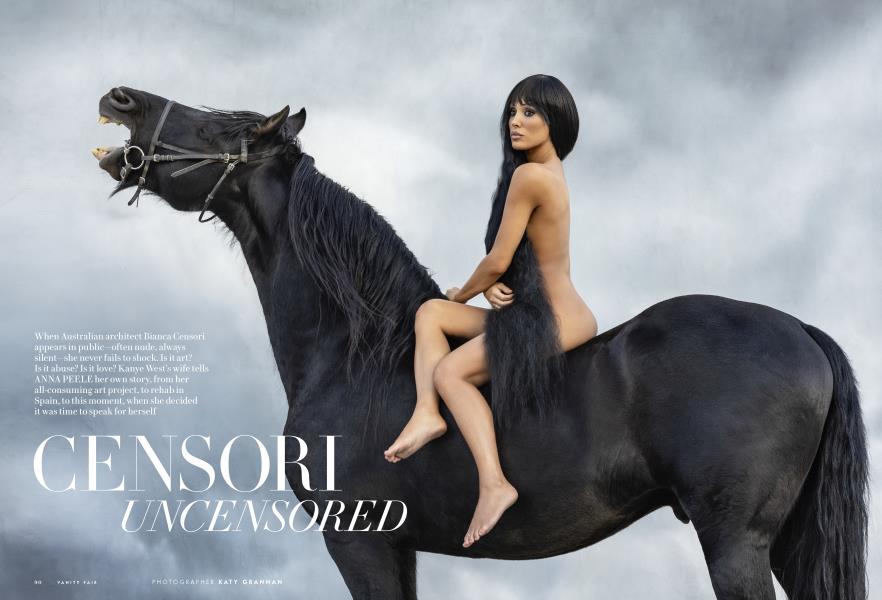
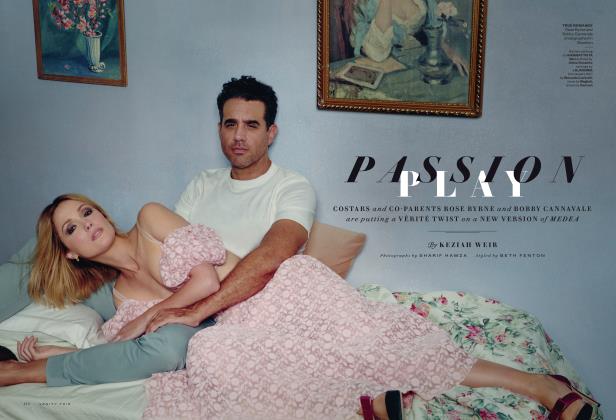
When Australian architect Bianca Censori appears in public—often nude, always silent—she never fails to shock. Is it art? Is it abuse? Is it love? Kanye West's wife tells ANNA PEELE her own story, from her all-consuming art project, to rehab in Spain, to this moment, when she decided it was time to speak for herself
ANNA PEELE
FOR DETAILS, GO TO VF.COM/CREDITS.
Bianca Censori says she's done being naked.
In her three years of public life since she married the artist formerly known as Kanye West, Censori's nudity had become ostentatious. When I note that yesterday, the first time we'd met in person, Censori's sheer bodysuit and lack of bra exposed her nipples, she says, "That, to me, is basically not nudity."
Undress has not been a new or public-facing endeavor. "I had an obvious obsession with nudity," the 31-year-old Australian says. We are in a quiet room upstairs from the space in which her first,
clothed, art show will take place, in Seoul in December. Ye, as he's now legally known, is there too, but is laying low, Censori suggests, to keep the spotlight of the show—and this story—on his wife. Until now,she says, "I was naked everywhere. I didn't detach with it at any point. I consistently showed the same imagery over and over and over again." Censori explains, "I live my artwork."
Censori's nakedness has been fully literal: confection as clothing, in the form of a hard-candy string bikini, as she wore for a business meeting about the planning of "BIO POP," the first installment of a seven-year performance-art project that she is in Korea to debut. Or when the world saw, thanks to paparazzi photos, her bare shoulders during a private moment with Ye in the back of a Venetian motorboat. Or, most memorably, on the Grammys red carpet last February. Censori stepped out of the limo, turned away from the cameras, and dropped her black Galliano fur to the floor to reveal herself in a nearly invisible mesh dress, sewn onto Censori by future Maison Margiela couturier Simon Carle. Censori hadn't planned for this to be the climax of her nudity project, but she'd been working on a film with Ye and the artist Vanessa Beecroft. A few days before the Grammys, they happened to come across the illusion fabric that actorswear in places like the back of "backless" gowns to keep them in place. Her multiyear process of disrobingwas complete.
In 2025 "Bianca Censori" was the most googled woman in the entire world—which Censori requests I point out to the editor of Vanity Fair in a bid for the cover.
"I'm trying not to sound like I'm bragging, but it is not a position that anybody in time has ever had that much visibility without speech," Censori says. "If it was just nudity, a lot of people would have that. But it also proves in a time that was so overexposed and vulnerable, that mystery still has power."
She's right that her nakedness may not be the only reason for her incredible search volume. But the other reasons are not such a mystery. In the only in-depth interview she's ever given, Censori is finally speaking—about all that nudity, about her childhood and her early career, about her husband's mental health and apparent antisemitism, and about who, exactly, is in control of her life.
Last February, the official channels to Censori ran through her husband's company Yeezy, where Censori leads the architecture department, and through Milo Yiannopoulos, a far-right provocateurwho had worked on Ye's 2024 presidential campaign. But after the Grammys moment, I took an educated guess at her personal email address and made contact. She agreed to a call to talk about her art, and we spoke for the first time a few weeks later. The conversations continued. Over months, the woman who called herself "Bianca, the elusive unicorn"—"bee-yo/zA'-uh," as she pronounces her own name, her Australian accent elongating vowels into dipand tripthongs—eventually explained much more. At the time it was widely reported that Censori was thinking of leaving Ye amid a deluge of horrifying behavior, and possibly—or so the leering speculation of tabloids and comments sections goes—abuse of Censori herself.
Five days after the Grammys, Ye posted "I'm a Nazi" on X, which he followed up with the message, "I HAVE DOMINION OVER MY WIFE. THIS AINT NO WOKE AS FEMINIST SHIT. SHES WITH A BILLIONAIRE." Two days after that, Ye ran a Super Bowl commercial directing people to his website Yeezy .com, where he began selling T-shirts with swastikas on them. If Censori's project was provoking the world by showing everything while saying nothing, Ye's was saying everything—a lot of which was very, very bad. In January of this year, he apologized, and the trajectory of Censori's story—and this story—changed yet again.
Censori knows that friends who don't have visibility into her frequently peripatetic life—before Korea, she'd been in LA, Australia, and Japan—see her only in tabloid photos, or wordless and nude in the background of footage of her billionaire husband and his coterie of...colleagues? Friends? Enablers? Like much of the public, these friends wonder whether she has consent in her public art or if Ye is puppeteering the display of her body. They want to know whether she is silent because she has not been allowed to speak. They want to ask what I first did a year ago: Is she okay?
"I don't really care," Censori says of what we make of her. "I always just think, They'll get it someday. And if they don't, they don't. As long as I'm able to express myself to my full potential, that's all that matters to me."
EACH OTHER'S SKIN
Before Censori became the most googled woman in the world, she was a precocious little girl in Melbourne. Her parents, who are still married, have three children: Bianca; her younger sister, Angelina; and a "brilliant" brother who does not want to be part of this mishegoss. The family was "super Greek Orthodox," Censori says, noting that she's still "very religious." When Censori was a child, she would read books of factoids so she'd have something to say about any topic that arose. "People would bring something up, and then I'd know something about that topic of information," she says, accurately. "I'm a researcher. And factual, also." Censori's father, who had been convicted on heroin possession and firearm charges before Censori was born, owned a fleet of claw machines successful enough to send his middle-class children to private school.
"Amusement machines are better than having a place that collects rent," he would tell his daughter. Censori knew the games were suspiciously impossible to win, but one day she decided she must have Baloo, the pear-shaped bear from The Jungle Book. Though her father could have simply opened the door and given her the toy, she sat in front of the machine for eight hours until she got him, then promptly added him to the 50-odd other plushies on her bed. "They slept with me, because I felt like they had feelings," she says. If one fell on the floor in the night, Censori would wake up bereft. She still occasionally carries stuffed animals around, but according to her, it's now for effect.
Censori says she has always been guided by overwhelming emotion. Her parents had to remove the phone in their living room because she would incessantly call her father at work, demanding to know when he was coming home. If the clock went one minute past the ETA, Censori would ring him back. "You're a liar!" she'd yell. "You're not here! Why would you do that to me?"
"I wasn't able to regulate for my whole life," Censori says. "I also pair-bond so intensely and so deeply that that person becomes part of me. That's my person. You know that movie Together, where they're getting into each other's skin? I loved that one. That's kind of who I am." In the 2025 film, actors and real-life spouses Alison Brie and Dave Franco slowly fuse into a single being. This depth of feeling tracks with how Censori describes nearly every relationship: As a girl, she would sit by the fence and wail when she couldn't be with her young neighbor; of her husband, she continually repeats, "I love him.... I love him so much"; when we part, she tells me she feels like she made a friend. "It's only ever brought joy to my life," she says of codependency. "I just love that person so deeply, so intensely, that I want to be around them."
Censori apparently got the highest grades for art in her high school graduating class, one of the only things her mother, Alexandra, nervous and wearing a faux-fur coat, feels comfortable revealing to mewhen we meet in Korea after Censori's show. After considering majoring in sculpture, Censori entered the University of Melbourne's architecture program, where she got bachelor's and then master's degrees. College, she says, was one of the most difficult periods of her life.
"I like when something feels intense, horrible, scary, all that sort of stuff," she says. "Because there's growth on the other side." Censori alternated between being "EvorcEm-level" upset while overworking on assignments, and getting deep in context, like a study abroad in Manila where she learned about sustainable housing. Kneeling on the sofa, Censori becomes extremely animated as she explains that, because of inadequate housing there, a large percentage of the homes in the city are part of informal settlements. Since a handful of families own all of Manila's land, these communities aren't protected by anything other than "de facto tenure"—unofficial temporary possession of an area. If the landowners want their space back, they will often give the people living there enough money to move somewhere less expensive, but far from their work and communities.
This monologue on housing theory was a roundabout way of explaining a photo of Censoriwith her mother, aunt, and sister, in which Censori looks like the daughter of a Real Housewife of New Jersey, with a clementine tan and leopard-print bustier. I had asked about the dissonant image of Censori, and she breezed past the picture itself, which was taken at a wedding that Censori attended after returning from Manila.
"I LIKE WHEN SOMETHING FEELS INTENSE, HORRIBLE, SCARY, ALL THAT SORT OF STUFF," CENSORI SAYS. "RECAUSE THERE'S GROWTH ON THE OTHER SIDE."
What I'd wanted to talk about was that the photo seems to date to a liminal period when Bianca the civilian ended and Bianca the unicorn began.
THE ELUSIVE UNICORN
Starting as an undergrad, Censori spent four years working at what she calls a "normie" architecture firm, where she discovered being an architect was less about creating monuments to genius ideas as it is filing for permits to install the correct number of toilets. She was finishing her thesis in 2020 when the general manager of Yeezy reached out because Ye had seen an image Censori had posted to Instagram—not a nude selfie, but a digital mask with alien proportions. Censori sent back her portfolio, and she met Ye in Switzerland in the middle of the pandemic. He offered her a job as "head of architecture" in Los Angeles, where she fell in with a group of fashionand art-world people, including Gadir Rajab, a stylist who would begin styling and photographing Censori, and Leo Becerra, the director of "BIO POP" and witness to the early days of Censori's nudity project, when she started sourcing barely-clothes from dance stores and sex shops. "She was always laughing, always dancing," Becerra says.
At Yeezy, Ye and Censori began to iterate.
Most of what they worked on was never realized, including more developed versions of the mound-like structures Ye built on his Calabasas, California, property in 2019 with the intention of revolutionizing sustainable housing. Censori was also involved with the "renovation" of a Malibu home built by the Pritzker Prize-winning architect Tadao Ando, which Ye bought in 2021 for $ 57.3 million and subsequently gutted. Though this was widely considered to be an architectural sin—a representative for Ando told The New Yorker he "does not like to talk much about" it—Censori feels absolved. She'd been trying to help make a home on a small oceanfront footprint feel as grand as Ando's work deserved. In so doing, Censori and Ye ruined it—to her glee. (Ando did not respond to Vanity Fair.)
The house was red-taped and sold at a reported eight-figure loss. When I suggest that her passion for housing security seems at odds with construction waste and moldering remnants, Censori says rehoming people to a beachfront property in Malibu is away of controlling them. "My husband and I had worked on affordable housing also, but I feel so strongly about the topic that I don't believe it is right to rehouse people in a place that you choose to rehouse them...affordable housing is not actually a housing issue, the other systems need to uplift the individual, so they're able to have autonomy and make choices. I don't think it's okay to say, like, 'Oh, you can't get a house? Let me get you a house, but let me put you in that place.' " "The thing about destruction is it gives life to something else," Censori says. "So when I would enter that house that was quote, unquote 'destroyed,' batswere living inside of it, and the sea salt had taken over the steel that was in the house and was rusting. "
"A tree is the shape of a tree, because that's what nature does or whatever," Censori says. "What does a house want to be? And that, I feel, will be my life's work. "
(The couple's new home, in Beverly Hills, is the subject of an HOA dispute with their more architecturally conservative neighbors. "It was built in the 2000s, but it looks like someone was like, 'Hey, have you seen that movie Blow'! That's what I want! An '80s cocaine house,' " Censori says. "Anytime anyone comes over, I'm like, 'Do not look at the house.' ")
Censori also liked that an expression of ego—this supposed Malibu masterpiece—was being used in a way that hadn't been intended. "They have this idea of, 'Okay, once I have this home, and I've handed it off to the client, it has to remain the same way as when I passed it off,' " Censori says of architects. "But that's not how people use space. I think that the destruction of the home was beautiful to me, and I think symbolic also of that time."
The year Ye purchased the house, Kim Kardashian filed for divorce, a decision she subsequently attributed partially to his "mental breaks," which were reported, self-documented, and frequently made into music. Around the same general period, Censori and Ye were falling in love. "Proximity," Censori offers byway of explanation. "Just working together. You're spending so much time with somebody. So we'd be either on the phone together or with each other all the time." His aura both overpowered her and complemented her own. "You've got to see it," Censori says of his magnetism. "We're so similar."
Suddenly Censori was experiencingwhat her producer Ted Lawson calls "the banality of extravagance. When you're in the bubble [Ye is in], it's ubiquitous." Censorijoined a kind of chaotic privilege captured in the 2025 documentary of Ye, In Whose Name?The doc was made over six years and comprised footage shot by Nico Ballesteros, to whom Ye gave seemingly complete access, letting the young stranger film him for more than half a decade.
Despite her inability to moderate in personal relationships, Censori does not make herself seem like an obvious fit for this environment with her rigorous restraint—in her academic and artistic pursuits, in her stringent silence. However, Lawson says, "She's completely natural there, amazingly. It doesn't faze her, in my view. You know, it's normal reality. As an entity, she already has a kind of iconic vibe and a sense of herself, and whether people understand what that means or not doesn't matter."
"I didn't marry my husband because I wanted some sort of platform," Censori says. "I married him because I love him. Is that like the corniest thing ever?"
Censori may not have wanted a platform, but now that she had one, she was going to stand on it, naked. She understands that no one would be interested in her if she weren't what she calls a "nepo wife—like, I'm famous by association. But your image is replicated without your consent all the time. It's replicated, it's brought down, it's picked apart, all those kind of things."
"THIS YEAR WAS A LOT LIKE DOING CPR FOR MONTHS. I HAVE THE LOVE AND EMPATHY FOR [YE] TO BE ABLE TO DO THAT, AND I UNDERSTAND THAT THE WORLD DOESN'T."
The public perception seemed to be that Censoriwas a mute captive being trafficked in daylight and dressed by her husband like a sex doll—a narrative that was not aided by the Venice incident. I ask if she knows what people thought happened in the water taxi. "Yes," she says. "That I gave a blow job on the boat?" She didn't. Ye was sitting on the stern, Censori says, and she was simply kneeling on a stool and resting her head on his lap. She says her aunt, the one in the college-era picture, was also on board. The coverage humiliated her. "Itwasthefirsttimelwasreally embarrassed," Censori says. "I felt embarrassed because of my dad. " But, she says, "as I've grown as a human being, no, I don't care."
"Iwouldn't be doing something I didn'twant to do," Censori says. Every time she has appeared nude, she says, it has been her choice. When she does put together a look, she asks Ye for feedback because she thinks he's a genius. "Me and my husband would work on my outfits together," Censori says. "So it was like a collaboration, it was never Twas being told to do something.'... If you were married to Gianni Versace, wouldn't he give you a dress or something?" Lawson says that when they were working on "BIO POP," Ye "always has a thought about something, and it's not like a loud thought. It's often quiet. I would say he's right almost all the time because he's very sensitive and perceptive, even though he steps back and it's Bianca's work. She's going to do what she wants to do."
"THIS IS FUCKING ART"
In 2024 multiple former employees and people who worked with Ye separately sued him, with accusations that included abuse, assault, and a hostile work environment. One filing claimed that the musician wore a shirt with a swastika on it and said that Kardashian was controlled by Jewish people. In another case, an assistant who worked on Douda asserted that Ye offered her a $ 1 million annual salary to be available to him "24-7," gave her an additional $ 1 million to delete her OnlyFans account, and that he masturbated in front of her and forced her to have oral sex with him before filing her without severance. In an additional filing, that woman accused Ye of "swatting" her house by hiring a third party to file false reports—including one that she'd killed her own mother—in order to incite armed law enforcement raids. (Ye has denied the allegations.) A model who participated in a 2010 music video involving Ye alleged that, during the shoot, he had strangled her and shoved his fingers down her throat while yelling, "This is art. This is fucking art. I am like Picasso." Ye is seeking to dismiss the case, contending in a court filing that, among other arguments, the shoot was an "on-camera performance" that included "staged conduct" to emulate sexual assault and other violence, and the model did not object or attempt to leave the set.
Censori seems to both agree with Ye's alleged sentiment that making great art can be obscene and scarring and that people may feel wronged by that process. "That's some people's path," she says. "You have to respect that some people, that's what they need to do. "
The things that go on in Ye and Censori's work would obviously be inappropriate if they occurred in, for example, an architecture firm. Censori implies that the discomfort with the environment is related to employment status; as in, when these former employees were part of the team, they were fine with how thingswere done. "There's always emotional charge," Censori says. "There's obviously times where somebody's hurt by not working anymore." Now, Censori says, when she hires a producer, she makes sure they're okay with things like nudity. over anything anyone has said, because it interests me when the reaction is not the intention, because that's just what lives within everybody. I was explaining this to somebody once, and he said, 'Well, your intention was lost. ' It's okay that the intention was lost. It doesn't matter. Iwas able to express myself. That's all that mattered."
Before Censori shares anything that might be considered pornographic, she asks, "Do I have your consent to show you this image?" She jokes that she sounds "shanti"—a Sanskrit term for possessing inner peace—about any employee's decision to pursue litigation but asks, "Can you censor the artist from showing something that they need to show to get their work done?"
Like the show's director, Becerra, and the cheery young people around the performance space who tell me they're thrilled to be here working with Censori and Ye, Lawson is, for now, a collaborator who understands the mission. "To see people as artists, you look beyond good and bad," he says. Ye's "glow is there even when things are controversial. The virtuous artist is like a bizarre idea to me—the artist is traveling up and down the realms of good and evil to find some truth." As to the question of whether you can separate the art from the artist, Lawson of course says, "I don't need to know whether Caravaggio was a good or bad person." He concedes, "I mean, murder is always obviously a problematic thing... while they live, they have to pay the consequences for thenchoices." Until February 2025, it didn't bother Censori that people were absorbing her nakedness as something cheap and attention-seeking rather than artistic work making a statement about control and sexuality—or if they did see it as the latter, that they were misinterpreting Censori's autonomy. "I didn't zzotlike that part," she says. "I've never gone home and cried myself to sleep
CONTINUED ON PAGE 126
CONTINUED FROM PAGE 97
Some people got it—Censori says Saint Laurent's creative director Anthony Vaccarello came up to her at Chateau Marmont and said Censori's hosiery had influenced a YSL show. A major pop star whom Censori declines to name on the record told Censori that she'd inspired the tour's looks. (I attended one of that star's concerts; several looks conjured Censori.)
But Censori also went to the home of a prominent gallerist. She says when she entered, he exclaimed, "Oh my gosh, it's the biggest performance artist in the world! " When Censori tried to collaborate, the gallerist didn't see the vision. "What are you going to do?" he asked her. "Walk in and out of restaurants for the rest of your life?"
GONE TOO FAR
After Ye's pro-Nazi posts and the one asserting his dominion over his wife and partner, a song called "Bianca" was leaked. The lyrics sound literal:
My baby, she ran away
Butfirst she tried to get me committed
Not going to the hospital, 'cause I am not sick....
She's having a panic attack, and she is not liking the way that I tweeted
Until Bianca's back, I stay up all night, I'm not going to sleep
I really don't know where she's at
I'm tracking my bitch through an app
I'm tracking my bitch through the city
I guess we the new Cassie and Diddy
With the antisemitism and the implications of violence, Ye had gone too far. I ask Censori if she is antisemitic. "No," she says. In a later conversation she tells me, "The fact that antisemitism is mainstream is terrifying." I say that her silence and continued presence in the marriage has allowed people to think that she supports her husband's statements, which she insists that even he doesn't believe. My father is Jewish and so is half of my family; Censori's complicity is something I had personally questioned too.
I ask Censori if she ever asked Ye about why he was focusing his energy on Jewish people and Nazism. She says she did, but that she didn't get an answer that made enough sense to remember. "You have to think of other obsessions he's had," she says. "Because this would have been one that was perceived as damaging—" Censori interrupts then corrects herself "—obviously it was damaging. But hasn't he also had extreme obsessions before?" A list: Christianity, architecture, his ex-wife during their divorce.
"The public wasn't at the forefront of my concerns at that time," says Censori. "I wasn't thinking about the PR cleanup. I was really focused on him and myself. And in the back of my mind, I was like, Okay, eventually we're going to have this conversation. I would have the opportunity to tell you that I'm not antisemitic."
"He met with a rabbi recently, " Censori says. "You know, he has to go through his process in how he amends that, and I'm here to support and love and be with him. I love him so much. We're like the same person." By the time I met Censori in Korea,
Ye was working on his apology to address the manic episode.
Avinoam Patt, the director of the Center for the Study of Antisemitism at NYU, tells VFthat the impact of Ye's words matters, regardless of intent. Ye's recent outbursts coincide with a rise in antisemitism across the US; the Anti-Defamation League has reported a 3 44 percent rise in attacks against Jewish people between 2019 and 2024. Patt, who says he still listens to Ye's music from before hewent "off the rails," cites the danger of mainstreaming: when a hugely influential figure espouses fringe conspiracies.
"All I can do is always just be there and help," Censori says, tearing up. "This year was a lot like doing CPR for months. I have the love and empathy for him to be able to do that, and I understand that the world doesn't." There were times when Censori says she felt like she could no longer continue the relationship, though she says she understands now that those feelings were "surface level" and that, at her core, she knew they would stay together.
Despite Ye's protestations that he would not be entering treatment, last year he checked into rehab in Switzerland. During a 2019 interview with David Letterman, Ye had discussed the trauma of the first time he was hospitalized for bipolar disorder. "They handcuff you, they drug you, they put you on the bed, and they separate you from everyone you know," Ye told Letterman. This time was different, not least because Censori had recently gone through in-patient treatment at the program's facility in Spain.
"I needed to work on myself," Censori says. "Because I had patterns of things that I would do that would not just hurt me but would hurt the people around me." She says she would "explode" on those closest to her. "I put a lot of pressure on other people being the reason for my happiness or the reason for my unhappiness," Censori says. "I would blame someone else if I wasn't feeling good." She was also self-medicatingwith benzodiazepines. Rehab, she says, "changed my life. How was I a completely
different person? Iwas very emotionally dysregulated. And I can function now." Censori recognizes the privilege she has to afford the kind of treatment she and Ye got. "Anything that you have ever bought me does not equate to how important this was to me," she told him when she thanked him for paying for the facility, which Censori acknowledges was "ridiculous" in price.
"There were very chaotic times over the last year," Lawson says. "So them seeking treatment in different ways has been really useful and really helpful. And obviously for the artist, you want to regulate, but you don't want to regulate so much that you're not digging...you're not in your creative flow. So there's like a sweet spot there. And they found it."
"So it was like a collaboration, it was never "I was being told to do something.'... If you were married to Gianni Versace, wouldn't he give you a dress or something?"
A FORM OF CONTROL
Though Censori likes being in creative mayhem, she and her husband now have a quotidian routine. Censori cooked Thanksgiving for their friends—two turkeys, two mac and cheeses, two collard greens. Censori gives me her poultry technique: herbs and a brine overnight, remove the turkey from the fridge and let rest until it's nearly room temp, eight sticks of butter per bird (yes, I asked if I'd heard her right), aluminum foil tent to steam, cheesecloth for a couple hours, rawdog at the end for crispy skin.
Censori and Ye spend a lot of time alone together indoors and not exercising—they simply don't enjoy it. She says the only difference between them is that "he's not really that into astrology," whereas Censori very much is, giving me the contact for her reader and noting that "me and my husband's charts are crazy together" in Vedic astrology, with the same moon and rising signs. She only talks about those signs off-record "because I'm convinced that people do weird things with astrology.... I like all sort ofwoo-woo, occult-y stuff. " Censori has the punctiliousness of a Capricorn—her birthday is January 5—but her moon speaks to her artistic, sensitive side. (Censori says that since rehab, she has been channeling messages from the dead.)
"I'll do the same thing over and over and over again," Censori says of her globe-circumnavigating constancy, noting that she's only eaten fries and ketchup for the last three days. Censori is currently into a cryptography puzzle app she uses on her phone, and Ye plays Mafia and other plot-heavy games like The Last of Us on the PlayStation. They also watch films, from docs on the band Die Antwoord and Kurt Cobain to Robert Eggers's oeuvre to what they call "Denny's movies"—so named for the diner chain to denote things that are so bad they're good, such as the M3 GAN franchise. Censori wants to see Babygirl, especially when I tell her that the filmmaker, Halina Reijn, grew up in a cult. "I love cults," Censori says. "I like that in human nature, we can push ourselves and devote ourselves to a point of literally dying for something." When I ask if Censori would die for her art, she stops short of committing to death. But, she says, "I would go to extreme lengths."
Censori wants to have a baby, though she isn't sure when. "When is it ever the right time for kids?" she muses. The next installment in her art series will be about children, specifically how society "consumes" them. Censori collects vintage pieces from the Royal Doulton ceramic company, which produced kitschy figurines of royals, like Kate Middleton and Prince William posing outside the hospital with Prince George days after she gave birth.
Censori's next piece also reckons with the way children are presented by their parents on social media. "I don't feel right watching kids perform like that," she tells me when we speak a few weeks later. "You obviously have child labor, which is an extreme point of using children for other people's gain. But also, if you have a social media account or something where you profit off your child, where does the line get drawn for that? I feel uncomfortable with the idea that a child becomes part of a machine.... Overexposure at a young age does, what I would say, probably does damage." As she and Ye think about reproducing, Censori considers the fact that the child will have no control over the fact of their nepotism, and moving to a country with stricter laws about publishing photos of minors; if their future progeny are raised in America, they will almost certainly be forcibly documented, as Ye's children were when he and Censori took them to Disneyland over the holidays. "My husband and I speak about it," she says. "He has a real issue with LA because of that idea that they can photograph kids. "
Though there have been rumors that Ye hadn't seen his children in six months, Censori says they are not accurate: He left her Vanity Fair photo shoot to be with them at home, where they were waiting for Censori when the day wrapped. "He's a really awesome dad," according to Censori. "He's fun and will do things like almost build worlds for them. I remember one time they came over and he made the whole room foam so they could jump on everything.... It's really cute, especially if you're a little kid—a tiny, short little bub."
Censori reminds me that during the COVID pandemic, he created an entire school. The unaccredited academy shuttered after a series of incidents including Ye posting, "when I wake up I'm going death con 3 On JEWISH PEOPLE." I ask if the school was a failure, given that it closed. "I think I don't believe in failures," Censori says. "I always see everything as cyclical, or like a wheel—it's always in motion, and it either happens for a reason, for a lesson. " She does note, "It can also be bad reasons. "
In Seoul, Censori is summoned to a final dress rehearsal for the show. The freckles I saw when we first met yesterday are buried under foundation and her hair obscured by a bang piece. Censori is in a Basic Instinctstyle white dress she had someone fabricate for her at Yeezy, and for much of the conversation she sits in the Sharon Stone manner. (Censori is wearing underwear.)
"Do you feel like you get me?" Censori asks before she leaves. I tell her she's the person I've interviewed who is least like the public version of herself. I'd been worried that Censori was right—that she was interesting because she was a black box mystery, and that once she was solved, she would cease to fascinate, a human version of Malaysia Airlines Flight 370. But squaring what we have projected onto her is actually more intriguing than not knowing. I ask her the most obvious question: Why is she talking now?
"Because I have something to talk about," Censori says. "I didn't necessarily have anything to say at that time, because the pressure to speak at those exact moments...whatwould I have spoken about? It was like the question that would have been asked to me at that time would have been regarding my marriage."
"Demanding me to speak," she says, "is a form of control in itself."
"MY HUSBAND WANTS TO MEET YOU"
Before Censori's first of two performances, her family comes out to watch on four folding chairs near the stage. Ye is in monochromatic blackwith wraparound sunglasses and a Croakies-style cord, and is followed by Censori's aunt—the one who was on the boat in Venice—sister, and mother, who is resplendent in the type of floor-length sequined dress Susan Lucci lost 18 Daytime Emmys in. As soon as Ye sits, people begin ramming their phones in his face, editing, captioning, posting.
The invitation to the show was a pharmacy-style bottle with a "prescription" label for "BIO POP" and filled with one heart-shaped candy. Having swallowed the pill, so to speak, we are here, listening to a score by Ye, his first newly released music in months. Censori comes out in a latex catsuit that required 5 0 swatches to capture the correct shade of blood red. She walks to a Flintstones-by-way-of-Jetsons kitchen set and slowly moves around the range, painstakingly making some mixture that requires infinite adjustments, then puts the bowl in the oven.
The pleasant orchestration becomes a scream as Censori pulls out a cake in the same scarlet as her latex. She slowly wheels it to the other side of the stage, where a curtain is drawn, what sounds like a bass-laden version of the credits to a TV Western play, and the turn is revealed: five body doubles of Censori, each with a Bianca wig and mask and a flesh-colored bodysuit. For the entire 15-minute show, they've been contorted into pieces of furniture Lawson fabricated, pieces befitting something between an asylum and BDSM dungeon, and reminiscent of Allen Jones's 1960s Pop sculpture series, which depicts fiberglass women in fetishware as home objects. One Bianca, a 19-year-old whom Censori found on Instagram, is folded backward into the table so she sits on her own head. A different Bianca is splayed open as a chandelier. Yet another dupe is ankles and ass up, with the real Censori perched on top of her, staring at the flesh cake.
Censori has taken from her mind the experience of becoming famous by proxy, of making your private self into something people consume. The demonstration of the cost of the labor is genuinely subversive, even remarkable. It also makes her and Ye's marriage make more sense.
"Someone said this to me once and it stuck in my mind: 'You and your husband make images that are so impactful in a time where we're flooded with images,' " she says. "It wasn't the spoken intention. It just naturally occurred."
"My life is my art," Censori had told me earlier. "Isn't that so annoying?"
So you can't separate the art from the artist? "I don't think so. Not for me, anyway. I know for some people you'd be able to." Ye? "I don't think with him either," she says.
Censori texts me after her show: "my husband wants to meet you."
Iwas ready for some version of the p erson Ye has always shown himself to be—asserting dominance over Taylor Swift, Kris Jenner—and for there to be at least a tinge of the semi-transactional relationships he'd always appeared to have with women. This evening Ye offers the merest glimpse of the credit-hungry benefactor. When I say how could she not want to collaborate with one of the biggest musical geniuses on the sound? Ye corrects me almost exactly the same way his wife had earlier: "The Zw musical genius."
But there is no other evidence of Kanye West. Ye is retiring and shy, eating a heart-shaped cake with his gloves as we chat. He compliments Censori's art and says she's the one with the aura.
I ask him about the videos people were taking of him, proving the point of Censori's show—that "your image is replicated without your consent all the time." He murmurs in assent while explaining that it's part of the bargain. If Censori had been the most different person in private than in public to date, Ye has now taken the cake and gotten it all over his black suede handwear.
As Ye stands covered in crumbs and deference to the artist whose night it is, Censori is soaring around the room in her Sharon Stone dress, laughing as her family and friends laud her work. He watches her silently. Whether it's good or bad, there doesn't seem to be any question about who is in control, at least tonight.
About a month after Censori and I met in Korea, just weeks before this story was scheduled to be published, I got a call from a friend of Ye's. He wanted to know if I was interested in an interview with the best musical genius, which would follow the publication of an apology he had been working on. The letter would be published as an advertisement in The Wall Street Journal and include expressions of regret to the Jewish and Black communities. It would explain the high that Ye felt during his manic episode and his subsequent anguish at his impact. It would discuss Ye's long-delayed diagnosis of bipolar I disorder after a traumatic brain injury.
Ye wanted to say he was sorry, to be understood, to clear the air that he had poisoned. He had a long-announced album called Bully coming out, which was meant to be the first piece of what Ye promised would be "positive, meaningful art"—and he would need to meaningfully address the harm he'd done. Like many other people, I had questions about what Ye hadn't said last year: why Jewish people, specifically, had become his obsession, what he thought about white supremacist and antisemite Nick Fuentes dancing to Ye's song "Heil Hitler," how he felt about claiming he had dominion over Censori.
To this intermediary, Iwas honest. If Ye talked about all of this in advance of the introduction of Censori putting her voice into the world, it would be impossible to control what would happen next. It would, once again, become all about Ye.
He was apparently okay with that. And, as always, Censori supported her husband's artistic vision.
Subscribers have complete access to the archive.
Sign In Not a Subscriber?Join Now


