Sign In to Your Account
Subscribers have complete access to the archive.
Sign In Not a Subscriber?Join NowLETTER FROM WASHINGTON: This Ain't No Disco
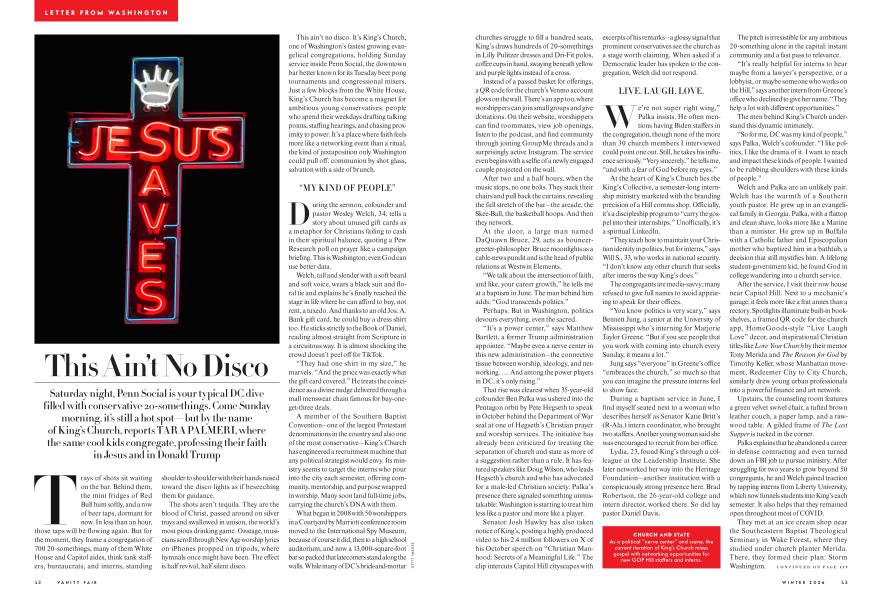
Saturday night, Penn Social is your typical DC dive filled with conservative 20-somethings. Come Sunday morning, it's still a hot spot—but by the name of King's Church, reports TARA PALMERI, where the same cool kids congregate, professing their faith in Jesus and in Donald Trump
TARA PALMERI
Trays of shots sit waiting on the bar. Behind them, the mini fridges of Red Bull hum softly, and a row of beer taps, dormant for now. In less than an hour, those taps will be flowing again. But for the moment, they frame a congregation of 700 20-somethings, many of them White House and Capitol aides, think tank staffers, bureaucrats, and interns, standing shoulder to shoulder with their hands raised toward the disco lights as if beseeching them for guidance.
The shots aren't tequila. They are the blood of Christ, passed around on silver trays and swallowed in unison, the world's most pious drinking game. Onstage, musicians scroll through New Age worship lyrics on iPhones propped on tripods, where hymnals once might have been. The effect is half revival, half silent disco.
This ain't no disco. It's King's Church, one of Washington's fastest growing evangelical congregations, holding Sunday service inside Penn Social, the downtown bar better known for its Tuesday beer pong tournaments and congressional mixers. Just a few blocks from the White House, King's Church has become a magnet for ambitious young conservatives: people who spend their weekdays drafting talking points, staffing hearings, and chasing proximity to power. It's a place where faith feels more like a networking event than a ritual, the kind of juxtaposition only Washington could pull off: communion by shot glass, salvation with a side of brunch.
"MY KIND OF PEOPLE"
uring the sermon, cofounder and pastor Wesley Welch, 34, tells a story about unused gift cards as a metaphor for Christians failing to cash in their spiritual balance, quoting a Pew Research poll on prayer like a campaign briefing. This is Washington; even God can use better data.
Welch, tall and slender with a soft beard and soft voice, wears a black suit and floral tie and explains he's finally reached the stage in life where he can afford to buy, not rent, a tuxedo. And thanks to an old Jos. A. Bank gift card, he could buy a dress shirt too. He sticks strictly to the Book of Daniel, reading almost straight from Scripture in a circuitous way. It is almost shocking the crowd doesn't peel off for TikTok.
"They had one shirt in my size," he marvels. "And the price was exactly what the gift card covered. " He treats the coincidence as a divine nudge delivered through a mall menswear chain famous for buy-oneget-three deals.
A member of the Southern Baptist Convention—one of the largest Protestant denominations in the country and also one of the most conservative—King's Church has engineered a recruitment machine that any political strategist would envy. Its ministry seems to target the interns who pour into the city each semester, offering community, mentorship, and purpose wrapped in worship. Many soon land full-time jobs, carrying the church's DNA with them.
What began in 2008with 5 0 worshipp ers in a Courtyard by Marriott conference room moved to the International Spy Museum, because of course it did, then to a high school auditorium, and now a 13,000-square-foot bar so packed that latecomers stand along the walls. While many of D C's brick-and-mortar churches struggle to fill a hundred seats, King's draws hundreds of 20-somethings in Lilly Pulitzer dresses and Dri-Fit polos, coffee cups in hand, swaying beneath yellow and purple lights instead of a cross.
Instead of a passed basket for offerings, a QR code for the church's Venmo account glows on the wall. There's an app too, where worshippers can join small groups and give donations. On their website, worshippers can find roommates, view job openings, listen to the podcast, and find community through joining Group Me threads and a surprisingly active Instagram. The service even begins with a selfie of a newly engaged couple projected on the wall.
After two and a half hours, when the music stops, no one bolts. They stack their chairs and pull back the curtains, revealing the full stretch of the bar—the arcade, the Skee-Ball, the basketball hoops. And then they network.
At the door, a large man named DaQuawn Bruce, 29, acts as bouncergreeter-philosopher. Bruce moonlights as a cable-news pundit and is the head of public relations at Westwin Elements.
"We talk about the intersection of faith, and like, your career growth," he tells me at a baptism in June. The man behind him adds: "God transcends politics."
Perhaps. But in Washington, politics devours everything, even the sacred.
"It's a power center," says Matthew Bartlett, a former Trump administration appointee. "Maybe even a nerve center in this new administration—the connective tissue between worship, ideology, and networking. ... And among the power players in DC, it's only rising."
That rise was clearest when 35-year-old cofounder Ben Palka was ushered into the Pentagon orbit by Pete Hegseth to speak in October behind the Department of War seal at one of Hegseth's Christian prayer and worship services. The initiative has already been criticized for treating the separation of church and state as more of a suggestion rather than a rule. It has featured speakers like Doug Wilson, who leads Hegseth's church and who has advocated for a male-led Christian society. Palka's presence there signaled something unmistakable: Washington is starting to treat him less like a pastor and more like a player.
Senator Josh Hawley has also taken notice of King's, posting a highly produced video to his 2.4 million followers on X of his October speech on "Christian Manhood: Secrets of a Meaningful Life." The clip intercuts Capitol Hill cityscapes with excerpts of his remarks—a glossy signal that prominent conservatives see the church as a stage worth claiming. When asked if a Democratic leader has spoken to the congregation, Welch did not respond.
LIVE. LAUGH. LOVE.
We're not super right wing," Palka insists. He often mentions having Biden staffers in the congregation, though none of the more than 30 church members I interviewed could point one out. Still, he takes his influence seriously. "Very sincerely," he tells me, "and with a fear of God before my eyes."
At the heart of King's Church lies the King's Collective, a semester-long internship ministry marketed with the branding precision of a Hill comms shop. Officially, it's a discipleship program to "carry the gospel into their internships." Unofficially, it's a spiritual Linkedln.
"They teach how to maintain your Christian identity in politics, but for interns," says Will S., 33, who works in national security. "I don't know any other church that seeks after interns the way King's does."
The congregants are media-sawy; many refused to give full names to avoid appearing to speak for their offices.
"You know politics is very scary," says Bennett Jung, a senior at the University of Mississippi who's interning for Marjorie Taylor Greene. "But if you see people that you work with coming into church every Sunday, it means a lot."
Jung says "everyone" in Greene's office "embraces the church," so much so that you can imagine the pressure interns feel to show face.
During a baptism service in June, I find myself seated next to a woman who describes herself as Senator Katie Britt's (R-Ala.) intern coordinator, who brought two staffers. Another young woman said she was encouraged to recruit from her office.
Lydia, 23, found King's through a colleague at the Leadership Institute. She later networked her way into the Heritage Foundation—another institution with a conspicuously strong presence here. Brad Robertson, the 26-year-old college and intern director, worked there. So did lay pastor Daniel Davis.
The pitch is irresistible for any ambitious 20-something alone in the capital: instant community and a fast pass to relevance.
"It's really helpful for interns to hear maybe from a lawyer's perspective, or a lobbyist, or maybe someone who works on the Hill, " says another intern from Greene's office who declined to give her name. "They help a lot with different opportunities."
The men behind King's Church understand this dynamic intimately.
"So for me, DC was my kind of people," says Palka, Welch's cofounder. "I like politics, I like the drama of it. I want to reach and impact these kinds of people. I wanted to be rubbing shoulders with these kinds of people."
Welch and Palka are an unlikely pair. Welch has the warmth of a Southern youth pastor. He grew up in an evangelical family in Georgia. Palka, with a flattop and clean shave, looks more like a Marine than a minister. He grew up in Buffalo with a Catholic father and Episcopalian mother who baptized him in a bathtub, a decision that still mystifies him. A lifelong student-government kid, he found God in college wandering into a church service.
After the service, I visit their row house near Capitol Hill. Next to a mechanic's garage, it feels more like a frat annex than a rectory. Spotlights illuminate built-in bookshelves, a framed QR code for the church app, HomeGoods-style "Live Laugh Love" decor, and inspirational Christian titles like Love Your Church by their mentor Tony Merida and The Reason for God by Timothy Keller, whose Manhattan movement, Redeemer City to City Church, similarly drew young urban professionals into a powerful finance and art network.
Upstairs, the counseling room features a green velvet swivel chair, a tufted brown leather couch, a paper lamp, and a rawwood table. A gilded frame of The Last Supper is tucked in the corner.
Palka explains that he abandoned a career in defense contracting and even turned down an FBI job to pursue ministry. After struggling for two years to grow beyond 50 congregants, he and Welch gained traction by tapping interns from Liberty University, which now funnels students into King's each semester. It also helps that they remained open throughout most of COVID.
They met at an ice cream shop near the Southeastern Baptist Theological Seminary in Wake Forest, where they studied under church planter Merida. There, they formed their plan: Storm Washington.
CONTINUED ON PAGE 119
CONTINUED FROM PAGE 43
8 YEARS, 250 BAPTISMS
Washington has always attracted spiritual entrepreneurs—from pastors seeking proximity to presidents to Christian nationalists eager to break down the wall between church and state. Recently, megachurches with deep pockets have made their move: Passion City from Atlanta expanded to DC in 2018; and more recently, Christian nationalist Wilson, the Idaho pastor and adviser to Hegseth, helped launch Christ Church on Capitol Hill last summer at the Conservative Partnership Institute.
"We understand that worship is warfare, we mean that," Pastor Jared Longshore warned in one of Wilson's services, according to Christianity Today The timing—paired with the zealotry at Charlie Kirk's funeral and Trump's revival of the White House Faith Office—has made a soft theocracy feel less fringe and more inevitable.
But Welch and Palka aren't fire-andbrimstone populists. They are careful. Disciplined. They speak moderation while building something more durable: nurturing a generation of young conservatives who will carry their teachings into agencies, congressional offices, the judiciary, and a returning Republican administration.
So does King's function as a soft-power pipeline for young conservatives in Washington? Its leaders bristle at the suggestion.
"We have nothing to do with getting people jobs. ... We have never, ever, ever done that," says Palka. "I do think it could be a by-product, though."
"Part of the Christian faith is that we don't compartmentalize it," says Welch. "So we want people to see that it does influence [your career], just like how your faith influences your family, your relationships, your kids, so that's just natural to how the church operates—it's not like this is the goal."
King's has done 250 baptisms in eight years. Palka jokes more than once that I could be baptized at their next ceremony. When I ask how long it takes to join the church, he smiles: "It could take 15 minutes, it could take 15 years."
He believes Gen Z is drawn not to megachurch gimmicks like slingshots and zip-lining pastors but to ancient ritual. King's recites the Nicene Creed weekly, rare among evangelical churches. Members must affirm nine core beliefs: God as Father, Son, Holy Ghost; Jesus fully God and fully human; born of a virgin; lived without sin; died; rose again; and will return to judge the living and the dead. Scripture is final. The church must carry out Christ's mission until he returns.
"They're looking to retrieve some of those anchors that have been lost," Palka says. "That is something the young people are flocking to—the high church liturgy."
Space, not attendance, is King's real problem. Expansion plans to cities like Paris and Berlin are on hold until they secure a permanent space in DC, and they need money. Their flock consists largely of interns and junior staffers, earnest but broke.
Palka knows that securing a physical home would give King's another ring of relevance, one more proof point that the church can be an institution.
"We thought we'd have a building by now," says Palka. "You can hit up a denomination for funding, but this capital campaign, it's been very slow."
Worshippers show up a half hour early to claim seats, and some longtime congregants have grumbled about the intern influx. One faction, calling itself "King's Church Members Take a Stand," lines the back wall to save room for newcomers.
They launched with a $50,000 loan from the Southern Baptist Convention's North American Mission Board—small by megachurch standards but enough to launch a movement. "I would love if we had a building of our own one day," Palka says. "All the statistics say it gives the Church credibility, it makes it more real in people's eyes when you see that it's their location."
Robertson, the 26-year-old running the intern ministry, may be one of the church's most influential figures. "It's a really interesting city," he says. "The fact that 25-year-olds kind of run the government." He is, in effect, their shepherd.
CONSERVATISM INC.
For interns living on stipends, King's offers free lunches, Nationals tickets, and speaker events featuring K Street veterans, senior aides, operatives, and even a Fox News producer. There are mixers too, where future staff assistants meet future legislative directors.
For the Republican Party, that makes King's more than a church. It's a long-term investment.
"If someone here hears about an opportunity, like a staff position opening up,," says Noah Larsen, 25, an operations director in Representative Claudia Tenney's (R-N.Y.) office, "[I'll ask] just flag it for a minute and say, 'Hey, you know, pass in your résumé." He's already helping his twin brother find a job through the congregation.
What makes King's so startling—even unnerving—for the secular left is how effortlessly it fills a void progressives never cracked: blending identity, community, and political machinery. Conservatives have spent years perfecting what insiders call "Conservatism Inc."—the pipeline of fellowships, think tank roles, K Street apprenticeships, and administration jobs. Seeing that ecosystem emerge inside a church signals an escalation.
"I've seen Conservatism Inc. working to engage churches," says Tina Nguyen, author of The MAGA Diaries. "But I've never seen something like a church become a networking hub for young career conservatives."
"To start at the tail end of the first Trump administration, and to be catching fire now with the returning Republican administration is great timing," says Gary Marx, the former executive director of the Faith & Freedom Coalition and a veteran of Bush-Cheney.
National Community Church, once the underground church frequented by conservative staffers on the Hill that grew from Union Station's basement movie theater into a Northern Virginia megachurch, never built a pipeline like this. King's is different. It is strategic. Hungry. And very aware of its moment.
At $2,200 per Sunday, the church has the venue only until 1 p.m. As Palka shepherds people up the stairwell, pop begins to blare, a photo booth rolls across the bar, high-tops scrape into place, and arcade games flicker back to life before football fans pour in for their own kind of ritual devotion. The church members disperse into the city, to their legislative memos and policy drafts, carrying with them the gospel and the group chat.
A new power is taking root in Washington. It doesn't march or lobby or storm the Capitol. It pours coffee, sings under disco lights, baptizes interns, and sends them into the machinery of government.
And it grows every Sunday.
Abi Baker
Subscribers have complete access to the archive.
Sign In Not a Subscriber?Join Now

