
Sign In to Your Account
Subscribers have complete access to the archive.
Sign In Not a Subscriber?Join NowNEW MEDIA: O Tech Bros, Where Art Thou?
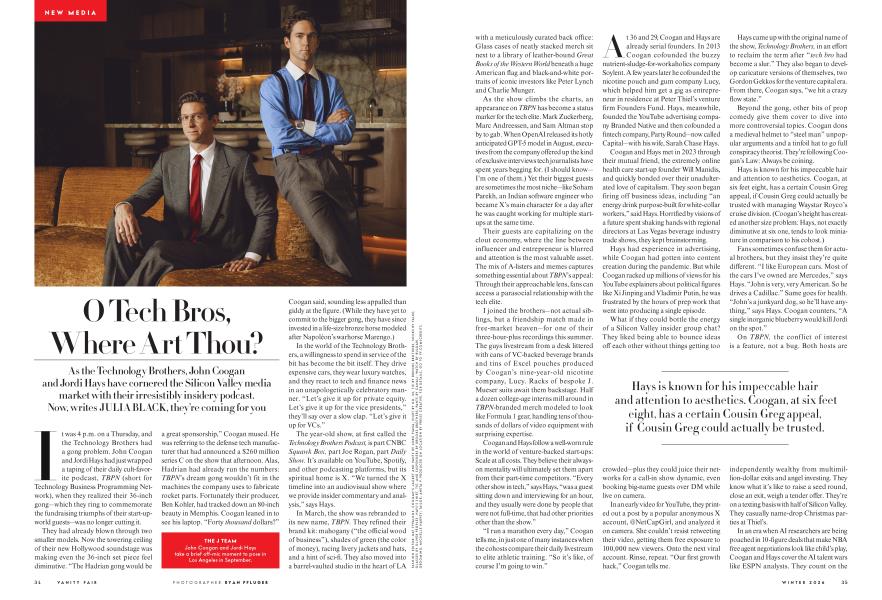
As the Technology Brothers, John Coogan and Jordi Hays have cornered the Silicon Valley media market with their irresistibly insidery podcast. Now, writes JULIA BLACK, they're coming for you
JULIA BLACK
It was 4 p.m. on a Thursday, and the Technology Brothers had a gong problem. John Coogan and JordiHays had just wrapped a taping of their daily cult-favorite podcast, TBPN (short for Technology Business Programming Network), when they realized their 36-inch gong—which they ring to commemorate the fundraising triumphs of their start-upworld guests—was no longer cutting it.
They had already blown through two smaller models. Now the towering ceiling of their new Hollywood soundstage was making even the 36-inch set piece feel diminutive. "The Hadrian gong would be a great sponsorship," Coogan mused. He was referring to the defense tech manufacturer that had announced a $260 million series C on the show that afternoon. Alas, Hadrian had already run the numbers: TBPN's dream gong wouldn't fit in the machines the company uses to fabricate rocket parts. Fortunately their producer, Ben Kohler, had tracked down an 80-inch beauty in Memphis. Coogan leaned in to see his laptop. "Forty thousand dollars?" Coogan said, sounding less appalled than giddy at the figure. (While they have yet to commit to the bigger gong, they have since invested in a life-size bronze horse modeled after NapoKon's warhorse Marengo.)
In the world of the Technology Brothers, a willingness to spend in service of the bit has become the bit itself. They drive expensive cars, they wear luxury watches, and they react to tech and finance news in an unapologetically celebratory manner. "Let's give it up for private equity. Let's give it up for the vice presidents," they'll say over a slow clap. "Let's give it up for VCs."
The year-old show, at first called the Technology Brothers Podcast, is part CNBC Squawk Box, part Joe Rogan, part Daily Show. It's available on YouTube, Spotify, and other podcasting platforms, but its spiritual home is X. "We turned the X timeline into an audiovisual show where we provide insider commentary and analysis," says Hays.
In March, the show was rebranded to its new name, TBPN. They refined their brand kit: mahogany ("the official wood of business"), shades of green (the color of money), racing livery jackets and hats, and a hint of sci-fi. They also moved into a barrel-vaulted studio in the heart of LA with a meticulously curated back office: Glass cases of neatly stacked merch sit next to a library of leather-bound Great Books of the Western World^Q^iAh a huge American flag and black-and-white portraits of iconic investors like Peter Lynch and Charlie Munger.
FOR DETAILS, GO TO VF.COM/CREDITS.
Hays is known for his impeccable hair and attention to aesthetics. Coogan, at six feet eight, has a certain Cousin Greg appeal, if Cousin Greg could actually be trusted.
As the show climbs the charts, an appearance on TBPNYVAS become a status marker for the tech elite. Mark Zuckerberg, Marc Andreessen, and Sam Altman stop by to gab. When OpenAI released its hotly anticipated GPT-5 model in August, executives from the company offered up the kind of exclusive interviews tech journalists have spent years begging for. (I should know— I'm one of them.) Yet their biggest guests are sometimes the most niche—like Soham Parekh, an Indian software engineer who became X's main character for a day after he was caught working for multiple startups at the same time.
Their guests are capitalizing on the clout economy, where the line between influencer and entrepreneur is blurred and attention is the most valuable asset. The mix of A-listers and memes captures something essential about TBPBPs appeal: Through their approachable lens, fans can access a parasocial relationship with the tech elite.
I joined the brothers—not actual siblings, but a friendship match made in free-market heaven—for one of their three-hour-plus recordings this summer. The guys livestream from a desk littered with cans of VC-backed beverage brands and tins of Excel pouches produced by Coogan's nine-year-old nicotine company, Lucy. Racks of bespoke J. Mueser suits await them backstage. Half a dozen college-age interns mill around in TS/W-branded merch modeled to look like Formula 1 gear, handling tens of thousands of dollars of video equipment with surprising expertise.
Coogan and Hays follow a well-worn rule in the world of venture-backed start-ups: Scale at all costs. They believe their alwayson mentality will ultimately set them apart from their part-time competitors. "Every other show in tech," says Hays, "was a guest sitting down and interviewing for an hour, and they usually were done by people that were not full-time, that had other priorities other than the show."
"I run a marathon every day," Coogan tells me, in just one ofmany instances when the cohosts compare their daily livestream to elite athletic training. "So it's like, of course I'm going to win."
At 36 and 29, Coogan and Hays are already serial founders. In 2013 Coogan cofounded the buzzy nutrient-sludge-for-workaholics company Soylent. A few years later he cofounded the nicotine pouch and gum company Lucy, which helped him get a gig as entrepreneur in residence at Peter Thiel's venture firm Founders Fund. Hays, meanwhile, founded the YouTube advertising company Branded Native and then cofounded a fintech company, Party Round—now called Capital—with his wife, Sarah Chase Hays.
Coogan and Hays met in 2023 through their mutual friend, the extremely online health care start-up founder Will Manidis, and quickly bonded over their unadulterated love of capitalism. They soon began firing off business ideas, including "an energy drink purpose-built forwhite-collar workers," said Hays. Horrified by visions of a future spent shaking hands with regional directors at Las Vegas beverage industry trade shows, they kept brainstorming.
Hays had experience in advertising, while Coogan had gotten into content creation during the pandemic. But while Coogan racked up millions of views for his YouTube explainers about political figures like Xi Jinping and Vladimir Putin, he was frustrated by the hours of prep work that went into producing a single episode.
What if they could bottle the energy of a Silicon Valley insider group chat? They liked being able to bounce ideas off each other without things getting too crowded—plus they could juice their networks for a call-in show dynamic, even booking big-name guests over DM while live on camera.
In an early video for YouTube, they printed out a post by a popular anonymous X account, @NetCapGirl, and analyzed it on camera. She couldn't resist retweeting their video, getting them free exposure to 100,000 new viewers. Onto the next viral account. Rinse, repeat. "Our first growth hack," Coogan tells me.
Hays came up with the original name of the show, Technology Brothers, in an effort to reclaim the term after "tech bro had become a slur." They also began to develop caricature versions of themselves, two Gordon Gekkos for the venture capital era. From there, Coogan says, "we hit a crazy flow state."
Beyond the gong, other bits of prop comedy give them cover to dive into more controversial topics. Coogan dons a medieval helmet to "steel man" unpopular arguments and a tinfoil hat to go full conspiracy theorist. They're following Coogan's Law: Always be coining.
Hays is known for his impeccable hair and attention to aesthetics. Coogan, at six feet eight, has a certain Cousin Greg appeal, if Cousin Greg could actually be trusted with managing Waystar Royco's cruise division. (Coogan's height has created another size problem: Hays, not exactly diminutive at six one, tends to look miniature in comparison to his cohost.)
Fans sometimes confuse them for actual brothers, but they insist they're quite different. "I like European cars. Most of the cars I've owned are Mercedes," says Hays. "John is very, very American. So he drives a Cadillac." Same goes for health. "John's a junkyard dog, so he'll have anything," says Hays. Coogan counters, "A single inorganic blueberry would kill Jordi on the spot."
On TBPN, the conflict of interest is a feature, not a bug. Both hosts are independently wealthy from multimillion-dollar exits and angel investing. They know what it's like to raise a seed round, close an exit, weigh a tender offer. They're on a texting basis with half of Silicon Valley. They casually name-drop Christmas parties at Thiel's.
In an erawhen AI researchers are being poached in 10-figure deals that make NBA free agent negotiations look like child's play, Coogan and Hays cover the AI talent wars like ESPN analysts. They count on the fact that their audience can keep up with the inside baseball. "A lot of other shows would say Amazon Web Services, Amazon's cloud computing business," explains Coogan. "We just say AWS."
Coogan and Hays started their show in part as away to combat the negativity of traditional tech journalists. "Sometimes they'll have good intentions but they'll miss the true story," says Hays. They argued that they are "providing commentary and analysis and a layer over the true journalism that is actually very healthy."
My own introduction to the "brothers" happened last year, when they devoted a 40-minute segment to picking apart a story I wrote for the tech publication The Information about Christianity in tech, which cast a somewhat critical eye on some of their friends in the Thiel-verse. ("She doesn't have the literary chops and expertise to write something truly groundbreaking," said Hays about me at the time.) He called to make nice after the episode came out. "It's like WWE," he informed me of our new public rivalry. I could either choose to be offended or I could embrace the growth hack. The traffic they helped direct to my piece made it one of my best performing that year.
TBPNcan also provide a soft landing for friends in the tech industry navigating an unfolding scandal. In July, after rampant flooding claimed more than 130 lives in the Texas Hill Country, false rumors started to spread on social media that Coogan and Hays's friend Augustus Doricko had contributed to the bad weather with his cloud-seeding company Rainmaker. Doricko took to X to call the accusations "baseless." Shortly after, Shaun Maguire, a partner at Sequoia, inflamed the internet by posting about the then New York City mayoral candidate Zohran Mamdani: "[He] comes from a culture that lies about everything. It's literally a virtue to lie if it advances his Islamist agenda." The brothers hosted Doricko and dedicated multiple segments to Maguire's drama.
In 2024, Lulu Cheng Meservey, a successful bulldog PR rep for many conservative companies, wrote an essay titled "Go Direct: The Manifesto." She warned founders against yielding "control over their narratives to media" and suggested instead using social media to develop their own voices. A friend of the pod, Meservey consulted TBPNon their launch strategy.
TBPN joins a group of right-leaning techno-optimist outlets creating a circular media ecosystem by, for, about, and funded by Silicon Valley: print publications like Arena and Colossus, publishing hagiographic profiles of founders and investors, and online outlets like Pirate Wires and the Paramount-owned The Free Press that take a strong libertarian stance. Every firm on Sand Hill Road has its own podcast. (In July, Andreessen Horowitz hired one of TEFFTs former employees to join its "New Media" team.) Last summer, Palantir chief technology officer Shyam Sankar, early Palantir employee Ryan Podolsky, and investor Christian Garrett announced they were launching Founders Films, a production company devoted to celebrating "American exceptionalism."
As for the technorati takeover of Washington, DC, Coogan and Hays see no issue. Following a November New York Times story critiquing investor David Sacks's potential conflicts of interest in his role as President Donald Trump's AI and crypto czar, Hays weighed in: "Unless you're just blanket against these industries, it's hard to argue that you want somebody [for that type of role] that doesn't have any expertise in said industries."
Part of the brothers' shtick is their tireless commitment to the products they are paid to shill. Unlike most podcasts, the TBPN hosts insert deadpan ads for Ramp, upscale Airbnb competitor Wander, and luxurywatch marketplace Bezel seamlessly into their flow of conversation. I lost count of the number of times they pivoted our conversation to ask if I'd considered switching to the business accounting software Ramp.
What these companies all have in common is they target a small tech elite. When your social circle has a combined net worth bigger than the GDP of most small countries, your total addressable market only needs to stretch so far.
Still, TSPAbrings a degree more objectivity than in-house editorial. "If one venture fund creates a media product, it's default boring," says Hays. "You're going to naturally create content to lift up your portfolio alone." TBPN, he says, aims to be the "Switzerland of technology," often hosting competitor companies and funds on the same episode.
This fall, after a historic bull run, markets started to wobble—in part due to fears of an AI bubble. At the same time, the hosts began to process feedback that they appeared to be blindly pro-tech. "The normie write-up on TBPN so far has been like, 'It's SportsCenter for tech. And they just love tech and they just sit here all the time, like, 'Tech good!' " Hays said in a November interview, pretending to clap like a seal.
They say they're not afraid to question overinflated valuations or unrealistic revenue projections. "We're in a position where we feelresponsible to calloutthe big players, even the players that come on our show," says Hays. They have also begun to weigh in more often on the negative externalities of technological progress, like chatbotinduced psychosis, AI labor displacement, and the industry's overeagerness to lean into adult content and gambling.
"Finding that line of, 'Technology is good, but we can still have real concerns around humanity' " is the goal, says Hays. "We both have, between us, five kids under five. We care not just about what data center development looks like in the next 12 months. We actually care about what—"
"You can just count the billionaires that follow the show," says Hays.
"Data center development looks like in the next 12 years!" Coogan interrupts, unable to resist a punch line.
"No, like, what is education going to look like in 12 years," says the more serious Hays.
I wondered aloud how long they would realistically ride out the show before getting bored. Coogan stopped me, dead serious, from the back seat of a Maybach an intern was chauffeuring us around in. "I would be shocked if the show isn't 90 percent of [our] income, or net worth, in a few years."
For the last few years, All-In has been the rising star of the tech media universe. Four entrepreneurs and venture capitalists in their 40s and 50s offer commentary on the day's tech news, markets, and—increasingly—politics. But as the middle-aged podcasters grew whinier, less self-aware, and more consumed by the kind of culture war bugaboos you'd expect to see from your great-aunt on Facebook, a gap opened up in the market. Combined with the powerful divorced-dad energy emanating from Elon Musk and the cringey midlife crisis makeovers of Zuckerberg and Jeff Bezos, it started to look like getting filthy rich off technology was, well, not a very cool thing to do.
Coogan and Hays never watch playback of their own show. For them, the only metric of success is asking themselves, "How do you feel at the end of that three hours?" says Coogan. "Do you feel happy? Were you laughing?" For now, the answer is consistently yes. Youthful, well-dressed, and charismatic, TBPN is making Silicon Valley wealth look fun again.
They know they're no saints—one of them runs an addictive nicotine company. But they have drawn certain lines in the sand. They don't swear on air, they try to avoid vulgarity, and they don't promote alcohol or drug use—mostly because they're not big drinkers themselves. Perhaps most importantly, "This show is never going to promote Burning Man," Hays deadpans.
On July 31 the brothers reported live from a booth at the New York Stock Exchange for the IPO of the design software company Figma, cofounded by their friend Dylan Field. Throughout the day, they hosted a revolving door of people whose personal net worths had just ticked up seven-plus figures. "We had them holding their own microphones and ringing the go ng...like kids!" Coogan told me later, laughing. The president of the NYSE Group, Lynn Martin, stopped by off the air, according to Coogan, to tell them she was a big fan and that she hoped they would be back soon. In December, NYSE announced that it would become TBPNs "exclusive exchange partner," giving the podcasters direct access to future IPOs and an ongoing presence on the floor, not unlike CNBC's.
The night of the Figma IPO, the brothers cohosted a party with newsletter writer Emily Sundberg at the exclusive San Vicente Bungalows in the Jane Hotel. In a room buzzing with the spirit of business, CNBC host and New York Times columnist Andrew Ross Sorkin, social platforms producer Adam Faze, and Odd Lots cohost Joe Weisenthal snacked on Wagyu pigs-in-blankets and caviar-topped hash browns.
For now, they've attracted a relatively small audience with a huge concentration of capital. "You can just count the billionaires that follow the show," says Hays. Sometimes, fans like Joshua Kushner, Travis Kalanick, and Larry Ellison are "more valuable as viewers than guests." He adds, "We care about people that are in the game, making investment decisions, building companies."
Their trip to New York, where their first billboard advertising campaign launched last summer, is part of an effort to expand TBPN's audience. After all, even normies could benefit from a peek inside the billionaire group chat.
Last summer, the brothers hosted the 24-year-old AI commentator Dwarkesh Patel for a half-hour segment. He had just released an essay detailing his revised projections for the arrival of artificial general intelligence. "It was narrative-setting in venture, and it should have moved the markets," says Coogan. "If you're a Citigroup analyst on Nvidia stock, that should be huge." That's the next market TBPNis hoping to capture.
"If in 2 0 years you told me, John, you're going to be as big as Andrew Ross Sorkin, I would be like, that's perfect." The respect is mutual. "I admire the entrepreneurial spirit behind what John and Jordi are doing with TBPN. They've built something real—superfast—and earned the trust of a sharp, influential audience. It's exciting to watch the next generation reinvent how we talk about tech and business," Sorkin tells me.
The brothers say they've taken meetings with most of the major TV networks at this point but have no plans to sell. They've seen other independent podcasters do so and lose their magic. "I can't imagine any acquisition scenario that doesn't make the content worse," says Hays. "And we want to do this indefinitely."
Meanwhile, they've got traditional tech media running scared. They estimated there have been seven different attempts by other media companies or podcasters to reverse engineer their show. None have taken off.
While prepping for the show during my visit, Hays reads aloud from X: " 'Never interrupt your opponent while he is in the middle of making a mistake,' " he says with a smirk. "I can repost that, right?"
The day I visited Coogan and Hays, in LA, a tech CEO was going viral after he was caught on camera at a Coldplay show snuggling up with one of his executives—who was notably not his wife. You couldn't have scripted a better piece of TBPNfodder. While in line for coffee that morning, Hays dashed off an X post: "Startup CEOs can't even hug their chief people officer at a concert in this country anymore. "
As he watched the likes pour in, he predicted they would top 10,000 or so. When I checked it the next morning, there were over 70,000. For the better part of a decade, I have sat in newsrooms and marketing brainstorms as media folk have tried to conjure the kind of virality that Hays produced in approximately 12 seconds.
Back in the studio, Coldplay's "Fix You" plays on the studio sound system as the brothers settle in for another hours-long livestream. Coogan stretches his massive wingspan and sways to the music as the on-air countdown ticks toward zero. "It's really simple! We're either journalists or analysts or comedians or...something else, and we'll figure it out over the next five years," he shouts over to me. "But we're not going anywhere."
Subscribers have complete access to the archive.
Sign In Not a Subscriber?Join Now


