






Sign In to Your Account
Subscribers have complete access to the archive.
Sign In Not a Subscriber?Join NowCUFFING SEASON
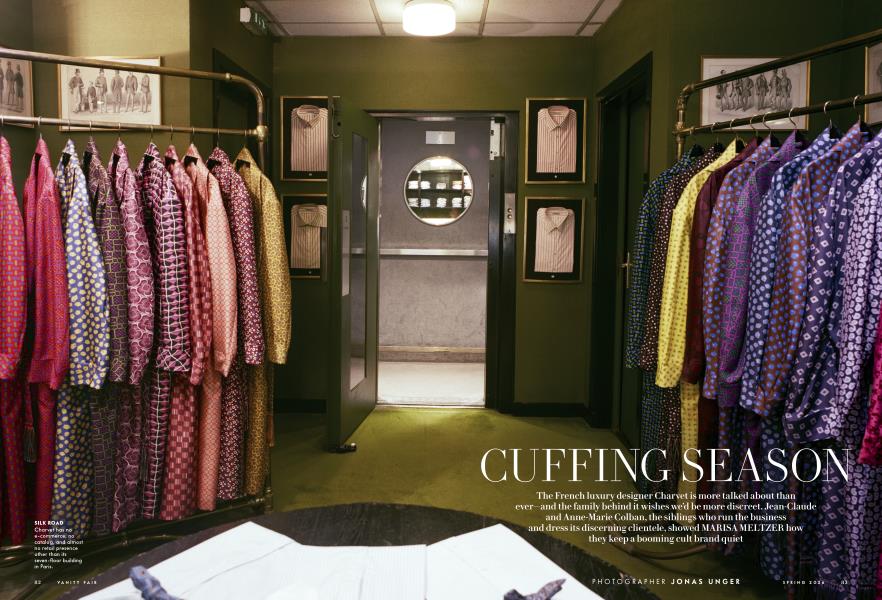
The French luxury designer Charvet is more talked about than ever—and the family behind it wishes we'd be more discreet. Jean-Claude and Anne-Marie Colban, the siblings who run the business and dress its discerning clientele, showed MARISA MELTZER how they keep a booming cult brand quiet
MARISA MELTZER
"It would be a mistake to think that our customers are mostly repeating tradition," says Jean-Claude Colban, who, alongside his sister, Anne-Marie Colban, owns Charvet, the 188-year-old French shirtmaker. The storied brand—although they would hate being called that— is something of an anomaly in today's world. You can get a shirt custom-made in about 6,000 different fabrics or suede kidskin slippers in 128 colors, but they have no e-commerce, no catalog, and almost no retail presence other than thenrambling seven-floor building at 28 Place Vendome in Paris. There aren't any plans for a second location or online ordering or any other nod to modernity you might expect—they are not celebrating a marketing rollout or a round-number birthday—and yet Charvet has never been more relevant than it is right now. Its white shopping bags with its name in script can be seen on the carry-ons ofmany a business class passenger on flights from Charles de Gaulle to New York. When I visited in January, a Charvet shirt designed with Matthieu Blazy from his first Chanel collection was about to hit stores. Even if you're willing to spend $4,000, good luck finding one. That is both the magic and mystery of Charvet: You must meet them on their own terms.
Both Colban siblings are soft talkers with impish, dry senses of humor. "If you asked how Charvet began, we were not yet born," says Jean-Claude with a little smile. But he's happy to tell the story: Charvet was started by Joseph-Christophe Charvet, who was the son of Napoleon's personal dresser. It was the first dedicated shirt shop in the world when it op ened in 1838, which dovetailed with the invention of the measuring tape and the availability of readyto-wear clothing. Denis Colban, Jean-Claude and Anne-Marie's father, was a fabric supplier who bought the company from Charvet's descendants in the mid-1960s.
Since then it has been a Colban family business. Jean-Claude joined in the early '80s, around when they moved to their current location, after working in banking, and Anne-Marie came to the business later after a career as an architect. Their father worked in his office on the fifth floor until he died in 1994, and their mother had an office until her death last year. Anne-Marie says the building feels more like home than a workplace. "This is our place, here," she says. It's also why she can't imagine opening another store.
"WE DON'T LIKE RATIONAL. WE DON'T LIKE RATIONAL AT ALL," JEAN-CLAUDE COLBAN SAYS.
Now Charvet employs about a hundred people between Paris and its workshops near the Indre region in Central France. The store on Place Vendome stands in contrast to the lines of tourists snapping photos in front of Cartier or the Ritz. Instead, the ground floor of Charvet is a little bit hushed—they don't play music and the lighting is muted. A few salespeople in suits are happy to help but don't hard-sell anyone on the piles of pocket squares or jewel-toned cashmere scarves or knit ties and belts from a silk knit developed in the late 19th century.
There's not a single piece of technology in sight beyond a credit card machine. Everything is written by hand, from clients' measurements to orders placed via landline. Ifyou want a custom creation of any kind, you have to call or email to make an appointment, so there must be a computer somewhere.
To say the Colbans like to keep a low profile is an understatement. "We tend to decline a lot of things," says Jean-Claude. He and his sister are seated in leather chairs in their father's former office, which is lined with books and ephemera such as Champagne-shaped bottles of Charvet detergent. They say no to most interviews and don't have much to say on the subject of their personal lives. (All I came to know after spending several days there was that Jean-Claude has a son who may one day come to work for them and that Anne-Marie lives somewhere on the Left Bank. )
They are also loath to discuss their notable clientele, past and present. "We don't like to play favorites," says Jean-Claude, who works on designs. "We enjoy making them shirts. And that's what's important, our relationship with the clients," says Anne-Marie, who works with customers.
People with money and power have long been fitted for shirts from Charvet. So while sultans, pashas, and princes have all been clients, and heads of state like Charles de Gaulle, John F. Kennedy, Francois Mitterrand, and Winston Churchill, it also has a long history with the creative set who defied typical boundaries of class and wealth: ^mile Zola, Charles Baudelaire, Robert de Montesquieu, Marcel Proust, Jean Cocteau, Serge Gainsbourg, Yves Saint Laurent, and, more recently, Sofia Coppola and her husband, Thomas Mars; and David Beckham. Chloe Sevigny has been photographed in its slippers, and The Row once sold them before it started making a similar version. The Manhattan gourmet grocer Eli Zabar gets his boxers made at Charvet and, Anne-Marie says with a giggle, "He always wears two shirts at a time."
Another reason they resist confirming customers is that they don't do logos. "Putting your name in a visible way on the corner is something we really don't like," says Jean-Claude. But also they know their work when they see it. "We have no doubt. It's due to the shape or the color. It's due to some details. But they are not there for recognition."
"SOMETIMES, IT'S ABOUT CREATING A LITTLE BIT OF EMOTION BY BRINGING IN A LITTLE BIT OF IRREGULARITY," JEAN-CLAUDE COLRAN SAYS. "BUT IT SOMETIMES NEEDS A DISCERNING EYE TO RECOGNIZE."
Charvet's ethos is about discretion, but the clothes are not dull. "When you take a very simple monochromatic stripe for shirts and then you are faced with the natural wish of customers to have something which is unique, how do you make something very simple, unique, and therefore identifiable?" asks Jean-Claude. "It's an interesting challenge. Sometimes, it's about creating a little bit of emotion by bringing in a little bit of irregularity. But it sometimes needs a discerning eye to recognize."
By now we have taken the building's tiny elevator up to their rarely seen showroom on the sixth floor, where they keep new fabrics and samples of patterns. Jean-Claude takes what first appears to be a simple white shirt with blue stripes off the shelf. "But see, there is a light blue here, which gives some shadow, and then it's asymmetric," he says, pointing to a subtle shade placed at intervals next to the main strips of blue. "Which makes it more interesting. And the use of this blue and that blue gives it a sense of bas relief. "
When a color or pattern is canceled, the Colbans get emotional. "Suppliers like to be rational about it. We don't like rational. We don't like rational at all," says Jean-Claude.
Charvet has evolved alongside the way men have dressed in the past two centuries. "When you look back 50 years ago, a much larger part of our business was bespoke," he says. He's not just referring to shirting but even their neckties and bow ties, which at one point were made with an individual's specifications and now are almost entirely bought off the rack. They used to make hats but don't any longer; same with luggage. They used to make gloves and are considering making them again. The Colbans aren't interested in getting into shoes.
At one point in the 1980s, they manufactured chocolates with their name on them. What customers most often fantasize about are Charvet bedsheets. "We don't feel we can do it at the moment," says Jean-Claude. They would need extra-wide looms, and they don't think any of the mills who make fabrics large enough for bed linens are up to the quality they want. "We realized that it was pointless to do products if we were not absolutely knowledgeable about all the possible mistakes. And we decided we would not risk our name and the trust of the customers." They are working on a Charvet beret, probably in silk.
The Colbans have resisted acquisition by a conglomerate, which might want to turn the house's whimsy into something more global along the lines of Hermes. What is unique is their lack of interest in that kind of expansion. Which doesn't mean they don't want to expand their creative horizons.
So why, I ask, did they say yes to Chanel? "Because it was not somebody coming with the brilliant idea of doing a T-shirt with two names on it," says Jean-Claude. "It's plain that some things come naturally, the context of a civilized discussion, and some of the things are products of a stretch, coming from people who don't really understand."
The brands are calling it not a collaboration but a conversation between the masculine and feminine. Blazy came to them with the idea of invoking the real-life boyfriend of Coco Chanel, Boy Capel, who was a real-life client of Charvet. Blazy's fantasy was about her wearing his clothes. And in 1929 Chanel designed costumes for Apollon Musagete dancers, whose tunicswere beltedwith Charvet ties. Says Jean-Claude, "It's something that makes historical sense. Not to reproduce, but to shed new light."
The second floor, where bespoke shirts are made, is the store's real locus. It's slightly shambolic, with thousands of bolts of fabrics (mostly from Switzerland and Italy and a few from Japan) vaguely ordered by colors and patterns. The day Iwas fitted, a middle-aged German-speaking couple was choosing fabrics for each to have five sets of custom pajamas made.
It is a palace of folly and fantasy that costs about $900 for a full bespoke shirt versus $500 and up for one off the rack. Ordering a shirt involves an hour and a half to take measurements and to choose the fabrics if you're decisive, much longer if you aren't. Even if you just want a white shirt, they have 100 shades and 400 texture s and we ave s.
I was tended to by two women, one who took measurements and one who ran about bringing options. They aren't just fitting for the length of the shirt but whether you want a curved hem or a straight one, which color of mother-of-pearl buttons, whether the design will have a bib or a monogram. They want to know if you wear a watch every day, how bulky it is, and which wrist it's on, because they generally give half a centimeter of room for one. In the fitting rooms there are walls showcasing varieties of collars and cuffs. None of it looks pristine, like some nouveau tailoring house where everything is just so, but lived in and imperfect. Anne-Marie came down to give me an air kiss hello and politely let me know she didn't like the fit of the women's shirt on me as much as the way the men's ones did.
One of their strengths is having the extremely seasoned salespeople weigh in on your vision. I wanted a shirt in a lavender shade that was so pale as to be almost white or gray. Rebecca, the woman whose main job was dashing around for supplies, found six bolts of cotton fabric that, upon first glance, looked the same. Then, one by one, she draped them on me and, like Goldilocks, I saw that one was a little too warm, one was a little too purple, one was too shiny of a weave, and one was deemed just right. I added French cuffs, a classic collar, and a bib to make it the more casual version of a tuxedo shirt I have always wanted but never found.
In that sense I was the typical customer, and why the Colbans have no trouble finding new ones despite their lack of marketing. "They are creating their own style. That's the deep value of this proposal. They create their own stories," Jean-Claude says. And in about three months, I will be getting an email that my first made-toorder shirt from Charvet will be ready. (You cannot rush a Charvet order.) "Through this process you are discovering a sense of time," he says. The more things change, the more they stay the same.
Subscribers have complete access to the archive.
Sign In Not a Subscriber?Join Now


