Sign In to Your Account
Subscribers have complete access to the archive.
Sign In Not a Subscriber?Join NowTaking Things for Granted at Auction
Showing That in Bridge Playing Even Exceptions are Governed by Rules
R. F. FOSTER
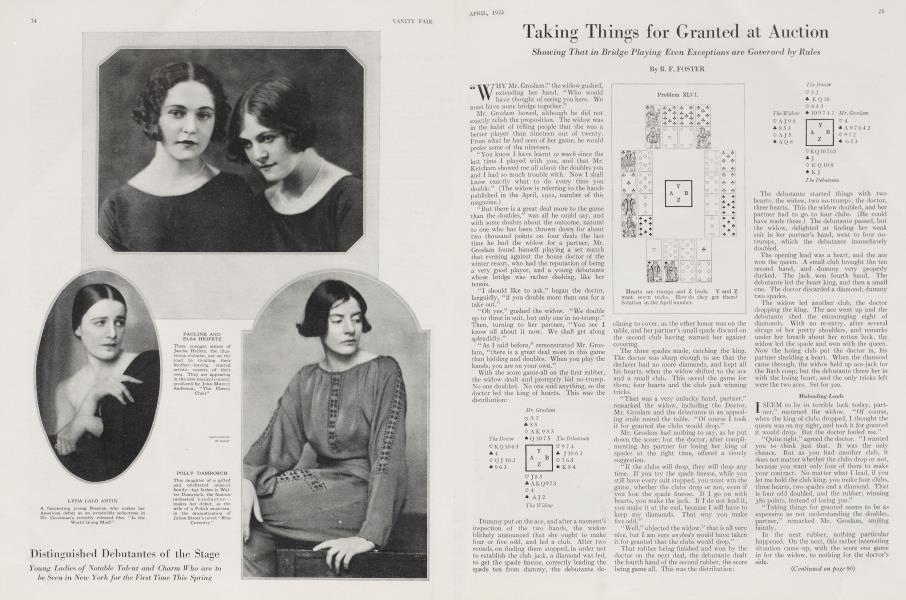
"WHY Mr. Groslam!" the widow gushed, extending her hand. "Who would have thought of seeing you here. We must have some bridge together."
Mr. Groslam bowed, although he did not exactly relish the proposition. The widow was in the habit of telling people that she was a better player than nineteen out of twenty. From what he had seen of her game, he would prefer some of the nineteen.
"You know I have learnt so much since the last time I played with you, and that Mr. Ketcham showed me all about the doubles you and I had so much trouble with. Now I shall know exactly what to do every time you double." (The widow is referring to the hands published in the April, 1922, number of this magazine.)
"But there is a great deal more to the game than the. doubles," was all he could say, and with some doubts about the outcome, natural to one who has been thrown down for about two thousand points on four deals the last time he had the widow for a partner, Mr. Groslam found himself playing a set match that evening against the house doctor of the winter resort, who had the reputation of being a very good player, and a young debutante whose bridge was rather dashing, like her tennis.
"I should like to ask," began the doctor, languidly, "if you double more than one for a take out."
"Oh yes," gushed the widow. "We double up to three in suit, but only one in no-trump." Then, turning to her partner, "You see I know all about it now. We shall get along splendidly."
"As I said before," remonstrated Mr. Groslam, "there is a great deal more in this game than bidding and doubles. When you play the hands, you are on your own."
With the score game-all on the first rubber, the widow dealt and promptly bid no-trump. No one doubled. No one said anything, so the doctor led the king of hearts. This was the distribution:
Dummy put on the ace, and after a moment's inspection of the two hands, the widow blithely announced that she ought to make four or five odd, and led a club. After two rounds, on finding them stopped, in order not to establish the club jack, a diamond was led, to get the spade finesse, correctly leading the spade ten from dummy, the debutante declining to cover, as the other honor was on the table, and her partner's small spade discard on the second club having warned her against covering.
The three spades made, catching the king. The doctor was sharp enough to see that the declarer had no more diamonds, and kept all his hearts, when the widow shifted to the ace and a small club. This saved the game for them; four hearts and the club jack winning tricks.
"That was a very unlucky hand, partner," remarked the widow, including the Doctor, Mr. Groslam and the debutante in an appealing smile round the table. "Of course I took it for granted the clubs would drop."
Mr. Groslam had nothing to say, as he put down the score; but the doctor, after complimenting his partner for losing her king of spades at the right time, offered a timely suggestion.
"If the clubs will drop, they will drop any time. If you try the spade finesse, while you still have every suit stopped, you must win the game, whether the clubs drop or not, even if you lose the spade finesse. If I go on with hearts, you make the jack. If I do not lead it, you make it at the end, because I will have to keep my diamonds. That way you make five odd."
"Well," objected the widow," that is all very nice, but I am sure anybody would have taken it for granted that the clubs would drop."
That rubber being finished and won by the doctor on the next deal, the debutante dealt the fourth hand of the second rubber, the score being game all. This was the distribution:
The debutante started things with two hearts; the widow, two 110-trumps; the doctor, three hearts. This the widow doubled, and her partner had to go to four clubs. (He could have made three.) The debutante passed, but the widow, delighted at finding her weak suit in her partner's hand, went to four notrumps, which the debutante immediately doubled.
The opening lead was a heart, and the ace won the queen. A small club brought the ten second hand, and dummy very properly ducked. The jack won fourth hand. The debutante led the heart king, and then a small one. The doctor discarded a diamond; dummy two spades.
The widow led another club, the doctor dropping the king. The ace went up and the debutante shed the encouraging eight of diamonds. With no re-entry, after several shrugs of her pretty shoulders, and remarks under her breath about her rotten luck, the widow led the spade and won with the queen. Now the losing club put the doctor in, his partner shedding a heart. When the diamond came through, the widow held up ace-jack for the Bath coup; but the debutante threw her in with the losing heart, and the only tricks left were the two aces. Set for 300.
Misleading Leads
I SEEM to be in terrible luck today, partner," mourned the widow. "Of course, when the king of clubs dropped, I thought the queen was on my right, and took it for granted it would drop. But the doctor fooled me."
"Quite right," agreed the doctor. " I wanted you to think just that. It was the only chance. But as you had another club, it does not matter whether the clubs drop or not, because you want only four of them to make your contract. No matter what I lead, if you let me hold the club king, you make four clubs, three hearts, two spades and a diamond. That is four odd doubled, and the rubber; winning 380 points, instead of losing 300."
"Taking things for granted seems to be as expensive as not understanding the doubles, partner," remarked Mr. Groslam, smiling faintly.
In the next rubber, nothing particular happened. On the next, this rather interesting situation came up, with the score one game in for the widow, to nothing for the doctor's side.
(Continued on page 90)
(Continued from page 75)
The dealer bid a heart; the debutante two clubs; the widow two no-trumps; the two others passing. The debutante now called her semi-two-suiter, according to Culbertson, three spades, and the widow went on to three no-trumps. This the debutante doubled, correctly guessing from the widow's denial of the hearts that the doctor had that suit safe.
The doctor picked the spade for his lead, partly because he had more of them than clubs, and partly because it is usually better to lead major suits up to no-trumpers. The ace won the jack and a small diamond was won by the ace. The return of the diamond was won by the queen, the doctor discarding the heart seven.
After a short "Ouch!" and a survey of the situation, the widow went right on and established the diamonds, the doctor discarding small hearts. Three spades made, the doctor winning the last round. The widow discarded a small heart. This would have allowed the doctor to make his ace with the certainty that the widow had only one heart. But he led the club. If the queen is allowed to hold, the contract is set right there. The forlorn hope seems to be that if the doctor has the ace of hearts, he has no more clubs; or, if he has not the ace, the play makes no difference, so the club ace is played and a heart led. The doctor had a club left; so the contract was set for 200.
"Well, I took nothing for granted that time, did I, partner? Who would have thought there could be four diamonds in the same hand as a two-suiter?" Then, turning to the doctor, "You must admit I played that hand all right. "
"I am sorry to say I cannot agree. There are five diamonds against you, to the jack nine. If they are all in one hand, it does not matter how you play. If there are four to the jack to your left, it does not matter what you do. You must make all your diamonds to get your contract, and you must play so that if you find four to the jack on your right, you can do so.
"It is exactly like a finesse. If the king is on the wrong side it does not matter what you do.. In all positions where there is a possibility of finding four in one hand against your eight, keep one of your winning cards in each hand for the second round. If both players follow suit, the cards drop. If the one on your right renounces, you could not help it. Your play was to lead the king of diamonds; not the small one. Then lead to the ace. If I discard, my partner's jack is caught. If my partner discards, nothing you could have done would matter."
" Then, I did take something for granted.'
"Not exactly, unless you took it for granted that a two-suiter could not have a third suit of four cards. If you play the diamonds as mechanically as you play a finesse, all we can make is three spades and the are of hearts."
On the last rubber of the evening this situation came up, the widow having the deal on the rubber game:
The dealer started with a heart; the doctor two clubs, Groslam two hearts, The doctor went to two spades; Groslam three hearts, overcalled by the debutante with three spades; the widow going to four hearts. The debutante took advantage of the free double.
The doctor led the club king. The widow won the trick with the ace, and led the suit again; dummy tramping. All that is needed now is to let dummy trump another club; and unless some one has all five trumps in one hand, the game is won. Dummy led a small diamond to the king, and the doctor trumped it.
Before the widow could recover from the shock, a small spade had put the debutante in to give her partner another ruff. The king of spades and another allowed a third ruff. Fortunately, the widow had trumps enough to pull both the adversary's and still ruff the club, As it was, the contract was set for 300.
Neither the doctor nor Groslam could suppress a laugh, for which they apologized and then laughed again.
"I don't see anything funny about that," observed the widow. "Who could have imagined that the doctor had not a single diamond in his hand?"
"But it does not matter whether I have anY diamonds or not," the doctor hastened to explain. "You want to be certain that dummy gets another ruff. Then lead the tramp. No one can take the Rad away from you there. You still have trumps enough to lead after the second ruffWe do not know anything about 3'our diamonds, and if my partner hapPens to discard one on the tramps, you make a little slam, winning about 550 points, instead of losing 300."
Answer to the February Problem
THIS was the February Problem: XLV.
Hearts are trumps and Z leads. Y anc Z want six tricks.
Z leads the ace of diamonds. A can discard either suit. Y trumps the diamo;:d with the jack of hearts and leads the small trump, so that Z shall pick up both B's. On these tricks, A must keep three spades, to protect that suit when B shall be forced to lead it. Y sheds a club Z now leads the losing diamond, putting B in. If A discards his last club, Y sheds a spade and makes a club trick. If A keeps a club, Y makes all three of his spades, as B has only spades to lead.
Subscribers have complete access to the archive.
Sign In Not a Subscriber?Join Now
