Sign In to Your Account
Subscribers have complete access to the archive.
Sign In Not a Subscriber?Join NowProhibition
SHERWOOD ANDERSON
Why Bootleg Liquor Is Bound to Bring About a General Decline in Taste
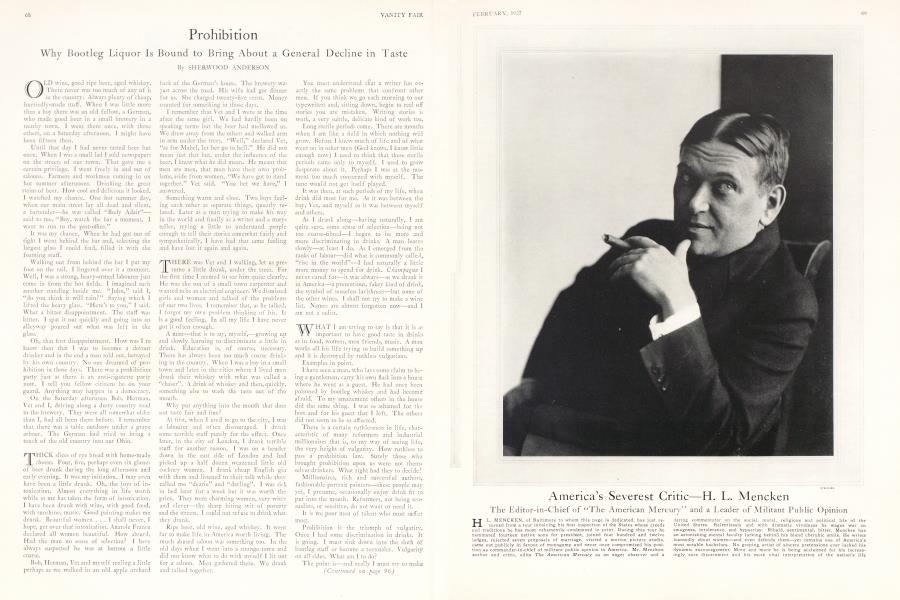
OLD wine, good ripe beer, aged whiskey. There never was too much of any of it in the country. Always plenty of cheap, hurriedly-made stuff. When I was little more than a boy there was an old fellow, a German, who made good beer in a small brewery in a nearby town. I went there once, with three others, on a Saturday afternoon. I might have been fifteen then.
Until that day I had never tasted beer but once. When I was a small lad I sold newspapers on the streets of our town. That gave me a certain privilege. 1 went freely in and out of saloons. Farmers and workmen coming in on hot summer afternoons. Drinking the great steins of beer. How cool and delicious it looked. I watched my chance. One hot summer day, when our main street lay all dead and silent, a bartender—he was called "Body Adair"— said to me, "Boy, watch the bar a moment. I want to run to the post-office."
It was my chance. When he had got out of sight I went behind the bar and, selecting the largest glass I could find, filled it with the foaming stuff.
Walking out from behind the bar I put my foot on the rail. I lingered over it a moment. Well, I was a strong, heavy-armed labourer just come in from the hot fields. I imagined such another standing beside me. "John," said I, "do you think it will rain?" Saying which I lifted the heavy glass. "Here's to you," I said. What a bitter disappointment. The stuff was bitter. I spat it out quickly and going into an alleyway poured out what was left in the glass.
Oh, that first disappointment. How was I to know then that I was to become a devout drinker and in the end a man sold out, betrayed by his own country. No one dreamed of prohibition in those days. There was a prohibition party just as there is an anti-cigarette party now. I tell you fellow citizens be on your guard. Anything may happen in a democracy.
On the Saturday afternoon Bob, Herman, Vet and I, driving along a dusty country road to the brewery. They were all somewhat older than I, had all been there before. I remember that there was a table outdoors under a grape arbour. The German had tried to bring a touch of the old country into our Ohio.
THICK slices of rye bread with home-made cheese. Four, five, perhaps even six glasses of beer drunk during the long afternoon and early evening. It was my initiation. I may even have been a little drunk. Oh, the joys of intoxication. Almost everything in life worth while to me has taken the form of intoxication. I have been drunk with wine, with good food, with sunshine, music. Good painting makes me drunk. Beautiful women ... I shall never, I hope, get over that intoxication. Anatole France declared all women beautiful. How absurd. Had the man no sense of selection? I have always suspected he was at bottom a little coarse.
Bob, Herman, Vet and myself reeling a little perhaps as we walked in an old apple orchard back of the German's house. The brewery was just across the road. His wife had got dinner for us. She charged twenty-five cents. Money counted for something in those days.
I remember that Vet and I were at the time after the same girl. We had hardly been on speaking terms but the beer had mellowed us. We drew away from the others and walked arm in arm under the trees. "Well," declared Vet, "as for Mabel, let her go to hell." He did not mean just that but, under the influence of the beer, I knew what he did mean. He meant that men are men, that men have their own problems, aside from women. "We have got to stand together." Vet said. "You bet we have," I answered.
Something warm and close. Two boys feeling each other as separate things, queerly related. Later as a man trying to make his way in the world and finally as a writer and a storyteller, trying a little to understand people enough to tell their stories somewhat fairly and sympathetically, I have had that same feeling and have lost it again and again.
THERE was Vet and I walking, let us presume a little drunk, under the trees. For the first time I seemed to see him quite clearly. He was the son of a small town carpenter and wanted to be an electrical engineer. We dismissed girls and women and talked of the problems of our two lives. I remember that, as he talked, I forgot my own problem thinking of his. It is a good feeling. In all my life I have never got it often enough.
A man—that is to say, myself,—growing up and slowly learning to discriminate a little in drink. Education is, of course, necessary. There has always been too much coarse drinking in the country. When I was a boy in a small town and later in the cities where I lived men drank their whiskey with what was called a "chaser". A drink of whiskey and then, quickly, something else to wash the taste out of the mouth.
Why put anything into the mouth that does not taste fair and fine?
At first, when I used to go to the city, I was a labourer and often discouraged. I drank some terrible stuff purely for the effect. Once later, in the city of London, I drank terrible stuff for another reason. I was on a bender down in the east side of London and had picked up a half dozen weazened little old cockney women. I drank cheap English gin with them and listened to their talk while they called me "dearie" and "darling". I was sick in bed later for a week but it was worth the price. They were charming women, very witty and clever—the sharp biting wit of poverty and the streets. I could not refuse to drink what they drank.
Ripe beer, old wine, aged whiskey. It went far to make life in America worth living. The much abused saloon was something too. In the old days when I went into a strange town and did not know what to do with myself I lit out for a saloon. Men gathered there. We drank and talked together.
You must understand that a writer has exactly the same problems that confront other men. If you think we go each morning to our typewriters and, sitting down, begin to reel off stories you are mistaken. Writing stories is work, a very subtle, delicate kind of work too.
Long sterile periods come. There are months when I am like a field in which nothing will grow. Before I knew much of life and of what went on in other men (God knows, I know little enough now) I used to think that these sterile periods came only to myself. I used to grow desperate about it. Perhaps I was at the moment too much concerned with myself. The tune would not get itself played.
It was then, at such periods of my life, when drink did most for me. As it was between the boy, Vet, and myself so it was between myself and others.
As I drank along—having naturally, I am quite sure, some sense of selection—being not too coarse-fibred—I began to be more and more discriminating in drinks. A man learns slowly—at least I do. As I emerged from the ranks of labour—did what is commonly called, "rise in the world"—I had naturally a little more money to spend for drink. Champagne I never cared for—it was always—as we drank it in America—a pretentious, fakey kind of drink, the symbol of senseless lavishness—but some of the other wines. I shall not try to make a wine list. Names are almost forgotten now—and I am not a sadist.
WHAT I am trying to say is that it is as important to have good taste in drinks as in food, women, men friends, music. A man works all his life trying to build something up and it is destroyed by ruthless vulgarians. Examples in point.
I have seen a man, who lays some claim to being a gentleman, carry his own flask into a house where he went as a guest. He had once been poisoned by bootleg whiskey and had become afraid. To my amazement others in the house did the same thing. I was so ashamed for the host and for his guest that I left. The others did not seem to be so affected.
There is a certain ruthlessness in life, characteristic of many reformers and industrial millionaires that is, to my way of seeing life, the very height of vulgarity. How ruthless to pass a prohibition law. Surely those who brought prohibition upon us were not themselves drinkers. What right had they to decide?
Millionaires, rich and successful authors, fashionable portrait painters—these people may yet, I presume, occasionally enjoy drink fit to put into the mouth. Reformers, not being sensualists, or sensitive, do not want or need it.
It is we poor men of talent who must suffer most.
Prohibition is the triumph of vulgarity. Once I had some discrimination in drinks. It is going. I must sink down into the sloth of bootleg stuff or become a teetotaler. Vulgarity on all sides. What am I to do?
The point is—and really I must try to make my point clear—the point is that I cannot lose my taste in one direction and retain it in another. If I am vulgar in one particular I am vulgar through and through. All this talk about a man being a good judge of prose but having no feeling for poetry, having taste in foods and none in drinks, in music and not in painting, is sheer nonsense. You are vulgar or you are not vulgar. You like coarse things or you like fine things.
(Continued on page 96)
(Continued from Page 68)
The point not very clearly understood is that in passing our prohibition law we have in reality struck at the slowly growing culture of the whole country.
Is it not stupid to think that, because coarse men use drink coarsely, no man shall drink? As well say that because some men have indigestion no man shall eat, because there is bad music played we shall have no good music.
Well enough I know that my voice is a feeble one. What I say will have no effect. However I feel this inclination to speak up. It has seemed to me, from the very beginning, that this whole matter of prohibition has been put on the wrong footing. We should begin to find out, sometime, that people are not changed by laws. You do not make men moral or immoral that way.
Anyway, being moral or immoral has nothing to do with the matter.
Men continue to drink. It is all a question of what we shall drink. It is a question of taste.
Drink is the great equalizer. I dare say that, unlike food, it is not an absolute necessity to the continuance of human life.
But who wants just to live? If I cannot put some flourish into my life what good is it to me? Too much greyness in an industrial civilization. I do not want to be grey. If I were a bird I would want to wear the most gaily-colored plumage I could find. I want to sing occasionally, shout, link arms with other men, tell them nice little complimentary lies about themselves, have them do the same to me.
I want to dance, make love, get drunk when getting drunk will loosen me up.
Being as I am, the kind of man I am, I dare say I will do these things in any event.
I will get drinks all right. Plenty of men offer me drinks. Almost every day I get letters—"Come to my house. I have something good here."
Mostly optimistic lies, a forlorn hope.
We are all sunk into the vulgarity of second rate drinks. We go deeper and deeper. Nothing has ever so discouraged me about democracy. Nothing has ever so stood in the way of the growth of good taste.
Nothing has ever struck such a blow at comradeship, as between man and man.
Prohibition—the triumph of vulgarity.
That is all I can see in the matter.
Subscribers have complete access to the archive.
Sign In Not a Subscriber?Join Now
