

Sign In to Your Account
Subscribers have complete access to the archive.
Sign In Not a Subscriber?Join NowPraise and prejudice
The new books, in review, by George Dangerfield
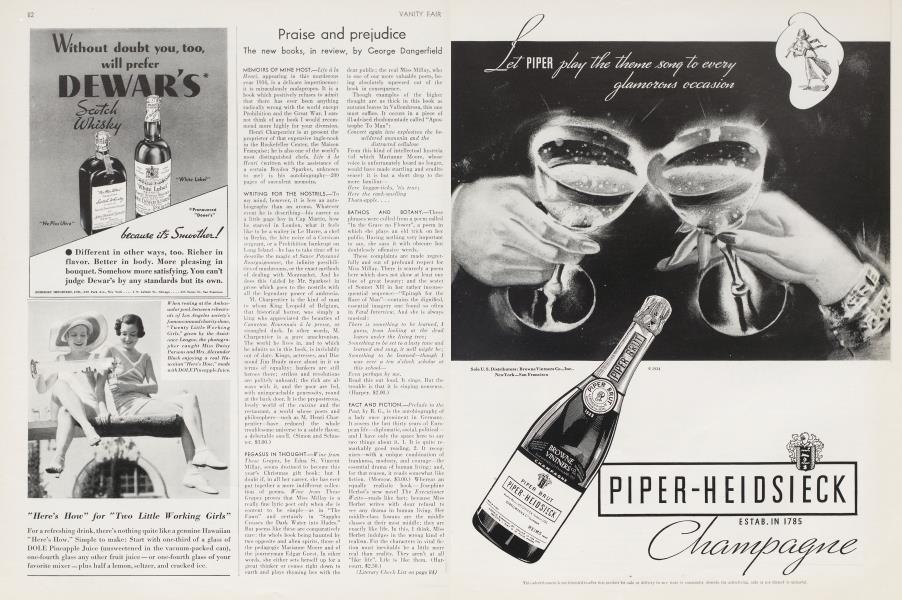
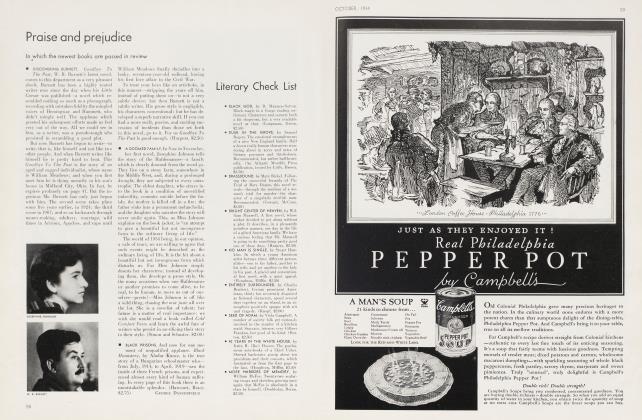
MEMOIRS OF MINE HOST.—Life a la Henri, appearing in this murderous year 1934, is a delicate impertinence: it is miraculously malapropos. It is a book which positively refuses to admit that there has ever been anything radically wrong with the world except Prohibition and the Great War. I cannot think of any book I would recommend more highly for your diversion.
Henri Charpentier is at present the proprietor of that expensive ingle-nook in the Rockefeller Center, the Maison Francaise; he is also one of the world's most distinguished chefs. Life a la Henri (written with the assistance of a certain Boyden Sparkes, unknown to me) is his autobiography—289 pages of succulent memoirs.
WRITING FOR THE NOSTRILS.—To my mind, however, it is less an autobiography than an aroma. Whatever event he is describing—his career as a little page boy in Cap Martin, how he starved in London, what it feels like to he a waiter in Le Havre, a chef in Berlin, the hete noire of a Corsican sergeant, or a Prohibition bankrupt on Long Island—he has to take time off to describe the magic of Sauce Paysanne Bourguignonne, the infinite possibilities of mushrooms, or the exact methods of dealing with Montrachet. And he does this (aided by Mr. Sparkes) in prose which goes to the nostrils with all the legendary power of ambrosia.
M. Charpentier is the kind of man to whom King Leopold of Belgium, that historical horror, was simply a king who appreciated the beauties of Canneton Rouennais a la presse, or strangled duck. In other words, M. Charpentier is a pure anachronism. The world he lives in, and to which he admits us in this hook, is inviolably out of date. Kings, actresses, and Diamond Jim Brady move about in it on terms of equality; bankers are still heroes there; strikes and revolutions are politely unheard; the rich are always with it, and the poor are fed, with unimpeachable generosity, round at the back door. It is the preposterous, lovely world of the cuisine and the restaurant, a world whose poets and philosophers—such as M. Henri Charpentier—have reduced the whole troublesome universe to a subtle flavor, a delectable smell. (Simon and Schuster. $3.00.)
PEGASUS IN THOUGHT.—Wine from These Crapes, by Edna St. Vincent Millay, seems destined to become this year's Christmas gift book: hut I doubt if, in all her career, she has ever put together a more indifferent collection of poems. Wine from These Crapes proves that Miss Millay is a really fine lyric poet only when she is content to be simple—as in "The Fawn" and certainly in "Sappho Crosses the Dark Water into Hades." But poems like these are comparatively rare: the whole book being haunted by two opposite and alien spirits, those of the pedagogic Marianne Moore and of the journeyman Edgar Guest. In other words, she either sets herself up for a great thinker or comes right down to earth and plays rhyming bee with the dear public; the real Miss Millay, who is one of our more valuable poets, being absolutely squeezed out of the book in consequence.
Though examples of the higher thought are as thick in this book as autumn leaves in Vallombrosa, this one must suffice. It occurs in a piece of ill-advised rhodomontade called "Apostrophe To Man":
Convert again into explosives the bewildered ammonia and the distracted cellulose
From this kind of intellectual hysteria (of which Marianne Moore, whose voice is unfortunately heard no longer, would have made startling and erudite sense) it is but a short drop to the more familiar—
Here beggar-ticks, 'tis true;
Here the rank-smelling Thorn-apple. . . .
BATHOS AND BOTANY.—These phrases were culled from a poem called "In the Grave no Flower", a poem in which she plays an old trick on her public. Having nothing very important to say, she says it with obscure but doubtlessly offensive weeds.
These complaints are made regretfully and out of profound respect for Miss Millay. There is scarcely a poem here which does not show at least one line of great beauty: and the sestet of Sonnet XII in her rather inconsequential sequence—"Epitaph for the Race of Man"—contains the dignified, essential imagery one found so often in Fatal Interview. And she is always musical:
There is something to be learned, I guess, from looking at the dead leaves under the living tree; Something to be set to a lusty tune and learned and sung, it well might be; Something to be learned—though I was ever a ten o'clock scholar at this school—
Even perhaps by me.
Read this out loud. It sings. But the trouble is that it is singing nonsense. (Harper. $2.00.)
FACT AND FICTION.—PreMde to the Past, by R. G., is the autobiography of a lady once prominent in Germany. It covers the last thirty years of European life—diplomatic, social, political— and I have only the space here to say two things about it. 1. It is quite remarkably good reading. 2. It recognizes—with a unique combination of frankness, modesty, and courage—the essential drama of human living; and, for that reason, it reads somewhat like fiction. (Morrow. $3.00.) Whereas an equally realistic book — Josephine Herbst's new novel The Executioner Waits—reads like fact; because Miss Herbst writes with dour refusal to see any drama in human living. Her middle-class Iowans are the middle classes at their most middle; they are exactly like life. In this, I think, Miss Herbst indulges in the wrong kind of realism. For the characters in vital fiction must inevitably be a little more real than reality. They aren't at all "like life". Life is like them. (Harcourt. $2.50.)
(Literary Check List on page 84)
Subscribers have complete access to the archive.
Sign In Not a Subscriber?Join Now