
Sign In to Your Account
Subscribers have complete access to the archive.
Sign In Not a Subscriber?Join NowBen Grader makes a call
TESS SLESINGER
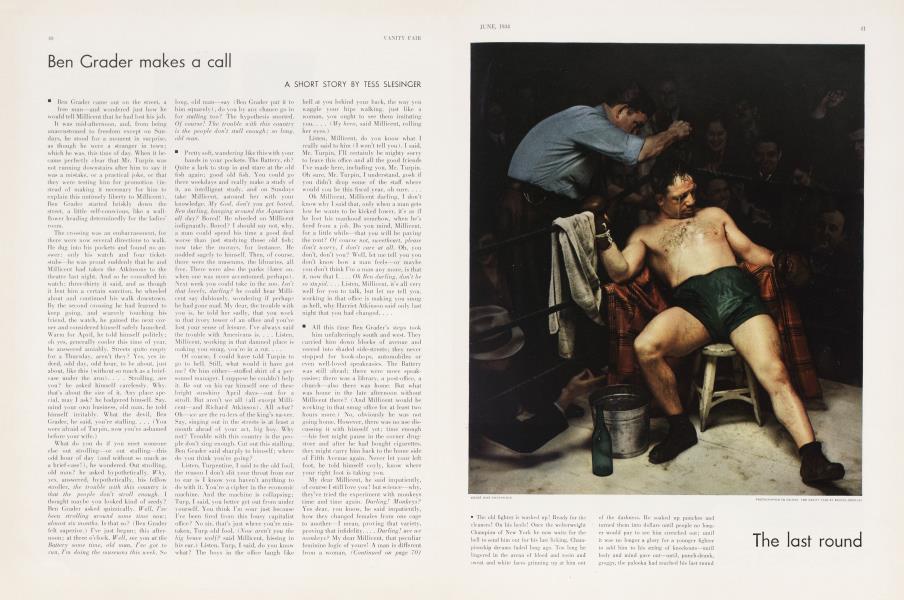
Ben Grader came out on the street, a free man—and wondered just how he would tell Millicent that he had lost his job.
It was mid-afternoon, and, from being unaccustomed to freedom except on Sundays, he stood for a moment in surprise, as though he were a stranger in town; which he was. this time of day. When it became perfectly clear that Mr. Turpin was not running downstairs after him to say it was a mistake, or a practical joke, or that they were testing him for promotion (instead of making it necessary for him to explain this untimely liberty to Millicent), Ben Grader started briskly down the street, a little self-conscious, like a wallflower heading determinedly for the ladies' room.
The crossing was an embarrassment, for there were now several directions to walk. He dug into his pockets and found no answer: only his watch and four ticket-stubs—he was proud suddenly that he and Millicent had taken the Atkinsons to the theatre last night. And so he consulted his watch: three-thirty it said, and as though it lent him a certain sanction, he wheeled about and continued his walk down-town. By the second crossing he had learned to keep going, and scarcely touching his friend, the watch, he gained the next corner and considered himself safely launched. Warm for April, he told himself politely; oh yes, generally cooler this time of year, he answered amiably. Streets quite empty for a Thursday, aren't they? Yes, yes indeed, odd day, odd hour, to be about, just about, like this (without so much as a briefcase under the arm). . . . Strolling, are you? he asked himself carelessly. Why, that's about the size of it. Any place special, may I ask? he badgered himself. Say, mind your own business, old man, he told himself irritably. What the devil, Ben Grader, he said, you're stalling. . . . (You were afraid of Turpin, now you're ashamed before your wife.)
What do you do if you meet someone else out strolling—or out stalling—this odd hour of day (and without so much as a brief-case!), he wondered. Out strolling, old man? lie asked hypothetically. Why, yes, answered, hypothetically, his fellow stroller, the trouble with this country is that the people don't stroll enough. I thought maybe you looked kind of seedy? Ben Grader asked quizzically. Well, I've been strolling around some time now; almost six months. Is that so? I Ben Grader felt superior.) I've just begun; this afternoon; at three o'clock. Well, see you at the Battery some time, old man, I've got to run. I m doing the museums this week. So long, old man—say I Ben Grader put it to him squarely), do you by any chance go in for stalling too? The hypothesis snorted. Of course! The trouble with this country is the people don't stall enough; so long, old man.
Pretty soft, wandering like this with your hands in your pockets. The Battery, eh? Quite a lark to stop in and stare at the old fish again; good old fish. You could go there weekdays and really make a study of it. an intelligent study, and on Sundays take Millicent, astound her with your knowledge. My God, don't you get bored. Hen darling, hanging around the Aquarium all day? Bored! He wheeled on Millicent indignantly. Bored? I should say not, why. a man could spend his time a good deal worse than just studying those old fish; now take the morays, for instance. He nodded sagely to himself. Then, of course, there were the museums, the libraries, all free. There were also the parks I later on, when one was more accustomed, perhaps). Next week you could take in the zoo. Isn't that lovely, darling? he could hear Millicent say dubiously, wondering if perhaps he had gone mad. My dear, the trouble with you is, he told her sadly, that you work in that ivory tower of an office and you've lost your sense of leisure. I've always said the trouble with Americans is. . . . Listen. Millicent, working in that damned place is making you smug, you re in a rut. . . .
Of course, I could have told Turpin to go to hell. Still, what would it have got me? Or him either—stuffed shirt of a personnel manager. I suppose he couldn't help it. Be out on his ear himself one of these bright sunshiny April days—out for a stroll. But aren't we all (all except Millicent—and Richard Atkinson). All what? Oh—we are the ru-lers of the king's na-vee. Say, singing out in the streets is at least a month ahead of your act, big boy. Why not? Trouble with this country is the people don't sing enough. Cut out this stalling. Ben Grader said sharply to himself; where do you think you're going?
Listen, Turpentine, I said to the old fool, the reason I don't slit your throat from ear to ear is I know you haven't anything to do with it. You're a cipher in the economic machine. And the machine is collapsing; Turp, I said, you better get out from under yourself. You think I'm sour just because I've been fired from this lousy capitalist office? No sir, that's just where you're mistaken, Turp old fool. (Now aren't you the big brave wolf? said Millicent, hissing in his ear.) Listen, Turp, I said, do you know what? The boys in the office laugh like hell at you behind your back, the way you waggle your hips walking, just like a woman, you ought to see them imitating you. . . . f My hero, said Millicent, rolling her eyes.)
Listen, Millicent, do you know what I really said to him (I won't tell you ). I said, Mr. Turpin, 1 11 certainly be mighty sorry to leave this office and all the good friends I've made here, including you, Mr. Turpin. Oh sure, Mr. Turpin, I understand, gosh if you didn't drop some of the staff where would you he this fiscal year, oh sure. . . .
Oh Millicent. Millicent darling, 1 don't know why I said that, only when a man gets low he wants to he kicked lower, it's as if he lost his manhood somehow, when he's fired from a job. Do you mind, Millicent, for a little while—that you will be paying the rent? Of course not, sweetheart, please don't, worry, I don't care at all. Oh, you don't, don't you? Well, let me tell you you don't know how a man feels—or maybe you don't think I'm a man any more, is that it, now that I. . . . Oh Hen darling, don't be so stupid. . . . Listen, Millicent, it's all very well for you to talk, hut let me tell you. working in that office is making you smug as hell, why Harriet Atkinson said only last night that you had changed. . . .
All this time Ben Grader's steps took him unfalteringly south and west. The)' carried him down blocks of avenue and veered into shaded side-streets; they never stopped for book-shops, automobiles or even well-loved speakeasies. The Battery was still ahead; there were more speakeasies; there was a library, a post-office, a church—also there was home. But what was home in the late afternoon without Millicent there? (And Millicent would be working in that smug office for at least two hours more.) No, obviously he was not going home. However, there was no use discussing it with himself yet; time enough —his feet might pause in the corner drugstore and after he had bought cigarettes, they might carry him back to the home side of Fifth Avenue again. Never let your left foot, he told himself coyly, know where your right foot is taking you.
My dear Millicent, he said impatiently, of course I still love you! but science—why, they've tried the experiment with monkeys time and time again. Darling! Monkeys? Yes dear, you know, he said impatiently, how they changed females from one cage to another—I mean, proving that variety, proving that infidelity. . . . Darling! are we monkeys? My dear Millicent, that peculiar feminine logic of yours! A man is different from a woman, my dear, and besides you've grown smug, working tip there all day in that big ivory capitalist office, I mean you're so busy doing unimportant things you've got into something of a rut, my dear. But Ben darling, if you love me. if I'm still attractive to you.
(Continued an page 70)
(Continued from page 40)
My dear Millicent, he said angrily, just because you work in a lousy office, just because you happen to he . . . well, don't think you can order my life, just because for a while you're paying the rent, I mean, don't forget I'm still the man of the family, Millicent. Besides, the trouble with this country is there's too little infidelity....
No, I don't mean for you to go and do likewise, he shouted at her. One trick like that, my little woman, and we're through!
He was trembling with anger against her as his steps landed him on the familiar drug-store corner. Her unreasonable female logic challenged him; he grew defiant as he stood there arguing with her. What do you want me to do, hang around the Aquarium and the museums and the zoo? he said to her. But after all it's absolutely none of your business! he said and bought a package of cigarettes that were definitely not her brand, and resolutely continued west.
My God, the way women hound one! he said, as though Millicent were pottering after him on determined feet. He veered sharply. Ass! it's only four I o'clock. All women looked like her from the back. Terrible how one's conscience turned all women into one's wife. Terrible too how a man had occasionally to take his manhood out of camphor and brush it up a bit. . . .
Ah, here we aft, he said cheerfully to himself at Number 47, much as one says Ah! nice doggie, I've got a little dog like you at home! on encountering a formidable beast on a lonely country road. Ah, exactly four o'clock! he said, glancing at his friend the watch. Oh, I just thought I would drop in, he practiced airily: why not? (No.) I've been wanting to see you alone for a long time (better, much better), why should that surprise you? Say, you haven't got an inferiority complex have you, just because you don't work all day in a lousy sunny capitalist office? What? who, Millicent? of course she wouldn't mind, she's the most sensible girl in the world. We have the completest understanding . . . she's the loveliest, sweetest, grandest wife a man ever had, she knows, my Millicent does, that the theory of the new leisure class is to kill time somehow, that infidelity is an occupational disease of the unoccupied . . . my Millicent, my darling Millicent. . . .
Altogether it was a brave and lonely Ben Grader who turned his back on all the Millicents that sadly were not in the street behind him, a brave and lonely Ben Grader who eventually took off his hat as he stood ringing Harriet Atkinson's doorbell at an hour when he was pretty certain that his friend Richard Atkinson (working smugly in a lousy office) would not he at home.
Subscribers have complete access to the archive.
Sign In Not a Subscriber?Join Now
