Sign In to Your Account
Subscribers have complete access to the archive.
Sign In Not a Subscriber?Join NowStrip Teaser
GEORGE DAVIS
An account of prevailing conditions, and something about a prevailing queen in the realm of burlesque
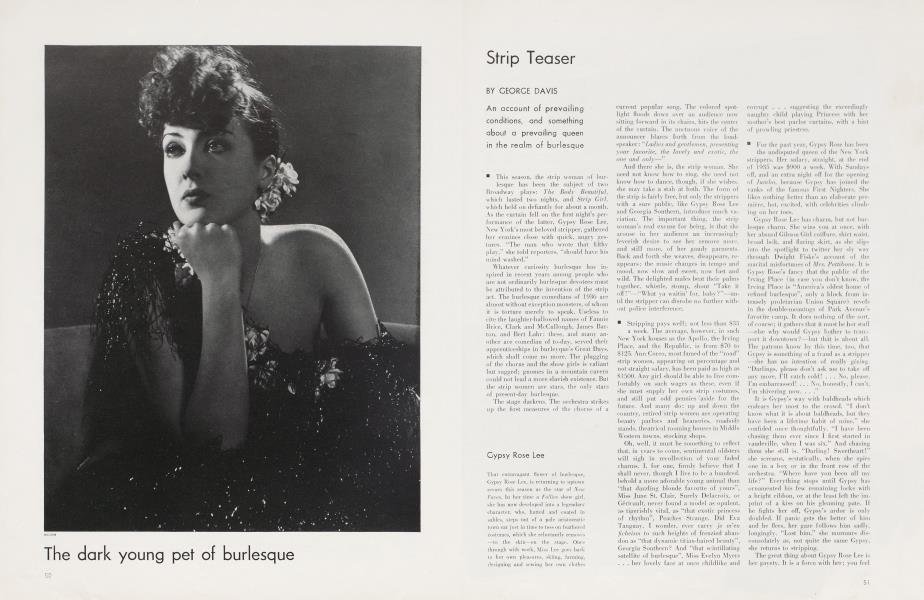
This season, the strip woman of burlesque has been the subject of two Broadway plays: The Body Beautiful, which lasted two nights, and Strip Girl, which held on defiantly for about a month. As the curtain fell on the first night's performance of the latter, Gypsy Rose Lee, New York's most beloved stripper, gathered her ermines close with quick, angry gestures. "The man who wrote that filthy play," she told reporters, "should have his mind washed."
Whatever curiosity burlesque has inspired in recent years among people who are not ordinarily burlesque devotees must be attributed to the invention of the strip act. The burlesque comedians of 1936 are almost without exception monsters, of whom it is torture merely to speak. Useless to cite the laughter-hallowed names of Fannie Brice, Clark and McCullough, James Barton, and Bert Lahr: these, and many another ace comedian of to-day, served their apprenticeships in burleyque's Great Days, which shall come no more. The plugging of the chorus and the show girls is valiant but ragged; gnomes in a mountain cavern could not lead a more slavish existence. But the strip women are stars, the only stars of present-day burlesque.
The stage darkens. The orchestra strikes up the first measures of the chorus of a current popular song. The colored spotlight floods down over an audience now sitting forward in its chairs, hits the center of the curtain. The unctuous voice of the announcer blares forth from the loudspeaker: "Ladies and gentlemen, presenting your favorite, the lovely and exotic, the one and only—"
And there she is, the strip woman. She need not know how to sing, she need not know how to dance, though, if she wishes, she may take a stab at both. The form of the strip is fairly free, but only the strippers with a sure public, like Gypsy Rose Lee and Georgia Southern, introduce much variation. The important thing, the strip woman's real excuse for being, is that she arouse in her audience an increasingly feverish desire to see her remove more, and still more, of her gaudy garments. Back and forth she weaves, disappears, reappears; the music changes in tempo and mood, now slow and sweet, now fast and wild. The delighted males beat their palms together, whistle, stomp, shout "Take it off!"—"What ya waitin' for, baby?"—until the stripper can disrobe no further without police interference.
Stripping pays well; not less than $35 a week. The average, however, in such New York houses as the Apollo, the Irving Place, and the Republic, is from $70 to $125. Ann Coreo, most famed of the "road" strip women, appearing on percentage and not straight salary, has been paid as high as $1500. Any girl should be able to live comfortably on such wages as these, even if she must supply her own strip costumes, and still put odd pennies -'aside for the future. And many do: up and down the country, retired strip women are operating beauty parlors and beaneries, roadside stands, theatrical rooming houses in Middle Western towns, stocking shops.
Oh, well, it must be something to reflect that, in years to come, sentimental oldsters will sigh in recollection of your faded charms. I, for one, firmly believe that I shall never, though I live to be a hundred, behold a more adorable young animal than "that dazzling blonde favorite of yours", Miss June St. Clair. Surely Delacroix, or Gericault, never found a model as opulent, as tigerishly vital, as "that exotic princess of rhythm", Peaches Strange. Did Eva Tanguay, I wonder, ever carry je m'en ficheism to such heights of frenzied abandon as "that dynamic titian-haired beauty", Georgia Southern? And "that scintillating satellite of burlesque", Miss Evelyn Myers . . . her lovely face at once childlike and corrupt . . . suggesting the exceedingly naughty child playing Princess with her mother's best parlor curtains, with a hint of prowling priestess.
For the past year, Gypsy Rose has been the undisputed queen of the New York strippers. Her salary, straight, at the end of 1935 was $900 a week. With Sundays off, and an extra night off for the opening of Jumbo, because Gypsy has joined the ranks of the famous First Nighters. She likes nothing better than an elaborate premiere, hot, excited, with celebrities climbing on her toes.
Gypsy Rose Lee has charm, but not burlesque charm. She wins you at once, with her absurd Gibson Girl coiffure, shirt waist, broad belt, and flaring skirt, as she slips into the spotlight to twitter her sly way through Dwight Fiske's account of the marital misfortunes of Mrs. Pettibone. It is Gypsy Rose's fancy that the public of the Irving Place (in case you don't know, the Irving Place is "America's oldest home of refined burlesque", only a block from intensely proletarian Union Square) revels in the double-meanings of Park Avenue's favorite camp. It does nothing of the sort, of course; it gathers that it must be hot stuff —else why would Gypsy bother to transport it downtown?—but that is about all. The patrons know by this time, too, that Gypsy is something of a fraud as a stripper —she has no intention of really giving. "Darlings, please don't ask me to take off any more, I'll catch cold! . . . No, please, I'm embarrassed! . . . No, honestly, I can't, I'm shivering now. . . ."
It is Gypsy's way with baldheads which endears her most to the crowd. "I don't know what it is about baldheads, but they have been a lifetime habit of mine," she confided once thoughtfully. "I have been chasing them ever since I first started in vaudeville, when I was six." And chasing them she still is. "Darling! Sweetheart!" she screams, ecstatically, when she spies one in a box or in the front row of the orchestra. "Where have you been all my life?" Everything stops until Gypsy has ornamented his few remaining locks with a bright ribbon, or at the least left the imprint of a kiss on his gleaming pate. If he fights her off, Gypsy's ardor is only doubled. If panic gets the better of him and he flees, her gaze follows him sadly, longingly. "Lost him," she murmurs disconsolately as, not quite the same Gypsy, she returns to stripping.
The great thing about Gypsy Rose Lee is her gayety. It is a force with her; you feel that it began in her cradle and will stay with her through a long and exuberant life; that along the way it is destined to hearten thousands and thousands of theatregoers. Among American actresses, I can name only Miss Ina Claire as possessing a sparkle, an honest-to-God joie de vivre, equal to Gypsy's.
One thing is certain: the theatre is the gal's life blood. At six, she was touring in vaudeville in support of her sister, Baby June, then the family's prize package. Often Gypsy was dressed in boy's clothes, and many a stage hand knew her as Baby June's "kid brother". Finally, in 1928, Gypsy had her own act, Rose Louise and her Hollywood Blondes, comedy and dancing. With vaudeville in the doldrums, the act turned to the nightclubs: The Bagdad, in Dallas, Mound's Country Club, in St. Louis—The Gibson House, Cincinnati—The Club Forest, New Orleans—winding up at The Cuban Gardens, in Kansas City. When something Gypsy calls "a political disturbance" closed the doors of this last jernt, the Hollywood Blondes found themselves stranded, until a kind gentleman bobbed up and said, "I know a theatre where you girls can get work." Forthwith he led them there. It was a burlesque house. "Shall we, girls?" asked Rose Louise. "You bet," answered the Hollywood Blondes, in chorus. And they did.
Billy Minsky introduced Gypsy Rose Lee to New York March 28, 1931, at his Republic Theatre on 42nd Street. She remained there twelve weeks, a record for a strip woman. Incidentally, she stayed long enough to be arrested with the rest of the company on an indecency charge; case dismissed. Followed engagements as a show girl in the Follies, Hot-Cha, and George White's Scandals. At the beginning of 1934, Billy Rose engaged her for his Casino de Paree. "But I was getting fed up by this time," says Gypsy Rose. "Who in hell wants to be a white zombie?"
So back she went to burlesque, where she and Mrs. Pettibone's biological twinkle have remained up to now. And now Gypsy Rose is restless again, and she is going to star in New Faces, Leonard Sillman's intimate revue. Meanwhile, she has been dividing her time between town and country. Not long ago, she bought a farm outside Highland Mills, New York, and that is enough in itself to keep her pretty busy. Already she has a flock of three hundred chickens, with the occasional accent of a duck or a turkey. Last Christmas, Gypsy Rose's mother found a pair of fine goats tethered to the Christmas tree as her gift from daughter Gypsy, with love.
In town, Gypsy lives on Irving Place, a block below old Gramercy Park, and a few blocks above the Irving Place Theatre, the scene of Gypsy's greatest triumphs. It is perhaps significant that Gypsy has chosen an apartment house nearer the conservative old park than the rowdy old theatre. She is drawn to the Intellectual Life these days. "Whither," she is apt to query offhand, "the New Negro?" She doesn't always brood over the New Negro in her apartment. Sometimes the talk is more bucolic, a simple exposition of the merits of White Orpingtons over Rhode Island Reds, or perhaps a critical estimate of the new strip number of the Countess Nadja, who used to be merely Ida of Kansas City.
"Gypsy Rose Lee is taller than Katharine Cornell," happily drooled a feature writer in the New York World Telegram. "Her speaking voice is more golden than Gladys Cooper's. She is quicker on the uptake than Beatrice Lillie." Sooner or later, I am confident, the Theatre Guild will claim her. Only, one word of warning to their box-office: "Don't sell any first row seat in the orchestra to a baldheaded man.." Not, that is, unless they want Gypsy Rose to stop Molnar, or Shaw, or Werfel or whomever it might be, with a frantic "Darling! Sweetheart! Where have you been all my life?"
Subscribers have complete access to the archive.
Sign In Not a Subscriber?Join Now
