
Sign In to Your Account
Subscribers have complete access to the archive.
Sign In Not a Subscriber?Join NowMixed Media
Death in the Afternoon in Santa Barbara
JAMES WOLCOTT
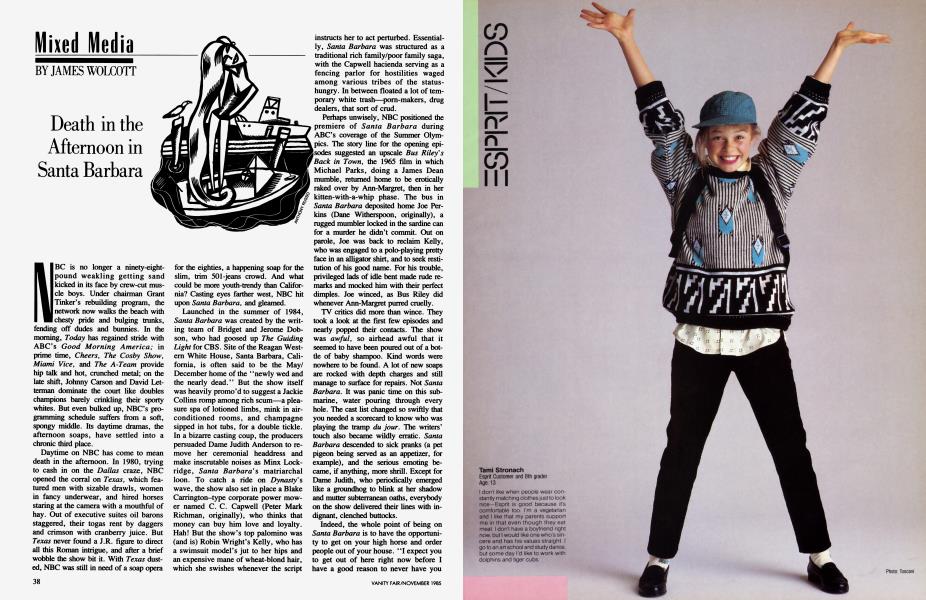
NBC is no longer a ninety-eightpound weakling getting sand kicked in its face by crew-cut muscle boys. Under chairman Grant Tinker's rebuilding program, the network now walks the beach with chesty pride and bulging trunks, fending off dudes and bunnies. In the morning, Today has regained stride with ABC's Good Morning America; in prime time, Cheers, The Cosby Show, Miami Vice, and The A-Team provide hip talk and hot, crunched metal; on the late shift, Johnny Carson and David Letterman dominate the court like doubles champions barely crinkling their sporty whites. But even bulked up, NBC's programming schedule suffers from a soft, spongy middle. Its daytime dramas, the afternoon soaps, have settled into a chronic third place.
Daytime on NBC has come to mean death in the afternoon. In 1980, trying to cash in on the Dallas craze, NBC opened the corral on Texas, which featured men with sizable drawls, women in fancy underwear, and hired horses staring at the camera with a mouthful of hay. Out of executive suites oil barons staggered, their togas rent by daggers and crimson with cranberry juice. But Texas never found a J.R. figure to direct all this Roman intrigue, and after a brief wobble the show bit it. With Texas dusted, NBC was still in need of a soap opera for the eighties, a happening soap for the slim, trim 501-jeans crowd. And what could be more youth-trendy than California? Casting eyes farther west, NBC hit upon Santa Barbara, and gleamed.
Launched in the summer of 1984, Santa Barbara was created by the writing team of Bridget and Jerome Dobson, who had goosed up The Guiding Light for CBS. Site of the Reagan Western White House, Santa Barbara, California, is often said to be the May/ December home of the "newly wed and the nearly dead.'' But the show itself was heavily promo'd to suggest a Jackie Collins romp among rich scum—a pleasure spa of lotioned limbs, mink in airconditioned rooms, and champagne sipped in hot tubs, for a double tickle. In a bizarre casting coup, the producers persuaded Dame Judith Anderson to remove her ceremonial headdress and make inscrutable noises as Minx Lockridge, Santa Barbara's matriarchal loon. To catch a ride on Dynasty's wave, the show also set in place a Blake Carrington-type corporate power mower named C. C. Capwell (Peter Mark Richman, originally), who thinks that money can buy him love and loyalty. Hah! But the show's top palomino was (and is) Robin Wright's Kelly, who has a swimsuit model's jut to her hips and an expensive mane of wheat-blond hair, which she swishes whenever the script instructs her to act perturbed. Essentially, Santa Barbara was structured as a traditional rich family/poor family saga, with the Capwell hacienda serving as a fencing parlor for hostilities waged among various tribes of the statushungry. In between floated a lot of temporary white trash—pom-makers, drug dealers, that sort of crud.
Perhaps unwisely, NBC positioned the premiere of Santa Barbara during ABC's coverage of the Summer Olympics. The story line for the opening episodes suggested an upscale Bus Riley's Back in Town, the 1965 film in which Michael Parks, doing a James Dean mumble, returned home to be erotically raked over by Ann-Margret, then in her kitten-with-a-whip phase. The bus in Santa Barbara deposited home Joe Perkins (Dane Witherspoon, originally), a nigged mumbler locked in the sardine can for a murder he didn't commit. Out on parole, Joe was back to reclaim Kelly, who was engaged to a polo-playing pretty face in an alligator shirt, and to seek restitution of his good name. For his trouble, privileged lads of idle bent made mde remarks and mocked him with their perfect dimples. Joe winced, as Bus Riley did whenever Ann-Margret purred cruelly.
TV critics did more than wince. They took a look at the first few episodes and nearly popped their contacts. The show was awful, so airhead awful that it seemed to have been poured out of a bottle of baby shampoo. Kind words were nowhere to be found. A lot of new soaps are rocked with depth charges and still manage to surface for repairs. Not Santa Barbara. It was panic time on this submarine, water pouring through every hole. The cast list changed so swiftly that you needed a scorecard to know who was playing the tramp du jour. The writers' touch also became wildly erratic. Santa Barbara descended to sick pranks (a pet pigeon being served as an appetizer, for example), and the serious emoting became, if anything, more shrill. Except for Dame Judith, who periodically emerged like a groundhog to blink at her shadow and mutter subterranean oaths, everybody on the show delivered their lines with indignant, clenched buttocks.
Indeed, the whole point of being on Santa Barbara is to have the opportunity to get on your high horse and order people out of your house. "I expect you to get out of here right now before I have a good reason to never have you back in this house!" a Santa Barbara hussy recently shouted, and try saying that with a mouthful of cheese and crackers. Even with Robin Wright's waterfall hair and Dame Judith's snooping through the hedges, you can't construct an entire soap opera around big bullies bossing little bullies out the door. It makes for a lot of foot traffic but not much dramatic give-and-take. But there is another problem with Santa Barbara that is far more bedrock.
The most evocative soaps are those set in mythical towns bordered by fog and rooted in family lore. Pine Valley on All My Children, Bay City on Another World, Port Charles on General Hospital, all are floating islands of intimate bustle based upon the branching of but a few genealogical trees. (On soaps, parents are always tripping over children they never knew they had.) The soap opera is a pocket of stylized turmoil in a parallel world, where desires and motives are worn on the face like war paint and no one suffers from introspection. Set in a real place and measured against real-life expectations, Santa Barbara is too much of this world, and, unlike Dallas, it doesn't present a turbocharged version of its namesake city. It doesn't take advantage of California's beachfront hedonism or kooky fringe elements; it remains in the ordinary indoors, rarely courting the sun. Failing to generate its own mystique, Santa Barbara seems stuck at the hacienda.
Can Santa Barbara survive? NBC stayed with Another World in its thin infancy and eventually saw dividends; but I've been sluttishly watching Santa Barbara for several weeks—it follows Another World, the only soap to which I'm devoted—and to me the show resembles a ghost town where no mail is forwarded and fallen telegraph wires worm into the dust. Mortality whistles in the wind. NBC has also been having trouble with Search for Tomorrow, which in its thirty-fifth year is feeling a bony chill. The peacock network can fan its tail feathers with pride over the accomplishments of the last few seasons. But in daytime the network seems doomed to eat a . heap more sand. Santa Barbara is not the place where green hope springs. □
Subscribers have complete access to the archive.
Sign In Not a Subscriber?Join Now
