


Sign In to Your Account
Subscribers have complete access to the archive.
Sign In Not a Subscriber?Join NowCaravaggio's Corps
EXHIBITION
John McEwen
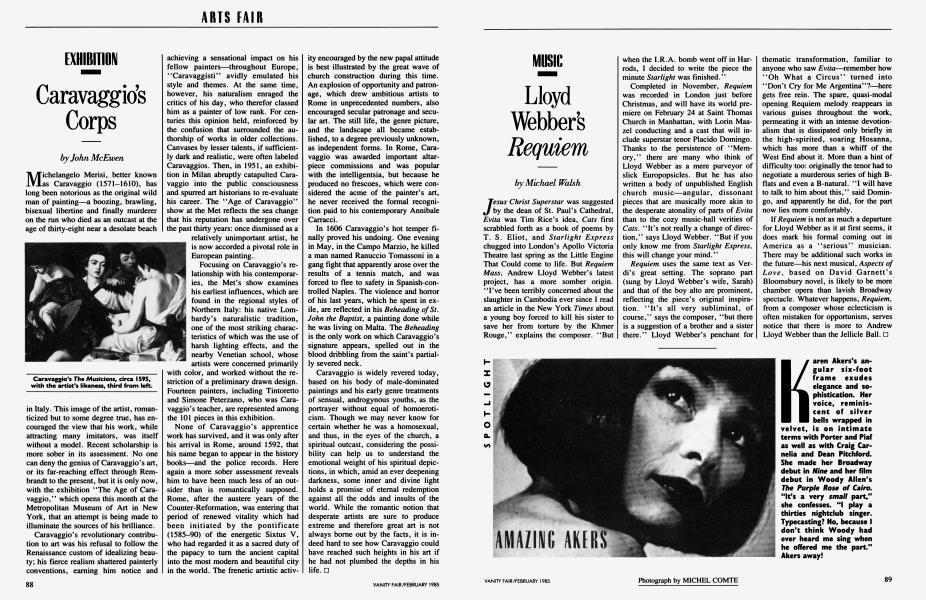
Michelangelo Merisi, better known as Caravaggio (1571-1610), has long been notorious as the original wild man of painting—a boozing, brawling, bisexual libertine and finally murderer on the run who died as an outcast at the age of thirty-eight near a desolate beach in Italy. This image of the artist, romanticized but to some degree true, has encouraged the view that his work, while attracting many imitators, was itself without a model. Recent scholarship is more sober in its assessment. No one can deny the genius of Caravaggio's art, or its far-reaching effect through Rembrandt to the present, but it is only now, with the exhibition "The Age of Caravaggio,'' which opens this month at the Metropolitan Museum of Art in New York, that an attempt is being made to illuminate the sources of his brilliance.
Caravaggio's revolutionary contribution to art was his refusal to follow the Renaissance custom of idealizing beauty; his fierce realism shattered painterly conventions, earning him notice and achieving a sensational impact on his fellow painters—throughout Europe, "Caravaggisti" avidly emulated his style and themes. At the same time, however, his naturalism enraged the critics of his day, who therefor classed him as a painter of low rank. For centuries this opinion held, reinforced by the confusion that surrounded the authorship of works in older collections. Canvases by lesser talents, if sufficiently dark and realistic, were often labeled Caravaggios. Then, in 1951, an exhibition in Milan abruptly catapulted Caravaggio into the public consciousness and spurred art historians to re-evaluate his career. The "Age of Caravaggio" show at the Met reflects the sea change that his reputation has undergone over the past thirty years: once dismissed as a relatively unimportant artist, he is now accorded a pivotal role in European painting.
Focusing on Caravaggio's relationship with his contemporaries, the Met's show examines his earliest influences, which are found in the regional styles of Northern Italy: his native Lombardy's naturalistic tradition, one of the most striking characteristics of which was the use of harsh lighting effects, and the nearby Venetian school, whose artists were concerned primarily with color, and worked without the restriction of a preliminary drawn design. Fourteen painters, including Tintoretto and Simone Peterzano, who was Caravaggio's teacher, are represented among the 101 pieces in this exhibition.
None of Caravaggio's apprentice work has survived, and it was only after his arrival in Rome, around 1592, that his name began to appear in the history books—and the police records. Here again a more sober assessment reveals him to have been much less of an outsider than is romantically supposed. Rome, after the austere years of the Counter-Reformation, was entering that period of renewed vitality which had been initiated by the pontificate (1585-90) of the energetic Sixtus V, who had regarded it as a sacred duty of the papacy to turn the ancient capital into the most modem and beautiful city in the world. The frenetic artistic activity encouraged by the new papal attitude is best illustrated by the great wave of church construction during this time. An explosion of opportunity and patronage, which drew ambitious artists to Rome in unprecedented numbers, also encouraged secular patronage and secular art. The still life, the genre picture, and the landscape all became established, to a degree previously unknown, as independent forms. In Rome, Caravaggio was awarded important altarpiece commissions and was popular with the intelligentsia, but because he produced no frescoes, which were considered the acme of the painter's art, he never received the formal recognition paid to his contemporary Annibale Carracci.
In 1606 Caravaggio's hot temper finally proved his undoing. One evening in May, in the Campo Marzio, he killed a man named Ranuccio Tomassoni in a gang fight that apparently arose over the results of a tennis match, and was forced to flee to safety in Spanish-controlled Naples. The violence and horror of his last years, which he spent in exile, are reflected in his Beheading of St. John the Baptist, a painting done while he was living on Malta. The Beheading is the only work on which Caravaggio's signature appears, spelled out in the blood dribbling from the saint's partially severed neck.
Caravaggio is widely revered today, based on his body of male-dominated paintings and his early genre treatments of sensual, androgynous youths, as the portrayer without equal of homoeroticism. Though we may never know for certain whether he was a homosexual, and thus, in the eyes of the church, a spiritual outcast, considering the possibility can help us to understand the emotional weight of his spiritual depictions, in which, amid an ever deepening darkness, some inner and divine light holds a promise of eternal redemption against all the odds and insults of the world. While the romantic notion that desperate artists are sure to produce extreme and therefore great art is not always borne out by the facts, it is indeed hard to see how Caravaggio could have reached such heights in his art if he had not plumbed the depths in his life.
Subscribers have complete access to the archive.
Sign In Not a Subscriber?Join Now