


Sign In to Your Account
Subscribers have complete access to the archive.
Sign In Not a Subscriber?Join NowDance Class
The collected criticism of Edwin Denby
BOOKS
ARTS FAIR
Mona Simpson's first novel is about dreams that never happen.
JAMES ATLAS
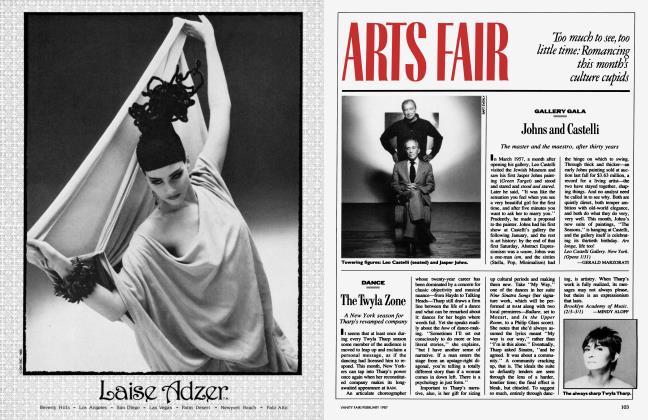
Edwin Denby (1903-83), whose writing on dance has guided the sensibilities of more leading American artists and intellectuals than any critic now alive, was a modest and gentle New Yorker who lived in the same Chelsea walk-up for half a century. His constant companions were some cats, a swath of naked space, and the English language. He would, however, leave his thinking studio often: to walk through the city for the pleasure of perceiving it, to visit friends (a list would comprise the flowering of Manhattan culture), and, night after night into his eightieth year, to attend performances of theatrical dancing, especially the ballets of George Balanchine.
His alchemical essays and reviews have long been out of print. Now, in Dance Writings (Knopf), Denby's vintage work is republished, and other work is published for the first time. The action he witnessed lives on here—quick, agile, slightly startling, and exquisitely motivated by images often just visible in the classic prose, the way the composed face of a Japanese actress betrays, in its minute disturbances, profound emotion. To find Denby's enchantment quickly, go to the second paragraph of "Nijinska's Noces" (1936), his first review, which opens, "Noces is noble, it is fierce, it is simple, it is fresh, it is thrilling. It is full of interest." But to know why he's incomparable, invest a quarter-hour with "Forms in Motion and in Thought" (1965), which starts (and how quietly for something that forever changes the mind), "In dancing one keeps taking a step and recovering one's balance."
MINDY ALOFF
Subscribers have complete access to the archive.
Sign In Not a Subscriber?Join Now