

Sign In to Your Account
Subscribers have complete access to the archive.
Sign In Not a Subscriber?Join NowPee-wee Herman is a dream projection of pixie strength, the cuckoo in his own clock
Pee-wee Herman is a dream projection of pixie strength, the cuckoo in his own clock
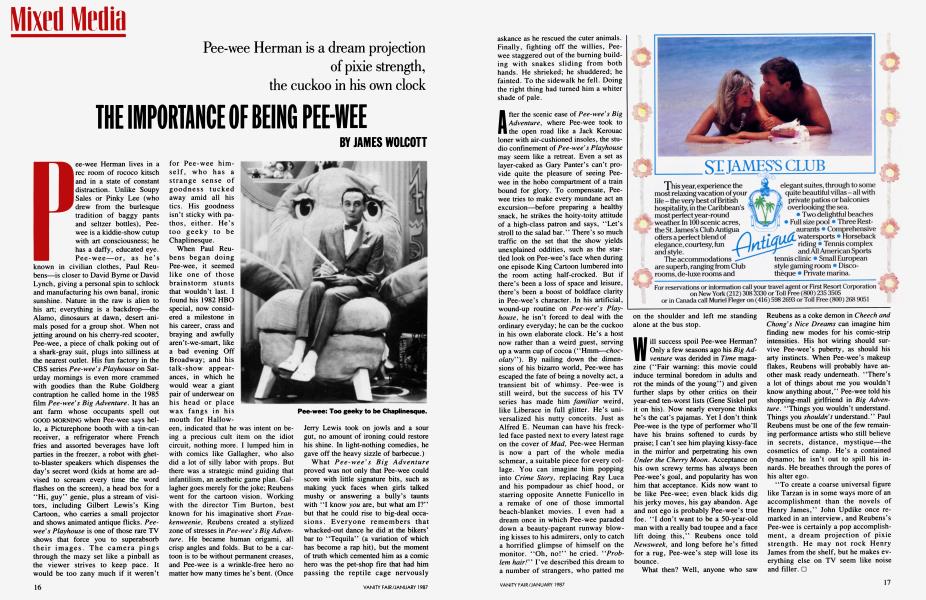
Pee-wee Herman lives in a rec room of rococo kitsch and in a state of constant distraction. Unlike Soupy Sales or Pinky Lee (who drew from the burlesque tradition of baggy pants and seltzer bottles), Peewee is a kiddie-show cutup with art consciousness; he has a daffy, educated eye. Pee-wee—or, as he's known in civilian clothes, Paul Reubens—is closer to David Byrne or David Lynch, giving a personal spin to schlock and manufacturing his own banal, ironic sunshine. Nature in the raw is alien to his art; everything is a backdrop—the Alamo, dinosaurs at dawn, desert animals posed for a group shot. When not jetting around on his cherry-red scooter, Pee-wee, a piece of chalk poking out of a shark-gray suit, plugs into silliness at the nearest outlet. His fun factory in the CBS series Pee-wee's Playhouse on Saturday mornings is even more crammed with goodies than the Rube Goldberg contraption he called home in the 1985 film Pee-wee's Big Adventure. It has an ant farm whose occupants spell out GOOD MORNING when Pee-wee says hello, a Picturephone booth with a tin-can receiver, a refrigerator where French fries and assorted beverages have loft parties in the freezer, a robot with ghetto-blaster speakers which dispenses the day's secret word (kids at home are advised to scream every time the word flashes on the screen), a head box for a "Hi, guy" genie, plus a stream of visitors, including Gilbert Lewis's King Cartoon, who carries a small projector and shows animated antique flicks. Peewee's Playhouse is one of those rare TV shows that force you to superabsorb their images. The camera pings through the mazy set like a pinball as the viewer strives to keep pace. It would be too zany much if it weren't for Pee-wee himself, who has a strange sense of goodness tucked away amid all his tics. His goodness isn't sticky with pathos, either. He's too geeky to be Chaplinesque.
When Paul Reubens began doing Pee-wee, it seemed like one of those brainstorm stunts that wouldn't last. I found his 1982 HBO special, now considered a milestone in his career, crass and braying and awfully aren't-we-smart, like a bad evening Off Broadway; and his talk-show appearances, in which he would wear a giant pair of underwear on his head or place wax fangs in his mouth for Halloween, indicated that he was intent on being a precious cult item on the idiot circuit, nothing more. I lumped him in with comics like Gallagher, who also did a lot of silly labor with props. But there was a strategic mind guiding that infantilism, an aesthetic game plan. Gallagher goes merely for the joke; Reubens went for the cartoon vision. Working with the director Tim Burton, best known for his imaginative short Frankenweenie, Reubens created a stylized zone of stresses in Pee-wee's Big Adventure. He became human origami, all crisp angles and folds. But to be a cartoon is to be without permanent creases, and Pee-wee is a wrinkle-free hero no matter how many times he's bent. (Once Jerry Lewis took on jowls and a sour gut, no amount of ironing could restore his shine. In light-nothing comedies, he gave off the heavy sizzle of barbecue.)
What Pee-wee's Big Adventure proved was not only that Pee-wee could score with little signature bits, such as making yuck faces when girls talked mushy or answering a bully's taunts with "I know you are, but what am I?" but that he could rise to big-deal occasions. Everyone remembers that whacked-out dance he did at the bikers' bar to "Tequila" (a variation of which has become a rap hit), but the moment of truth which cemented him as a comic hero was the pet-shop fire that had him passing the reptile cage nervously askance as he rescued the cuter animals. Finally, fighting off the willies, Peewee staggered out of the burning building with snakes sliding from both hands. He shrieked; he shuddered; he fainted. To the sidewalk he fell. Doing the right thing had turned him a whiter shade of pale.
After the scenic ease of Pee-wee's Big Adventure, where Pee-wee took to the open road like a Jack Kerouac loner with air-cushioned insoles, the studio confinement of Pee-wee's Playhouse may seem like a retreat. Even a set as layer-caked as Gary Panter's can't provide quite the pleasure of seeing Peewee in the hobo compartment of a train bound for glory. To compensate, Peewee tries to make every mundane act an excursion—before preparing a healthy snack, he strikes the hoity-toity attitude of a high-class patron and says, "Let's stroll to the salad bar." There's so much traffic on the set that the show yields unexplained oddities, such as the startled look on Pee-wee's face when during one episode King Cartoon lumbered into the room acting half-crocked. But if there's been a loss of space and leisure, there's been a boost of boldface clarity in Pee-wee's character. In his artificial, wound-up routine on Pee-wee's Playhouse, he isn't forced to deal with the ordinary everyday; he can be the cuckoo in his own elaborate clock. He's a host now rather than a weird guest, serving up a warm cup of cocoa ("Hmm—chocolaty"). By nailing down the dimensions of his bizarro world, Pee-wee has escaped the fate of being a novelty act, a transient bit of whimsy. Pee-wee is still weird, but the success of his TV series has made him familiar weird, like Liberace in full glitter. He's universalized his nutty conceits. Just as Alfred E. Neuman can have his freckled face pasted next to every latest rage on the cover of Mad, Pee-wee Herman is now a part of the whole media schmear, a suitable piece for every collage. You can imagine him popping into Crime Story, replacing Ray Luca and his pompadour as chief hood, or starring opposite Annette Funicello in a remake of one of those immortal beach-blanket movies. I even had a dream once in which Pee-wee paraded down a beauty-pageant runway blowing kisses to his admirers, only to catch a horrified glimpse of himself on the monitor. "Oh, no!" he cried. "Problem hair!" I've described this dream to a number of strangers, who patted me on the shoulder and left me standing alone at the bus stop.
Will success spoil Pee-wee Herman? Only a few seasons ago his Big Adventure was derided in Time magazine ("Fair warning: this movie could induce terminal boredom in adults and rot the minds of the young") and given further slaps by other critics on their year-end ten-worst lists (Gene Siskel put it on his). Now nearly everyone thinks he's the cat's pajamas. Yet I don't think Pee-wee is the type of performer who'll have his brains softened to curds by praise; I can't see him playing kissy-face in the mirror and perpetrating his own Under the Cherry Moon. Acceptance on his own screwy terms has always been Pee-wee's goal, and popularity has won him that acceptance. Kids now want to be like Pee-wee; even black kids dig his jerky moves, his gay abandon. Age and not ego is probably Pee-wee's true foe. "I don't want to be a 50-year-old man with a really bad toupee and a face lift doing this," Reubens once told Newsweek, and long before he's fitted for a rug, Pee-wee's step will lose its bounce.
What then? Well, anyone who saw Reubens as a coke demon in Cheech and Chong's Nice Dreams can imagine him finding new modes for his comic-strip intensities. His hot wiring should survive Pee-wee's puberty, as should his arty instincts. When Pee-wee's makeup flakes, Reubens will probably have another mask ready underneath. "There's a lot of things about me you wouldn't know anything about," Pee-wee told his shopping-mall girlfriend in Big Adventure. "Things you wouldn't understand. Things you shouldn't understand." Paul Reubens must be one of the few remaining performance artists who still believe in secrets, distance, mystique—the cosmetics of camp. He's a contained dynamo; he isn't out to spill his innards. He breathes through the pores of his alter ego.
"To create a coarse universal figure like Tarzan is in some ways more of an accomplishment than the novels of Henry James," John Updike once remarked in an interview, and Reubens's Pee-wee is certainly a pop accomplishment, a dream projection of pixie strength. He may not rock Henry James from the shelf, but he makes everything else on TV seem like noise and filler.
Subscribers have complete access to the archive.
Sign In Not a Subscriber?Join Now
