
Sign In to Your Account
Subscribers have complete access to the archive.
Sign In Not a Subscriber?Join NowMANN AT HIS BEST
"Michael Mann has too few tricks in his repertoire to keep ripping himself off "
JAMES WOLCOTT
Mixed Media
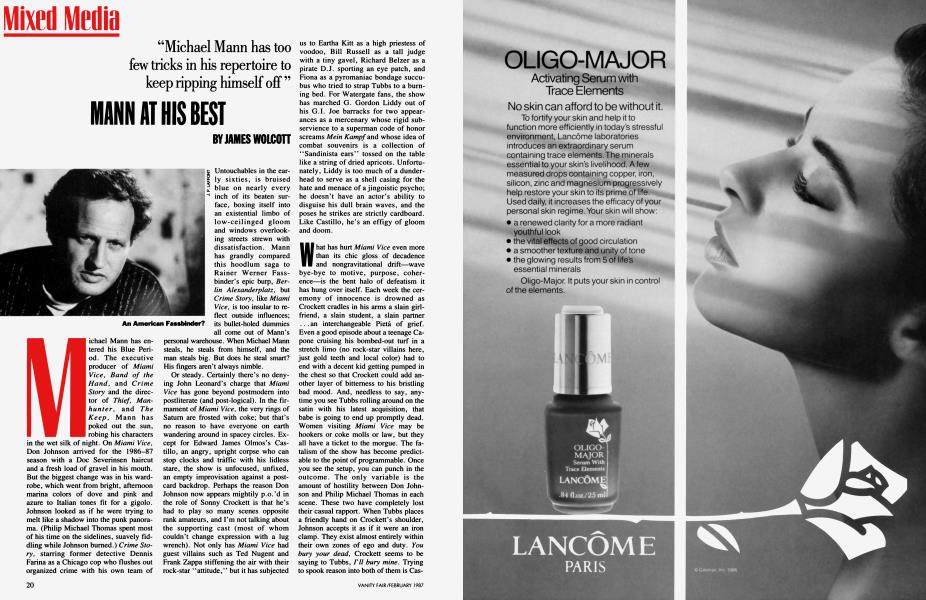
Michael Mann has entered his Blue Period. The executive producer of Miami Vice, Band of the Hand, and Crime Story and the director of Thief, Manhunter, and The Keep, Mann has poked out the sun, robing his characters in the wet silk of night. On Miami Vice, Don Johnson arrived for the 1986-87 season with a Doc Severinsen haircut and a fresh load of gravel in his mouth. But the biggest change was in his wardrobe, which went from bright, afternoon marina colors of dove and pink and azure to Italian tones fit for a gigolo. Johnson looked as if he were trying to melt like a shadow into the punk panorama. (Philip Michael Thomas spent most of his time on the sidelines, suavely fiddling while Johnson burned.) Crime Story, starring former detective Dennis Farina as a Chicago cop who flushes out organized crime with his own team of Untouchables in the early sixties, is bruised blue on nearly every inch of its beaten surface, boxing itself into an existential limbo of low-ceilinged gloom and windows overlooking streets strewn with dissatisfaction. Mann has grandly compared this hoodlum saga to Rainer Werner Fassbinder's epic burp, Berlin Alexanderplatz, but Crime Story, like Miami Vice, is too insular to reflect outside influences; its bullet-holed dummies all come out of Mann's personal warehouse. When Michael Mann steals, he steals from himself, and the man steals big. But does he steal smart? His fingers aren't always nimble.
Or steady. Certainly there's no denying John Leonard's charge that Miami Vice has gone beyond postmodern into postliterate (and post-logical). In the firmament of Miami Vice, the very rings of Saturn are frosted with coke; but that's no reason to have everyone on earth wandering around in spacey circles. Except for Edward James Olmos's Castillo, an angry, upright corpse who can stop clocks and traffic with his lidless stare, the show is unfocused, unfixed, an empty improvisation against a postcard backdrop. Perhaps the reason Don Johnson now appears mightily p.o.'d in the role of Sonny Crockett is that he's had to play so many scenes opposite rank amateurs, and I'm not talking about the supporting cast (most of whom couldn't change expression with a lug wrench). Not only has Miami Vice had guest villains such as Ted Nugent and Frank Zappa stiffening the air with their rock-star "attitude," but it has subjected us to Eartha Kitt as a high priestess of voodoo, Bill Russell as a tall judge with a tiny gavel, Richard Belzer as a pirate D.J. sporting an eye patch, and Fiona as a pyromaniac bondage succubus who tried to strap Tubbs to a burning bed. For Watergate fans, the show has marched G. Gordon Liddy out of his G.I. Joe barracks for two appearances as a mercenary whose rigid subservience to a superman code of honor screams Mein Kampf and whose idea of combat souvenirs is a collection of "Sandinista ears" tossed on the table like a string of dried apricots. Unfortunately, Liddy is too much of a dunderhead to serve as a shell casing for the hate and menace of a jingoistic psycho; he doesn't have an actor's ability to disguise his dull brain waves, and the poses he strikes are strictly cardboard. Like Castillo, he's an effigy of gloom and doom.
What has hurt Miami Vice even more than its chic gloss of decadence and nongravitational drift—wave bye-bye to motive, purpose, coherence—is the bent halo of defeatism it has hung over itself. Each week the ceremony of innocence is drowned as Crockett cradles in his arms a slain girlfriend, a slain student, a slain partner ... an interchangeable Pieta of grief. Even a good episode about a teenage Capone cruising his bombed-out turf in a stretch limo (no rock-star villains here, just gold teeth and local color) had to end with a decent kid getting pumped in the chest so that Crockett could add another layer of bitterness to his bristling bad mood. And, needless to say, anytime you see Tubbs rolling around on the satin with his latest acquisition, that babe is going to end up promptly dead. Women visiting Miami Vice may be hookers or coke molls or law, but they all have a ticket to the morgue. The fatalism of the show has become predictable to the point of programmable. Once you see the setup, you can punch in the outcome. The only variable is the amount of hostility between Don Johnson and Philip Michael Thomas in each scene. These two have completely lost their casual rapport. When Tubbs places a friendly hand on Crockett's shoulder, Johnson accepts it as if it were an iron clamp. They exist almost entirely within their own zones of ego and duty. You bury your dead, Crockett seems to be saying to Tubbs, I'll bury mine. Trying to spook reason into both of them is Castillo, wearing his witch-doctor mask. Too late, too late!
Crime Story, by comparison, was born in the doldrums, beneath a dim bulb. Crime Story was renewed by NBC for a full season early in its run, a remarkable act of faith considering:
(a)the series was getting creamed in the ratings by ABC's Moonlighting; (b)the price tag for each episode was a hefty $1 million plus; (c)two earlier, Godfather-like sagas, The Gangster Chronicles and Our Family Honor, had swiftly bit the pavement, indicating that there is a limited amount of leisure time TV audiences want to spend in the ratty womb of crime; and (d)the show hadn't even stimulated the cult buzz upon which a mass hit could be built (the yuppie vote went to L.A. Law). Just as Steven Bochco was indulged with Bay City Blues after the success of Hill Street Blues (an indulgence which led to L.A. Law), Michael Mann was being indulged with Crime Story after the success of Miami Vice, some suggested. I happened to see a big-screen sneak of Crime Story's two-hour premiere in Los Angeles, introduced by NBC's president of entertainment, Brandon Tartikoff, and the biggest cheer of the evening went up during the opening credits when the cast struck a united front under the show's logo, looking less like a crimefighting team than the Justice League of America. But Crime Story, unlike The Untouchables, wasn't conceived in comic-strip panels. It had art pretensions. "Looks like a Jackson Pollock," said Dennis Farina's Lieutenant Mike Torello, commenting on a blood-splattered corpse. In Crime Story, slaughter adds a certain zest to the d6cor.
Since its launch, Crime Story has settled down into a contest between conspicuous hairdos. Farina, who had a brownish-gray mop of curls as a cop in the movie Manhunter, braves the rain here with his hair wearing a fresh coat of boot black (and in a Michael Mann drama, there's always precipitation—it goes with the film noir territory). As a swingman in Chicago's Major Crime Unit, Torello has sworn war on Ray
Luca (Anthony Denison), a surly hood with a fabulous pompadour. Like Manhunter, in which an F.B.I. agent tried to track down a serial killer by entering his thought processes, Crime Story is essentially a psych job—a slow, teasing mind probe between hunter and prey that climaxes in canvas-size explosions of Pollock splatter. Unfortunately, the weak foreplay seldom justifies all that violent discharge. A former flatfoot himself, Farina provided solid backup to the star of Manhunter, William Petersen, but he doesn't have enough bottled presence as an actor to front a show himself—he's all gruff, pocked surface and verisimilitude. As Luca, Denison is more pressurized and yet more remote; his emotions are so contained they are leakproof. Around the periphery of these two brainmasters, faceless subordinates mill about in bulky coats, mumbling something about tryin' to git some sleep. As Torello's neglected, dejected wife, Darlanne Fluegel—sensational in small parts in Once upon a Time in America and To Live and Die in L.A., her sleek curves carved from an ivory tusk—has been reduced to a domestic drag on the action, a complaining voice on the telephone. It's no fun being nagged after a hard day roughing up suspects down in the interrogation room... hassling scum is Man's Work. (Fed up with her sorehead husband, Fluegel's character eventually hit the bricks.) Crime Story is loaded with period detail—Flintstone furniture, thick applications of pomade, boomerang-shaped neon bar signs, Fluegel playing hostess in hip-huggers—but mostly it just brings out its dead.
One would be tempted to dump Michael Mann's entire career down the laundry chute if it weren't for Manhunter. Thief—showy but sham; The Keep—mumbo jumbo in an allegorical castle; Band of the Hand—blood oaths and greasy-kid's-stuff heroics; Miami Vice—one good season, then pffft; Crime Story. . . No, all this sound and fury doesn't tote up to much. But Manhunter, which came and went in the summer of 1986 with barely a stir, had real excitement and eerie, furtive pockets of compassion. Based on a novel called Red Dragon, Manhunter enabled Mann to work off of a solid plane of
high-tech police procedure (computer scans, laser analysis) and saturate the screen in night-blooming atmosphere without going completely gaga; the original material helped anchor his Mannerisms. A gruesome story involving filed false teeth and visions of William Blake, the movie has horrific images—a flaming wheelchair racing down an underground-garage ramp being the most spectacular—and the final shoot-out is a dazzling spray of glass splinters. What make the movie memorable, however, are the quiet, almost tender interludes in the killer's lair (the role of the killer was haunted by Tom Noonan, a pale wraith with a scarred lip), reminiscent of those moments in the Frankenstein films when mercy was shown to the monster. Even with its MTV montages and excessive flash, Manhunter demonstrated that Mann could enter a hypnotic mode once he got out of his own way. Too bad he's become a big cheese basking in his own brilliance. If he were merely a hired hand, a hack in a hurry, he might be able to hone his style so close to the knuckle that his movies would take on the muscular perversion of the best fifties B films. Compared with Phil Karlson or Don Siegel, Fassbinder is a pretty flabby influence. Berlin Alexanderplatz sits heavy on a soft head.
A hack at least steals from himself economically in order to get on with the story. When a director who fancies himself an artist steals from himself, the effect tends to be far more pompous and grand (witness Fellini). There have already been episodes of both Crime Story and Miami Vice recycling elements of Manhunter. Miami Vice was the more blatant, as Crockett submerged himself in mania in order to mirror the movements of a deeply antisocial sickie. (FBI PURSUES PERVERT was a tabloid headline in Manhunter, and in a TV Guide ad for Miami Vice, Tubbs was depicted asking Crockett, "What makes you think you can get inside the mind of a pervert?") Since I admire Manhunter, I hate to see Mann scavenging it for spare parts. As a producer-director, Michael Mann has too few tricks in his repertoire to keep ripping himself off. Before long he's not going to have anything left to rip. His Blue Period is dangerously close to bleak abstraction.
Subscribers have complete access to the archive.
Sign In Not a Subscriber?Join Now

