

Sign In to Your Account
Subscribers have complete access to the archive.
Sign In Not a Subscriber?Join NowMY OSCARS
Movies
It's that time again. V.F.'s critic hauls out his tray of trophies
STEPHEN SCHIFF
People say that 1987 was the year the knell finally tolled for Yuppie Nation. And whether or not that's true— frankly, I don't see all those coffee achievers burning their suspenders and forswearing arugula—the year's films certainly reflected yuppie terror. Long before Black Monday, the big screen was telling us the jig was up; the bill had come due, and there was hell to pay. At the movies, money turned poisonous, and sex was downright lethal. If you wanted to survive, you slept with an android, as Ann Magnuson did in Making Mr. Right, or, better yet, with a shopwindow dummy, as Andrew McCarthy did in Mannequin. Carnal knowledge was so scary that even that snuggly haven the family was better off without it. In Raising Arizona, Baby Boom, and the monstrously successful Three Men and a Baby, children dropped into people's lives from out of the blue, as if the stork really were behind it all—as if the only safe form of parenting were immaculate conception.
In fact, safety first was what 1987's pictures consistently counseled: retreat, caution—couch-potato-hood. Which made for the dullest year at the movies in recent memory. My ten favorite 1987 films were all terribly flawed, all movies that in a decent year could never have ranked so high. A number of them may even find favor with the Academy— proof positive that the pickings were slim. In the end, I found myself giving points to anything with a sense of exuberance and adventure, a willingness to break out of tater consciousness and navigate other worlds. In order of preference:
1. THE LAST EMPEROR. As a piece of storytelling, Bernardo Bertolucci's biography of China's child emperor is a bit of a mess. But its real power lies beneath the story line, in the symbols and patterns that filigree the movie's larger spectacle. The Last Emperor isn't quite a great film, but it's a stunning one—a historical epic with real sensuality and real cinematic bravado.
2. MOONSTRUCK. Norman Jewison's best film is a rarity in this skittish year— it urges its audience to take risks, run wild, fall in love. Jewison and his talented screenwriter, John Patrick Shanley, imagine a New York populated entirely by Italians (and Italian passions). The movie has the sort of extravagant romantic tone we remember from the great thirties comedies—a tone almost impossible to sustain in a more ironic age.
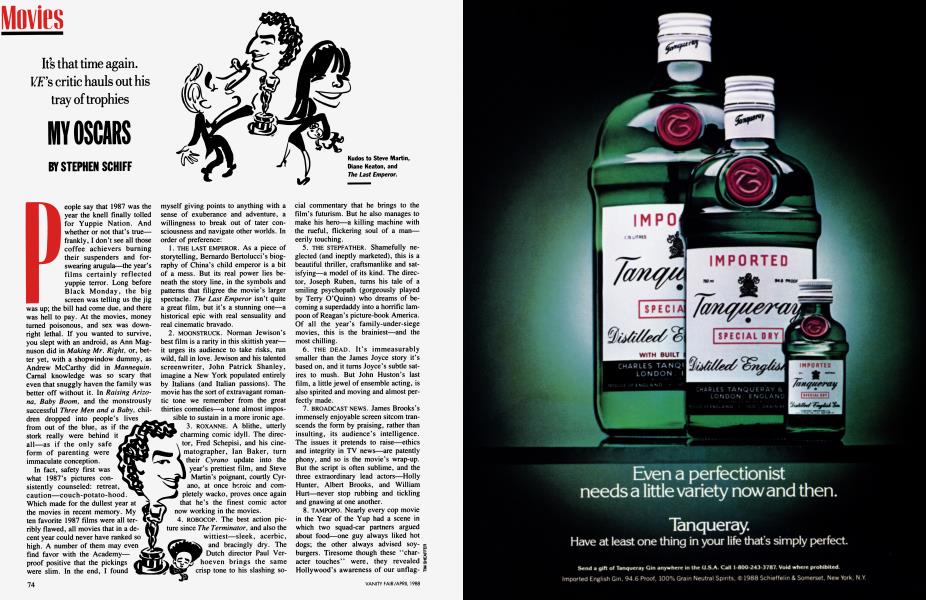
3. ROXANNE. A blithe, utterly charming comic idyll. The director, Fred Schepisi, and his cinematographer, Ian Baker, turn their Cyrano update into the year's prettiest film, and Steve Martin's poignant, courtly Cyrano, at once heroic and completely wacko, proves once again that he's the finest comic actor now working in the movies.
4. ROBOCOP. The best action picture since The Terminator, and also the wittiest—sleek, acerbic, and bracingly dry. The Dutch director Paul Verhoeven brings the same crisp tone to his slashing social commentary that he brings to the film's futurism. But he also manages to make his hero—a killing machine with the rueful, flickering soul of a man— eerily touching.
5. THE STEPFATHER. Shamefully neglected (and ineptly marketed), this is a beautiful thriller, craftsmanlike and satisfying—a model of its kind. The director, Joseph Ruben, turns his tale of a smiling psychopath (gorgeously played by Terry O'Quinn) who dreams of becoming a superdaddy into a horrific lampoon of Reagan's picture-book America. Of all the year's family-under-siege movies, this is the brainiest—and the most chilling.
6. THE DEAD. It's immeasurably smaller than the James Joyce story it's based on, and it turns Joyce's subtle satires to mush. But John Huston's last film, a little jewel of ensemble acting, is also spirited and moving and almost perfectly made.
7. BROADCAST NEWS. James Brooks's immensely enjoyable screen sitcom transcends the form by praising, rather than insulting, its audience's intelligence. The issues it pretends to raise—ethics and integrity in TV news—are patently phony, and so is the movie's wrap-up. But the script is often sublime, and the three extraordinary lead actors—Holly Hunter, Albert Brooks, and William Hurt—never stop rubbing and tickling and gnawing at one another.
8. TAMPOPO. Nearly every cop movie in the Year of the Yup had a scene in which two squad-car partners argued about food—one guy always liked hot dogs; the other always advised soyburgers. Tiresome though these "character touches'' were, they revealed Hollywood's awareness of our unflagging fascination with eating; you'd think one of the studios would finally make a movie foodies could love. Instead, hungry yups had to buy Japanese—and Juzo Itami's sly comedy suggested that eating well is the best revenge. Tampopo combines a passion for noodles with a deadpan spoof of The Seven Samurai, and the result is a delirious, scattershot comedy that, by poking fun at the importance of food, winds up confirming it.
9. TIN MEN. The writer-director Barry Levinson returns to Baltimore, the scene of his great comedy, Diner, and though his middle-aged aluminum-siding salesmen aren't quite as scintillating as Diner's deadbeat Peter Pans, their con jobs and sleazoid joshing have enough zing to keep a dozen movies bouncing.
10. HOPE AND GLORY. John Boorman's exuberant, cockeyed memoir of a London boyhood during the blitz. Its final third, when we are whisked off to the river habitat of Boorman's ostensibly entertaining grandfather, drove me up the wall; until then, it's a dream of a movie—vivid, fresh, and very funny.
Stephen Schiff s Nominations
► Best Actor
1. Steve Martin, ROXANNE
2. Gary Oldman, PRICK UP YOUR EARS
3. Albert Brooks, BROADCAST NEWS
4. Dennis Quaid, THE BIG EASY
5. Mickey Rourke, BARFLY
► Best Supporting Actor
1. Morgan Freeman, STREET SMART
2. Denzel Washington, CRY FREEDOM
3. Robert De Niro, THE UNTOUCHABLES
4. Robert Downey Jr., LESS THAN ZERO
5. William Forsythe, RAISING ARIZONA and WEEDS
► Best Actress
1. Diane Keaton, BABY BOOM
2. Holly Hunter, BROADCAST NEWS and RAISING ARIZONA
3. Emily Lloyd, WISH YOU WERE HERE
4. Carmen Maura, LAW OF DESIRE
5. Cher, MOONSTRUCK
► Best Supporting Actress
1. Kathy Baker, STREET SMART
2. Vanessa Redgrave, PRICK UP YOUR EARS
3. Margaret Whitton, THE SECRET OF MY SUCCESS
4. Marthe Keller, DARK EYES
5. Marie Kean, THE DEAD
Of course, there were other likable films this year, among them Raising Arizona, Prick Up Your Ears, The Untouchables, No Way Out, My Life as a Dog, and Wish You Were Here. But in 1987, as in much better years, the bad movies far outnumbered the good. I admit to a certain vengeful pleasure in devising a "worst" list, which is why I don't like to devote it to the obvious lulus. Turkeys like Ishtar and Who's That Girl and The Sicilian (not to mention the ineffable Surf Nazis Must Die) were hooted off the screen almost before they got on it—at this late date, they're more to be pitied than stomped on. No, the movies that really got my dander up were those whose pretensions or glitz or sheer muscle managed to fool a lot of the people a lot of the time. Five that did:
1. FATAL ATTRACTION. Vile—and also badly made. Fans will tell you it was a hit (the second biggest of 1987, after Beverly Hills Cop II) because everyone has had an Alex in his or her life, or because it reflected the qualms and quirks of the post-feminist eighties. I have another theory: I think people went gaga for this movie because it was so much less than what they had expected. Look at it this way. From the moment Glenn Close slashes her wrists and goes bonkers, she's a certifiable movie monster, a female Freddy in a posh Nightmare on Elm Street. Now, from movie monsters we expect mayhem, but Close's Alex refuses to deliver. First she buys some acid, and before our horrified eyes she pours it on. . .the car? She turns vicious, homicidal, and before our horrified eyes she murders .. .a rabbit? Now she's kidnapped the little girl, and before our horrified eyes she. .. brings her home? After a nice trip to the amusement park? By the time Close, dagger in hand, confronts the absurdly idealized wifey, Anne Archer, in the family bathroom, the audience is screaming for blood, and when the blood is finally delivered, the relief, so long delayed, feels nearly orgasmic. In Fatal Attraction, it's the waiting that gets you.
2. BEVERLY HILLS COP II. From Chaplin and Keaton to Richard Pryor and Woody Allen, the great movie comedians have based their appeal on being more vulnerable than we are. But Eddie Murphy is a new kind of comedy star. He's invulnerable—godlike, preening, and passionately in love with himself. During most of Beverly Hills Cop II we're asked to applaud his skill at insulting secretaries, bureaucrats, and assorted construction workers—ordinary people doing their jobs—and to admire how much cleverer he is than the audiences that come to worship him. Murphy has become a kind of comic demagogue, and Beverly Hills Cop II is his bully pulpit.
3. THREE MEN AND A BABY. Excruciating—and the third-biggest hit released in 1987. Steamrolling through the Christmas season, Three Men and a Baby summed up the year's on-screen baby boom. Just look at the hilariously huge, chic, overdecorated apartment its three cloying bachelors live in. What a great place to party, dude. What a great place to bring women and show off your stereo and your CD and your video equipment and your remote controls and your cordless phones and your computer and—your baby. And there's the rub. In the baby-boom movies a child becomes just another digital, stereophonic, yuppie gadget. The little gizmo may be hard to figure out at first, but, hey, that's why Dr. Spock wrote the owner's manual. And once you learn how to operate your new plaything, you'll find it plenty userfriendly—in fact, you won't want to live without it. Three Men and a Baby reassures its audience that parenthood isn't one of life's awesome mysteries. Not at all. Just think of it as a higher form of shopping.
4. LA BAMBA. A portrait of the artist as a young sleeping pill. Luis Valdez's squeaky-clean biopic follows the life and premature death of the fifties rock star Ritchie Valens, who apparently spent his days singing nursery rhymes to the neighborhood kids and his nights sleeping alone with—you guessed it— his guitar.
5. MANNEQUIN. The movie responsible for the Mannequin Syndrome, an ominous new Hollywood disease. This confection about the romance between a window dresser and his dummy was nearly unwatchable, but teenage girls (whose rites and behavior remain as mysterious as those of the Druids) flocked to it. It was big, very big. And now whenever someone in Hollywood comes up with an idea so pitiful that it once would have been guffawed out of the room, the studio types all gulp back their derision and murmur (sometimes in unison), "Yeah, but don't forget Mannequin."
Subscribers have complete access to the archive.
Sign In Not a Subscriber?Join Now
