















Sign In to Your Account
Subscribers have complete access to the archive.
Sign In Not a Subscriber?Join NowMILANO CORTINA 2026: A BEGINNER'S GUIDE TO SKIMO
The latest endurance sport to hit the slopes and the Winter Olympics: ski mountaineering
Tom Kludt
The Olympic program is never static. Nagano '98 saw the introduction of snowboarding, now a quadrennial staple, while recent editions of the Summer Games have ushered in the likes of surfing and breaking— the latter of which won't be returning, despite the memorable exploits of an Australian known as Raygun.
Milano Cortina continues that tradition with the debut of ski mountaineering, or "skimo," a multidisciplinary sport requiring its competitors to traverse a mountain both uphill and down. "You have to be strong, you have to be fast, and you have to be a really, really good skier," says Catie Friend, who will serve as the English-speaking venue announcer for skimo at this year's Winter Games. "It's an all-around showcase of the sport at large."
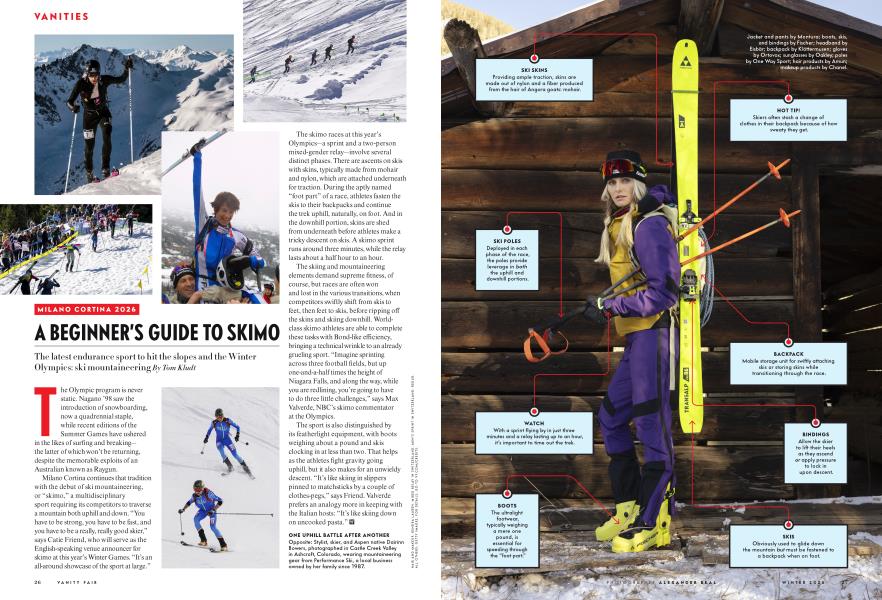
The skimo races at this year's Olympics—a sprint and a two-person mixed-gender relay—involve several distinct phases. There are ascents on skis with skins, typically made from mohair and nylon, which are attached underneath for traction. During the aptly named "foot part" of a race, athletes fasten the skis to their backpacks and continue the trek uphill, naturally, on foot. And in the downhill portion, skins are shed from underneath before athletes make a tricky descent on skis. A skimo sprint runs around three minutes, while the relay lasts about a half hour to an hour.
The skiing and mountaineering elements demand supreme fitness, of course, but races are often won and lost in the various transitions, when competitors swiftly shift from skis to feet, then feet to skis, before ripping off the skins and skiing downhill. Worldclass skimo athletes are able to complete these tasks with Bond-like efficiency, bringing a technical wrinkle to an already grueling sport. "Imagine sprinting across three football Helds, but up one-and-a-half times the height of Niagara Falls, and along the way, while you are redlining, you're going to have to do three little challenges," says Max Valverde, NBC's skimo commentator at the Olympics.
The sport is also distinguished by its featherlight equipment, with boots weighing about a pound and skis clocking in at less than two. That helps as the athletes fight gravity going uphill, but it also makes for an unwieldy descent. "It's like skiing in slippers pinned to matchsticks by a couple of clothes-pegs," says Friend. Valverde prefers an analogy more in keeping with the Italian hosts: "It's like skiing down on uncooked pasta."
SKI SKINS Providing ample traction, skins are made out of nylon and a fiber produced from the hair of Angora goats: mohair.
HOT TIP!
Skiers often stash a change of clothes in their backpack because of how sweaty they get.
SKI POLES
Deployed in each phase of the race, the poles provide leverage in both the uphill and downhill portions.
BACKPACK
Mobile storage unit for swiftly attaching skis or storing skins while transitioning through the race.
WATCH
With a sprint flying by in just three minutes and a relay lasting up to an hour, it's important to time out the trek.
BINDINGS
Allow the skier to lift their heels as they ascend or apply pressure to lock in upon descent.
BOOTS
The ultralight footwear, typically weighing a mere one pound, is essential for speeding through the "foot part."
SKIS
Obviously used to glide down the mountain but must be fastened to a backpack when on foot.
Subscribers have complete access to the archive.
Sign In Not a Subscriber?Join Now
