
Sign In to Your Account
Subscribers have complete access to the archive.
Sign In Not a Subscriber?Join NowMotors for Charon's ferry
STANLEY WALKER
How the gangs of New York have made taking a victim "for a ride" one of the more perfect arts
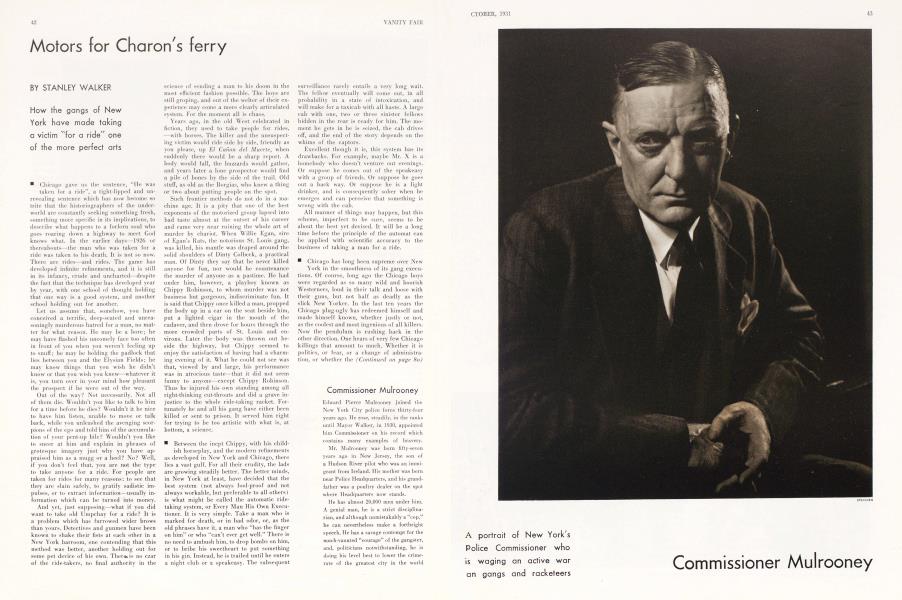
■ Chicago gave us the sentence, "He was taken for a ride", a tight-lipped and unrevealing sentence which has now become so trite that the historiographers of the underworld are constantly seeking something fresh, something more specific in its implications, to describe what happens to a forlorn soul who goes roaring down a highway to meet God knows what. In the earlier days—1926 or thereabouts—the man who was taken for a ride was taken to his death. It is not so now. There are rides—and rides. The game has developed infinite refinements, and it is still in its infancy, crude and uncharted—despite the fact that the technique has developed year by year, with one school of thought holding that one way is a good system, and another school holding out for another.
Let us assume that, somehow, you have conceived a terrific, deep-seated and unreasoningly murderous hatred for a man, no matter for what reason. He may be a bore; he may have flashed his uncomely face too often in front of you when you weren't feeling up to snuff; he may be holding the padlock that lies between you and the Elysian Fields; he may know things that you wish he didn't know or that you wish you knew—whatever it is, you turn over in your mind how pleasant the prospect if he were out of the way.
Out of the way? Not necessarily. Not all of them die. Wouldn't you like to talk to him for a time before he dies? Wouldn't it be nice to have him listen, unable to move or talk back, while you unleashed the avenging scorpions of the ego and told him of the accumulation of your pent-up bile? Wouldn't you like to sneer at him and explain in phrases of grotesque imagery just why you have appraised him as a mugg or a heel? No? Well, if you don't feel that, you are not the type to take anyone for a ride. For people are taken for rides for many reasons: to see that they are slain safely, to gratify sadistic impulses, or to extract information—usually information which can he turned into money.
And yet, just supposing—what if you did want to take old IJmpchay for a ride? It is a problem which has furrowed wider brows than yours. Detectives and gunmen have been known to shake their fists at each other in a New York barroom, one contending that this method was better, another holding out for some pet device of his own. Thero* is no czar of the ride-takers, no final authority in the science of sending a man to his doom in the most efficient fashion possible. The boys are still groping, and out of the welter of their experience may come a more clearly articulated system. For the moment all is chaos.
Years ago, in the old West celebrated in fiction, they used to take people for rides, •—with horses. The killer and the unsuspecting victim would ride side by side, friendly as you please, up El Canon del Muerte, when suddenly there would be a sharp report. A body would fall, the buzzards would gather, and years later a lone prospector would find a pile of bones by the side of the trail. Old stuff, as old as the Borgias, who knew a thing or two about putting people on the spot.
Such frontier methods do not do in a machine age. It is a pity that one of the best exponents of the motorized group lapsed into bad taste almost at the outset of his career and came very near ruining the whole art of murder by chariot. When Willie Egan, sire of Egan's Rats, the notorious St. Louis gang, was killed, his mantle was draped around the solid shoulders of Dinty Colbeck, a practical man. Of Dinty they say that he never killed anyone for fun, nor would he countenance the murder of anyone as a pastime. He had under him, however, a playboy known as Chippy Robinson, to whom murder was not business but gorgeous, indiscriminate fun. It is said that Chippy once killed a man, propped the body up in a car on the seat beside him, put a lighted cigar in the mouth of the cadaver, and then drove for hours through the more crowded parts of St. Louis and environs. Later the body was thrown out beside the highway, but Chippy seemed to enjoy the satisfaction of having had a charming evening of it. What he could not see was that, viewed by and large, his performance was in atrocious taste—that it did not seem funny to anyone—except Chippy Robinson. Thus he injured his own standing among all right-thinking cut-throats and did a grave injustice to the whole ride-taking racket. Fortunately he and all his gang have either been killed or sent to prison. It served him right for trying to be too artistic with what is, at bottom, a science.
■ Between the inept Chippy, with his childish horseplay, and the modern refinements as developed in New York and Chicago, there lies a vast gulf. For all their crudity, the lads are growing steadily better. The better minds, in New York at least, have decided that the best system (not always fool-proof and not always workable, but preferable to all others) is what might be called the automatic ride-taking system, or Every Man His Own Executioner. It is very simple. Take a man who is marked for death, or in bad odor, or, as the old phrases have it, a man who "has the finger on him" or who "can't ever get well." There is no need to ambush him, to drop bombs on him, or to bribe his sweetheart to put something in his gin. Instead, he is trailed until he enters a night club or a speakeasy. The subsequent surveillance rarely entails a very long wait. The fellow eventually will come out, in all probability in a state of intoxication, and will make for a taxicab with all haste. A large cab with one, two or three sinister fellows hidden in the rear is ready for him. The moment he gets in he is seized, the cab drives off, and the end of the story depends on the whims of the captors.
Excellent though it is, this system has its drawbacks. For example, maybe Mr. X is a homebody who doesn't venture out evenings. Or suppose he comes out of the speakeasy with a group of friends. Or suppose he goes out a back way. Or suppose he is a light drinker, and is consequently sober when he emerges and can perceive that something is wrong with the cab.
All manner of things may happen, but this scheme, imperfect to be sure, seems to be about the best yet devised. It will be a long time before the principle of the automat can be applied with scientific accuracy to the business of taking a man for a ride.
■ Chicago has long been supreme over New York in the smoothness of its gang executions. Of course, long ago the Chicago boys were regarded as so many wild and boorish Westerners, loud in their talk and loose with their guns, but not half as deadly as the slick New Yorker. In the last ten years the Chicago plug-ugly has redeemed himself and made himself known, whether justly or not, as the coolest and most ingenious of all killers. Now the pendulum is rushing back in the other direction. One hears of very few Chicago killings that amount to much. Whether it is politics, or fear, or a change of administration, or whether the lads are arm-weary, the fact remains that in the last few months New York and New York's suburbs have made Chicago look to its laurels.
(Continued on page 80)
(Confinued from page 42)
But the American metropolis is gradually solving its difficulties. It has about decided that the line must he drawn between an assassination and a shake-down—and the latter is preferable, and far more profitable. Thus one hears more and more of persons who were taken for a ride, but who came back with nothing to say.
The "ride," as developed by the smart Easterners, combines the best features of the Black Hand, the Mexican ransom experts and the practices of the late Torquemada. Only rarely do they want to kill anyone. They want to "put the blast" on some one, usually a third party, or they want to send a message where it will do the most good. The revival of torture— mild Hayings, foot-burnings, ear-snipping and what not—is one of the most disturbing features of this recrudescence of barbarism. And yet, it has not been so long a time since torture was accepted as a legal part of the processes of justice, and according to one of the Wickersham reports some police departments still use the third degree to elicit what passes as truth.
It is a tenet of English faith, imbedded in the law, that contracts executed under duress are not binding. The gangs are apparently unaware of this, and perhaps it is just as well, because the contracts made by the muggs of the underworld are more binding than all the legal paper that could he drawn up by all the members of the Bar Association. Indeed, some of the boys never heard of duress. The boys have the advantage of quick justice, and a nod from a Big Shot can get more things done than all the brilliant decisions handed down by a Court of Appeals.
Now and then, of course, somebody must he killed to preserve the authority of force, and to prove that riding is not all monkey business. There have been enough killings to get the idea across that when a man has a gun and invites you for a ride in New York, you'd better go along. The New York hoys don't carry guns habitually, a circumstance which heightens the effect when they do produce that little persuasive firearm vulgarly known as a "rod." The eternal truth, enunciated years ago, is that Smith & Wesson made all men equal. More than that, Smith & Wesson turned some of them into Big Shots.
Subscribers have complete access to the archive.
Sign In Not a Subscriber?Join Now
