
Sign In to Your Account
Subscribers have complete access to the archive.
Sign In Not a Subscriber?Join NowBRIT WITS
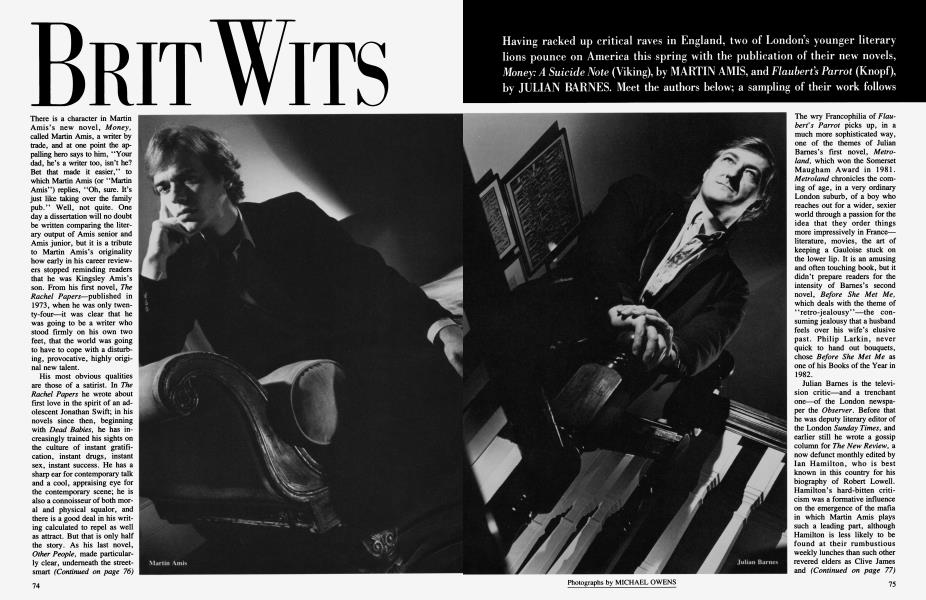
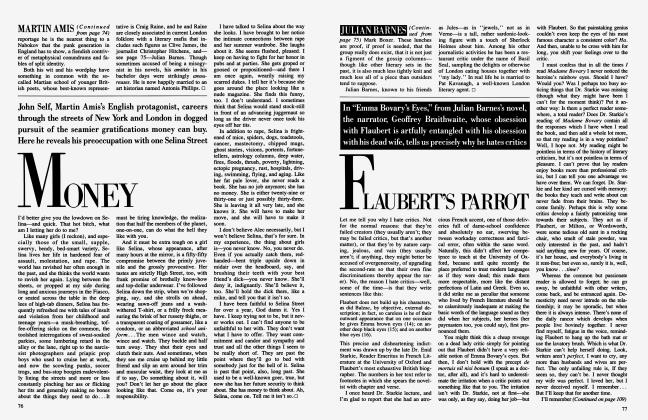
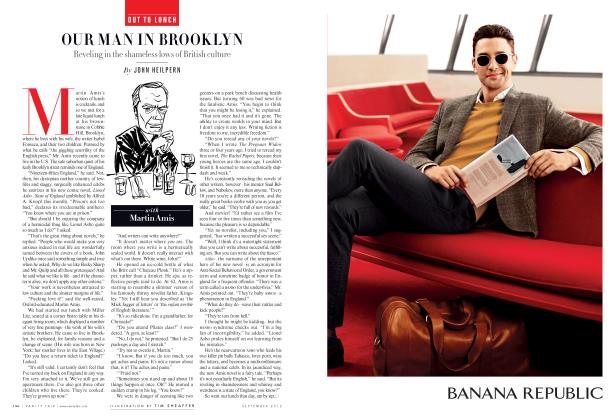
There is a character in Martin Amis's new novel, Money, called Martin Amis, a writer by trade, and at one point the appalling hero says to him, "Your dad, he's a writer too, isn't he? Bet that made it easier," to which Martin Amis (or "Martin Amis") replies, "Oh, sure. It's just like taking over the family pub." Well, not quite. One day a dissertation will no doubt be written comparing the literary output of Amis senior and Amis junior, but it is a tribute to Martin Amis's originality how early in his career reviewers stopped reminding readers that he was Kingsley Amis's son. From his first novel, The Rachel Papers—published in 1973, when he was only twenty-four—it was clear that he was going to be a writer who stood firmly on his own two feet, that the world was going to have to cope with a disturbing, provocative, highly original new talent.
His most obvious qualities are those of a satirist. In The Rachel Papers he wrote about first love in the spirit of an adolescent Jonathan Swift; in his novels since then, beginning with Dead Babies, he has increasingly trained his sights on the culture of instant gratification, instant drugs, instant sex, instant success. He has a sharp ear for contemporary talk and a cool, appraising eye for the contemporary scene; he is also a connoisseur of both moral and physical squalor, and there is a good deal in his writing calculated to repel as well as attract. But that is only half the story. As his last novel, Other People, made particularly clear, underneath the streetsmart reportage he is the nearest thing to a Nabokov that the punk generation in England has to show, a fiendish contriver of metaphysical conundrums and fables of split identity.
Continued on page 76
Having racked up critical raves in England, two of London's younger literary lions pounce on America this spring with the publication of their new novels, Money:ASuicideNote(Viking), by MARTIN AMIS, andFlaubert's Parrot(Knopf), by JULIAN BARNES. Meet the authors below; a sampling of their work follows
MARTIN
JULIAN BARNES
The wry Francophilia of Flaubert's Parrot picks up, in a much more sophisticated way, one of the themes of Julian Barnes's first novel, Metroland, which won the Somerset Maugham Award in 1981. Metroland chronicles the coming of age, in a very ordinary London suburb, of a boy who reaches out for a wider, sexier world through a passion for the idea that they order things more impressively in France— literature, movies, the art of keeping a Gauloise stuck on the lower lip. It is an amusing and often touching book, but it didn't prepare readers for the intensity of Barnes's second novel, Before She Met Me, which deals with the theme of "retro-jealousy"—the consuming jealousy that a husband feels over his wife's elusive past. Philip Larkin, never quick to hand out bouquets, chose Before She Met Me as one of his Books of the Year in 1982.
Julian Barnes is the television critic—and a trenchant one—of the London newspaper the Observer. Before that he was deputy literary editor of the London Sunday Times, and earlier still he wrote a gossip column for The New Review, a now defunct monthly edited by Ian Hamilton, who is best known in this country for his biography of Robert Lowell. Hamilton's hard-bitten criticism was a formative influence on the emergence of the mafia in which Martin Amis plays such a leading part, although Hamilton is less likely to be found at their rumbustious weekly lunches than such other revered elders as Clive James and page 75) Mark Boxer. These lunches are proof, if proof is needed, that the group really does exist, that it is not just a figment of the gossip columns— though like other literary sets in the past, it is also much less tightly knit and much less all of a piece than outsiders tend to suppose. Julian Barnes, known to his friends
Continued on page 77
MARTIN AMIS
{?on,Te* from page 74)
Both his wit and his wordplay have something in common with the socalled Martian school of younger British poets, whose best-known represen-
tative is Craig Raine, and he and Raine are closely associated in current London folklore with a literary mafia that includes such figures as Clive James, the journalist Christopher Hitchens, and— see page 75—Julian Barnes. Though sometimes accused of being a misogynist in his novels, his amities in his bachelor days were strikingly amoureuses. He is now happily married to an art historian named Antonia Phillips. □
JULIAN BARNES
(Continued from
as Jules—as in "jewels," not as in Verne—is a tall, rather sardonic-looking figure with a touch of Sherlock Holmes about him. Among his other journalistic activities he has been a restaurant critic under the name of Basil Seal, sampling the delights or otherwise of London eating houses together with "my lady." In real life he is married to Pat Kavanagh, a well-known London literary agent.
Subscribers have complete access to the archive.
Sign In Not a Subscriber?Join Now


