


Sign In to Your Account
Subscribers have complete access to the archive.
Sign In Not a Subscriber?Join NowArt Throb
Tremors and Fissures and Earthquake Art
BY AMY HEMPEL
In 1975,1 am shaking in San Francisco. There have been earth tremors the morning friends arrive from the stable Midwest. They invite me for vodka and vistas at the Top of the Mark. The Top of the Mark is on the nineteenth floor.
I tell them the better view is across the street at the Fairmont. But do I take them to the towering Crown Room? I do not. Moments later my friends sit scowling over mai tais in the Tonga Room, looking not at a panoramic view of San Francisco but at the simulated thunderstorm in the center of the oddball Polynesian scene that is the Tonga Room.
The Tonga Room, God love it, is on the Terrace Floor—i.e., under the lobby.
This because we're in California, the state that is also a ride. California— where "The Big One'' does not mean The Bomb, but the magnitude-8.3 earthquake that has a 50 percent chance of splitting the state in the next thirty years.
If you feel uncomfortable about earthquakes, as Charles Richter made clear, you had better leave California.
I did, and I did. But not for twelve years. For the twelve years I lived in San Francisco and Los Angeles, I slept with a glass of water on a table beside the bed. I never drank the water; it was a crude but reliable seismographic tool. I used it to register tremors the way the Chinese keep pans of dried peas in their yards. A dry rattle of peas in a pan, a lapping of water in a glass, and it is time to move to a doorway, the safest place to be if you are indoors during an earthquake. There are 15,000 earthquakes a year in California, and I have felt my share. The first one was the worst, the San Fernando Valley quake in 1971. It hit at six A.M. with a magnitude of 6.6. A magnitude of 5 will do structural damage. Each step in magnitude—say, from 5 to 6—represents a tenfold increase in ground motion and thirtyfold increase in the quake's energy.
I lay paralyzed as the plaster in the ceiling crumbled to chunks and dust and covered the bed with a ghostly smoking blanket. Cracks forked like lightning down the vibrating walls, and the banister pulled away from the stairs. It sounded as though the Coast Starlight train were steaming through the hall. (Duplicated for the movie Earthquake, the sensation was called "Sensurround.")
Who could ever be the same? I mean, "Are not you mov'd, when all the sway of earth / Shakes like a thing unfirm?"
I became conversant with the theory of plate tectonics, and heard harrowing statistics and predictions, the most colorful of which is that in 13 million years Los Angeles will have pushed up alongside San Francisco. I read Helmut Tributsch's When the Snakes Awake, and began to watch animals for anomalous pre-quake behavior. When rats act drunk, when fish jump out of the creeks, when pigs bite their tails off— hold on, says Helmut. (Animals don't like earthquakes any more than we do. After the '83 quake that devastated Coalinga, Koko, the remarkable "talking" gorilla who lives in nearby Woodside, was quoted as having signed: "Dam dam floor bad bite. Trouble trouble.")
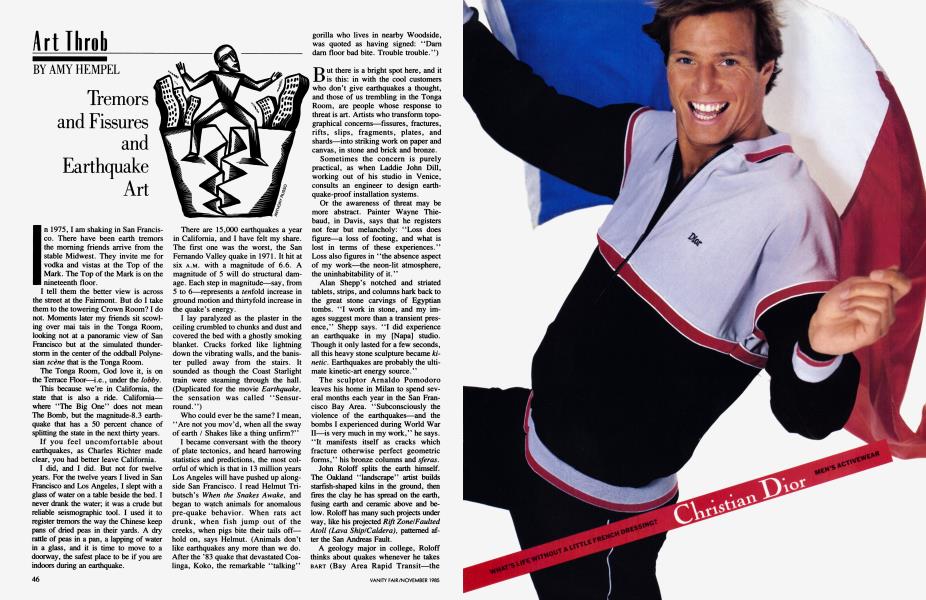
But there is a bright spot here, and it is this: in with the cool customers who don't give earthquakes a thought, and those of us trembling in the Tonga Room, are people whose response to threat is art. Artists who transform topographical concerns—fissures, fractures, rifts, slips, fragments, plates, and shards—into striking work on paper and canvas, in stone and brick and bronze.
Sometimes the concern is purely practical, as when Laddie John Dill, working out of his studio in Venice, consults an engineer to design earthquake-proof installation systems.
Or the awareness of threat may be more abstract. Painter Wayne Thiebaud, in Davis, says that he registers not fear but melancholy: "Loss does figure—a loss of footing, and what is lost in terms of these experiences." Loss also figures in "the absence aspect of my work—the neon-lit atmosphere, the uninhabitability of it."
Alan Shepp's notched and striated tablets, strips, and columns hark back to the great stone carvings of Egyptian tombs. "I work in stone, and my images suggest more than a transient presence," Shepp says. "I did experience an earthquake in my [Napa] studio. Though it only lasted for a few seconds, all this heavy stone sculpture became kinetic. Earthquakes are probably the ultimate kinetic-art energy source."
The sculptor Arnaldo Pomodoro leaves his home in Milan to spend several months each year in the San Francisco Bay Area. "Subconsciously the violence of the earthquakes—and the bombs I experienced during World War II—is very much in my work," he says. "It manifests itself as cracks which fracture otherwise perfect geometric forms," his bronze columns and sferas.
John Roloff splits the earth himself. The Oakland "landscrape" artist builds starfish-shaped kilns in the ground, then fires the clay he has spread on the earth, fusing earth and ceramic above and below. Roloff has many such projects under way, like his projected Rift Zone!Faulted Atoll (Lava Ship/Caldera), patterned after the San Andreas Fault.
A geology major in college, Roloff thinks about quakes whenever he takes BART (Bay Area Rapid Transit—the trains go under the bay) into San Francisco. "It's like a disaster movie," he says. ''You picture the water pouring in when the tunnel cracks—you look around and think, These are the people I am going to die with."
The most literal translation of earthquake into art comes from ''project artist" Dustin Shuler. In an elevated six-foot-by-six-foot mahogany sandbox, Shuler constructed miniature buildings, about four feet high, from miniature bricks ("Brick has no lateral strength"). Underneath the sandbox he installed a motor which, when activated, caused the sand to chum, dust to rise, and the buildings to crumble. "If you're in control of the earthquake, you can handle the fear."
Shuler got the idea during a real quake, watching the floor roll and the chairs slide along it. He went on to build Destruction of the Nightmare Towers—"kind of like the ARCO Center in L.A." Another construction, Gapping the Nightmare Arch, brought down half of a miniature Arc de Triomphe.
Forget glasses of water—Shuler keeps a helmet beside his bed.
Nance O'Banion sets things awry.
For years, she built lattice-like constructions of bamboo and handmade translucent paper, which she coated with a layer of iridescent paint. And something would always be awry—a stick, for example, that "slipped" out of the grid or a standing construction that leaned to one side. These were the pieces with titles like Slipt Skin, Standing Fractured, and Linears of Probable Geologic Activity.
She remembers sitting on a California beach as a child and feeling queasy with motion sickness as an earthquake churned the damp sand beneath her in the phenomenon of liquefaction. In her work she makes use of Landsat (satellite) photographs, and, in fact, a line in one of her pieces traces the actual coastline of California. The rock silhouettes of the changing Pacific coastline inspired her "rocks"—porcupiny, screenlike pieces with unmatched sides (like the fault that runs down the San Francisco peninsula) which she assembles from
acrylic-sprayed bamboo spikes, handmade-paper strips and "flames," and varicolored telephone circuit wire. "Like the faults, creative energy builds and builds and then one day it snaps," says O'Banion. "At what point does it fracture? When does one break?"
As a child in Los Angeles, Stephanie Weber saw her backyard split wide open. "There was a deep growl from the earth," she recalls. Today, her house in Berkeley sits directly atop a fault; she finds she can now call an earthquake to the decimal—"It takes some of the scare out of it when you can sit back after a quake and say, 'Four point two.' " Still, she feels "a sense of the momentary" here, and her work moves quickly.
Weber is a sea diver who as a teenager worked as a guide on Disneyland's Jungle Cruise, which combined two of her frequent motifs—water and the things that disturb it. Like the rich coastal waters, Weber's acrylic paintings are seductive, ominous, in flux.
"People who think about earthquakes think about deluge," she says, meaning more than the tidal waves that are generated by offshore quakes. Her last thought on earthquakes: "The violence of nature puts people back in scale. It is more acceptable than human cruelty."
David Geiser, who painted in San Francisco for twelve years before a recent move to New York, talks about the primal significance of working in what is known as "the Ring of Fire" (the band of earthquake and volcanic activity that circles the Pacific): "Earthquakes produce fear and reverence in tribal peoples and lead them to position burial mounds and spots of religious and magical significance along fault lines."
Which is not unlike what a San Francisco psychiatrist had to say about earthquakes: "They're godlike—so show some respect!"
Postscript: So I left California and moved to New York. In New York, I stopped shaking and started to write. I wrote a book and set all of the stories in California. In this book the subject of earthquakes comes up thirty-four times. □
Subscribers have complete access to the archive.
Sign In Not a Subscriber?Join Now
