
Sign In to Your Account
Subscribers have complete access to the archive.
Sign In Not a Subscriber?Join NowBrit Lit
PRINTED MATTER
James Atlas
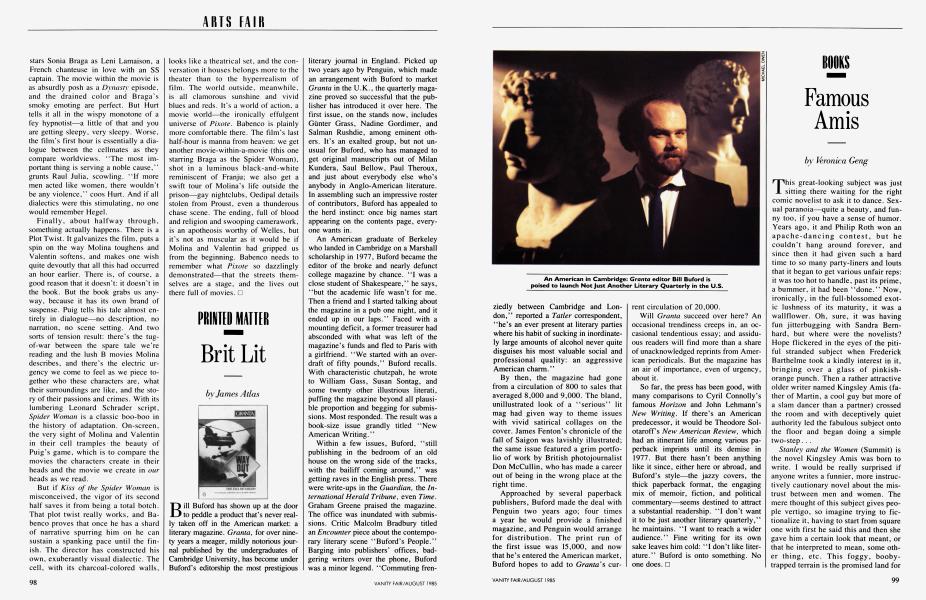
Bill Buford has shown up at the door to peddle a product that's never really taken off in the American market: a literary magazine. Granta, for over ninety years a meager, mildly notorious journal published by the undergraduates of Cambridge University, has become under Buford's editorship the most prestigious literary journal in England. Picked up two years ago by Penguin, which made an arrangement with Buford to market Granta in the U.K., the quarterly magazine proved so successful that the publisher has introduced it over here. The first issue, on the stands now, includes Gunter Grass, Nadine Gordimer, and Salman Rushdie, among eminent others. It's an exalted group, but not unusual for Buford, who has managed to get original manuscripts out of Milan Kundera, Saul Bellow, Paul Theroux, and just about everybody else who's anybody in Anglo-American literature. In assembling such an impressive roster of contributors, Buford has appealed to the herd instinct: once big names start appearing on the contents page, everyone wants in.
An American graduate of Berkeley who landed in Cambridge on a Marshall scholarship in 1977, Buford became the editor of the broke and nearly defunct college magazine by chance. "I was a close student of Shakespeare,'' he says, "but the academic life wasn't for me. Then a friend and I started talking about the magazine in a pub one night, and it ended up in our laps.'' Faced with a mounting deficit, a former treasurer had absconded with what was left of the magazine's funds and fled to Paris with a girlfriend. "We started with an overdraft of fifty pounds,'' Buford recalls. With characteristic chutzpah, he wrote to William Gass, Susan Sontag, and some twenty other illustrious literati, puffing the magazine beyond all plausible proportion and begging for submissions. Most responded. The result was a book-size issue grandly titled "New American Writing."
Within a few issues, Buford, "still publishing in the bedroom of an old house on the wrong side of the tracks, with the bailiff coming around," was getting raves in the English press. There were write-ups in the Guardian, the International Herald Tribune, even Time. Graham Greene praised the magazine. The office was inundated with submissions. Critic Malcolm Bradbury titled an Encounter piece about the contemporary literary scene "Buford's People." Barging into publishers' offices, badgering writers over the phone, Buford was a minor legend. "Commuting frenziedly between Cambridge and London," reported a Tatler correspondent, "he's an ever present at literary parties where his habit of sucking in inordinately large amounts of alcohol never quite disguises his most valuable social and professional quality: an aggressive American charm. ''
By then, the magazine had gone from a circulation of 800 to sales that averaged 8,000 and 9,000. The bland, unillustrated look of a "serious" lit mag had given way to theme issues with vivid satirical collages on the cover. James Fenton's chronicle of the fall of Saigon was lavishly illustrated; the same issue featured a grim portfolio of work by British photojournalist Don McCullin, who has made a career out of being in the wrong place at the right time.
Approached by several paperback publishers, Buford made the deal with Penguin two years ago; four times a year he would provide a finished magazine, and Penguin would arrange for distribution. The print run of the first issue was 15,000, and now that he's entered the American market, Buford hopes to add to Granta's current circulation of 20,000.
Will Granta succeed over here? An occasional trendiness creeps in, an occasional tendentious essay; and assiduous readers will find more than a share of unacknowledged reprints from American periodicals. But the magazine has an air of importance, even of urgency, about it.
So far, the press has been good, with many comparisons to Cyril Connolly's famous Horizon and John Lehmann's New Writing. If there's an American predecessor, it would be Theodore Solotaroff's New American Review, which had an itinerant life among various paperback imprints until its demise in 1977. But there hasn't been anything like it since, either here or abroad, and Buford's style—the jazzy covers, the thick paperback format, the engaging mix of memoir, fiction, and political commentary—seems destined to attract a substantial readership. "I don't want it to be just another literary quarterly," he maintains. "I want to reach a wider audience." Fine writing for its own sake leaves him cold: "I don't like literature." Buford is onto something. No one does.
Subscribers have complete access to the archive.
Sign In Not a Subscriber?Join Now
