





Sign In to Your Account
Subscribers have complete access to the archive.
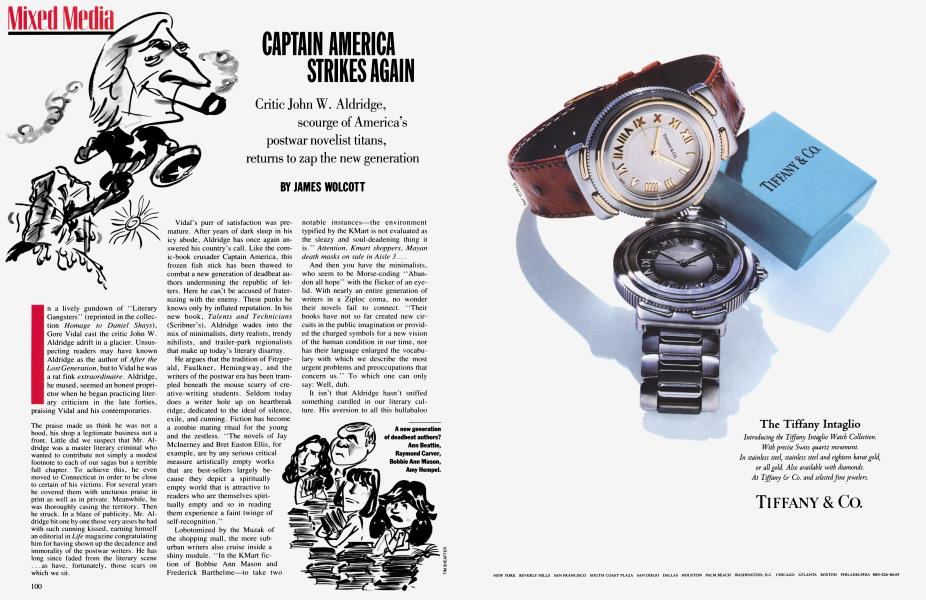
Sign In Not a Subscriber?Join NowCAPTAIN AMERICA STRIKES AGAIN
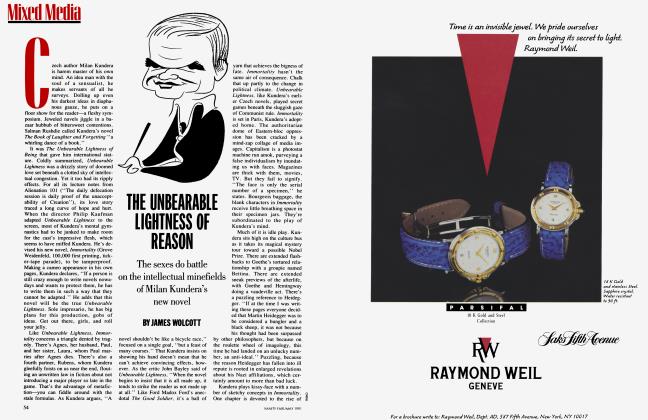
JAMES WOLCOTT
Critic John W. Aldridge, scourge of America's postwar novelist titans, returns to zap the new generation
Mixed Media
In a lively gundown of "Literary Gangsters'' (reprinted in the collection Homage to Daniel Shays), Gore Vidal cast the critic John W. Aldridge adrift in a glacier. Unsuspecting readers may have known Aldridge as the author of After the Lost Generation, but to Vidal he was a rat fink extraordinaire. Aldridge, he mused, seemed an honest proprietor when he began practicing literary criticism in the late forties, praising Vidal and his contemporaries.
The praise made us think he was not a hood, his shop a legitimate business not a front. Little did we suspect that Mr. Aldridge was a master literary criminal who wanted to contribute not simply a modest footnote to each of our sagas but a terrible full chapter. To achieve this, he even moved to Connecticut in order to be close to certain of his victims. For several years he covered them with unctuous praise in print as well as in private. Meanwhile, he was thoroughly casing the territory. Then he struck. In a blaze of publicity, Mr. Aldridge bit one by one those very asses he had with such cunning kissed, earning himself an editorial in Life magazine congratulating him for having shown up the decadence and immorality of the postwar writers. He has long since faded from the literary scene ...as have, fortunately, those scars on which we sit.
Vidal's purr of satisfaction was premature. After years of dark sleep in his icy abode, Aldridge has once again answered his country's call. Like the comic-book crusader Captain America, this frozen fish stick has been thawed to combat a new generation of deadbeat authors undermining the republic of letters. Here he can't be accused of fraternizing with the enemy. These punks he knows only by inflated reputation. In his new book, Talents and Technicians (Scribner's), Aldridge wades into the mix of minimalists, dirty realists, trendy nihilists, and trailer-park regionalists that make up today's literary disarray.
He argues that the tradition of Fitzgerald, Faulkner, Hemingway, and the writers of the postwar era has been trampled beneath the mouse scurry of creative-writing students. Seldom today does a writer hole up on heartbreak ridge, dedicated to the ideal of silence, exile, and cunning. Fiction has become a zombie mating ritual for the young and the zestless. "The novels of Jay Mclnerney and Bret Easton Ellis, for example, are by any serious critical measure artistically empty works that are best-sellers largely because they depict a spiritually empty world that is attractive to readers who are themselves spiritually empty and so in reading them experience a faint twinge of self-recognition."
Lobotomized by the Muzak of the shopping mall, the more suburban writers also cruise inside a shiny module. "In the KMart fiction of Bobbie Ann Mason and Frederick Barthelme—to take two notable instances—the environment typified by the KMart is not evaluated as the sleazy and soul-deadening thing it is." Attention, Kmart shoppers, Mayan death masks on sale in Aisle 3.. .
And then you have the minimalists, who seem to be Morse-coding "Abandon all hope" with the flicker of an eyelid. With nearly an entire generation of writers in a Ziploc coma, no wonder their novels fail to connect. "Their books have not so far created new circuits in the public imagination or provided the charged symbols for a new vision of the human condition in our time, nor has their language enlarged the vocabulary with which we describe the most urgent problems and preoccupations that concern us." To which one can only say: Well, duh.
It isn't that Aldridge hasn't sniffed something curdled in our literary culture. His aversion to all this hullabaloo is widely shared. Alfred Kazin—he's kvetched. The novelists Madison Smartt Bell and Mark Helprin have argued the supremacy of protein-rich prose over minimalism's starvation rations. In an American Scholar essay entitled "Mistah Perkins—He Dead," Gerald Howard anatomized the fast-buck fix fiction writers find themselves in. (His argument was that, given the haphazard nature of publishing today, in which writers aren't nurtured for the future but are packaged as passing fancies, you can hardly blame them for going for the fast buck. That may be the only foothold they ever get.) Indeed, the significance of Talents and Technicians, subtitled "Literary Chic and the New AssemblyLine Fiction," is that it is the first booklength attempt to box this dissatisfaction into a solid overview.
To his credit, Aldridge isn't cowed by reputation. (Vidal, nursing memories of his sore behind, was a bit harsh about Aldridge's personal honor.) He doesn't hesitate to remove some of the saintly haze from the cult of Raymond Carver. He understands that Anne Tyler has been knitting tea cozies for her characters' heads. But if by night Aldridge sports the blue trunks of Captain America, by day he is a professor of English at the University of Michigan. And like many a pipe smoker, he has this unfortunate habit of correcting everyone in sight. His corrections make you feel that he really doesn't understand how fiction functions from the inside. He wants the imagination, in short, to behave.
He contends that Mary Robison's stories might improve if she curbed her flaky characters' freedom "and required them to become subservient to some thematic idea that they should exist to serve." Turn those ragged recruits into good little soldiers! Louise Erdrich also lets her kids run wild. "Erdrich seems to possess abundant raw materials for fiction. But she evidently lacks the ability to take complete imaginative possession of those materials and employ them in the service of a significantly developed dramatic theme." Professors like themes, because they're easy to write on the blackboard. They also enjoy charting influences, because it lets them draw family trees. Stephen Crane begat Hemingway begat Carver begat a pair of faded jeans hanging on the clothesline.
However, writers today—those ingrates—seem to have no respect for their elders. "They appear on the whole to have only moderate intellectual culture. They evidently possess very little critical or satirical perspective on contemporary life, slight knowledge of the past, and apparently no sense that they belong to a literary tradition that might prove nourishing if they were able and willing to learn from it." Maybe; but it's one thing to acknowledge the biggies, another to be oppressed by them. Wrapping up his chapter on T. Coraghessan Boyle, Aldridge laments, "He has not been able, as Scott Fitzgerald once said about Thomas Wolfe, 'to line himself up along a solid gold bar, like Hemingway's courage or Joseph Conrad's art or D. H. Lawrence's intense cohabitations.' " Five famous names in one sentence!—what writer sitting around in his scratchy long johns could compete with that lineup of Solid Gold dancers? (And Boyle is a writer Aldridge likes.) Aldridge isn't comfortable with writers' asserting unclassifiable individuality. He wears a helmet while reviewing Amy Hempel. He envisions writers as members of a citizen army toting their themes aloft like placards in some Great March of influence.
It's tempting to see that Great March as trending downhill into a ditch. For Aldridge, as for many critics, American literature has been losing horsepower since the heyday of the twenties. Oh, he allows for exceptions to this general entropy: "I think of Pynchon's Gravity's Rainbow, Gaddis's JR and The Recognitions, Mailer's Harlot's Ghost, Heller's Catch-22 and Something Happened, Vonnegut's Slaughterhouse Five, and DeLillo's Players and White Noise." But in the big picture, each generation has failed its parents. The postwar generation fumbled the legacy of Hemingway-Fitzgerald-Faulkner. The crabgrass crew led by John Updike flubbed the lessons of the postwar generation. And now the blank generation has blown the entire franchise, reducing fiction to sound bites and stubble.
Aldridge sees young writers not as ripe but wizened. They have dried figs for testicles, shrunken balloons for ovaries. Most won't last the first frost.
The last chapter of Talents and Technicians is titled "Ripeness Is All," which seems intended as rueful irony. For Aldridge sees young writers not as ripe but wizened. They have dried figs for testicles, shrunken balloons for ovaries. Most of them won't last the first frost. "Even those like Raymond Carver and Ann Beattie, who are perhaps the best known... appear destined to join the host of people who will enjoy the experience of being famous for fifteen minutes."
It ought to be depressing, seeing American lit tottering on its last legs, trying to make it to the end of the century. So why isn't it? I think it's because the release of a book like Talents and Technicians tells us we've seen the low. To use an economic analogy: the investor Jim Rogers said the recession was over the day President Bush announced that the country was in a recession. His explanation was that Bush sits atop the pyramid of Prevailing Opinion, which makes him the last one to know about hardship down below. Once he knows, everyone knows, and once everyone knows, the bad news has peaked. The situation can only improve.
Similarly, Talents and Technicians typifies the lofty malaise of a certain kind of literary mind. Now that it's been put to the page, there are no negatives left in the pipeline. Like presidential leadership, punditry is always one beat behind. Hence the studied gloom of Talents and Technicians is grounds for optimism, its funeral oration planting the seeds of resurrection.
Far from seeing the nineties as a feeble wind-down, I predict that the decade will confound Captain America. There's activity afoot with younger Americans such as Larry Brown, Kaye Gibbons, Allegra Goodman, Jennifer Egan, Alice Hoffman, Helen Schulman, Dani Shapiro, Lewis Nordan, Thomas William Simpson, William T. Vollman—none of whom make Aldridge's book. In England, there's Rose Boyt, the Granta gang. And there's no reason to rule out the prospect of an impressive pop from old stalwarts. Probably the most impassioned piece of writing in recent years is Saul Bellow's The Bellarosa Connection. Who knows what Tom Wolfe is whipping up in his soda shop? Even if none of this pans out, it's still better than playing dead.
Subscribers have complete access to the archive.
Sign In Not a Subscriber?Join Now
