Sign In to Your Account
Subscribers have complete access to the archive.
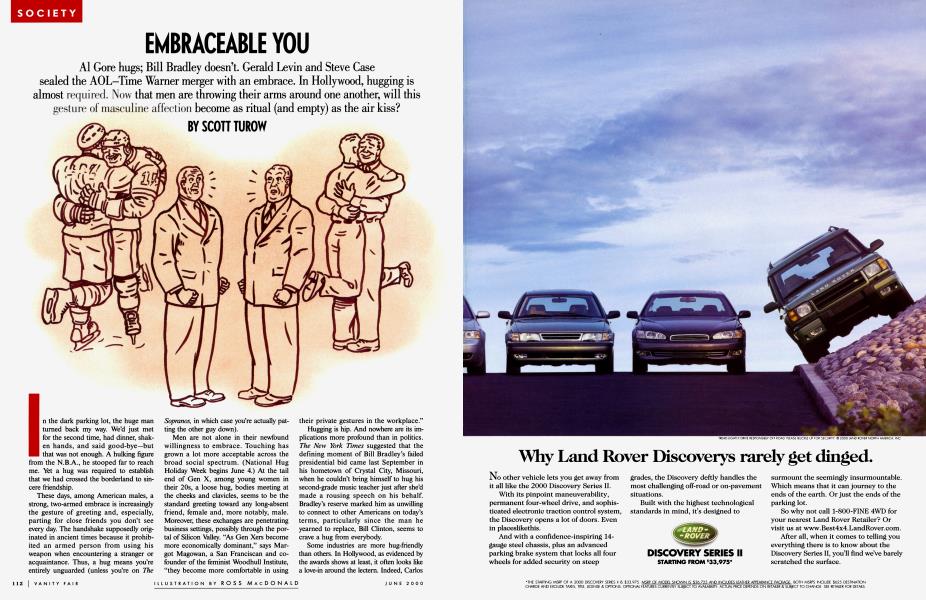
Sign In Not a Subscriber?Join NowAl Gore hugs; Bill Bradley doesn’t. Gerald Levin and Steve Case sealed the AOL-Time Warner merger with an embrace. In Hollywood, hugging is almost required. Now that men are throwing their arms around one another, will this gesture of masculine affection become as ritual (and empty) as the air kiss?
Al Gore hugs; Bill Bradley doesn’t. Gerald Levin and Steve Case sealed the AOL-Time Warner merger with an embrace. In Hollywood, hugging is almost required. Now that men are throwing their arms around one another, will this gesture of masculine affection become as ritual (and empty) as the air kiss?
In the dark parking lot, the huge man turned back my way. We’d just met for the second time, had dinner, shaken hands, and said good-bye—but that was not enough. A hulking figure from the N.B.A., he stooped far to reach me. Yet a hug was required to establish that we had crossed the borderland to sincere friendship.
These days, among American males, a strong, two-armed embrace is increasingly the gesture of greeting and, especially, parting for close friends you don’t see every day. The handshake supposedly originated in ancient times because it prohibited an armed person from using his weapon when encountering a stranger or acquaintance. Thus, a hug means you’re entirely unguarded (unless you’re on The Sopranos, in which case you’re actually patting the other guy down).
Men are not alone in their newfound willingness to embrace. Touching has grown a lot more acceptable across the broad social spectrum. (National Hug Holiday Week begins June 4.) At the tail end of Gen X, among young women in their 20s, a loose hug, bodies meeting at the cheeks and clavicles, seems to be the standard greeting toward any long-absent friend, female and, more notably, male. Moreover, these exchanges are penetrating business settings, possibly through the portal of Silicon Valley. “As Gen Xers become more economically dominant,” says Margot Magowan, a San Franciscan and cofounder of the feminist Woodhull Institute, “they become more comfortable in using their private gestures in the workplace.”
Hugging is hip. And nowhere are its implications more profound than in politics. The New York Times suggested that the defining moment of Bill Bradley’s failed presidential bid came last September in his hometown of Crystal City, Missouri, when he couldn’t bring himself to hug his second-grade music teacher just after she’d made a rousing speech on his behalf. Bradley’s reserve marked him as unwilling to connect to other Americans on today’s terms, particularly since the man he yearned to replace, Bill Clinton, seems to crave a hug from everybody.
Some industries are more hug-friendly than others. In Hollywood, as evidenced by the awards shows at least, it often looks like a love-in around the lectern. Indeed, Carlos Santana set many tongues wagging when he kissed singer-songwriter Rob Thomas (his collaborator on their award-winning hit, “Smooth”) smack on the lips at the Grammys. On the other hand, in Lawyerland, where I still spend much of my time, there is not a whole lot of huggin’ goin’ on. Obviously, I don’t embrace opposing counsel (nor, frankly, can I recall ever feeling the urge to do so). But I don’t even hug my clients—no matter what they are paying per hour. One of my younger colleagues, John Koski, points out that hugging is harder in a suit and tie, and the willingness to hug may be linked to whether an industry accepts casual attire.
Obviously, I don't embrace opposing counsel. But I don’t even hug my clients—no matter what they are paying per hour.
Despite that, the revolution in the behavior of professional men remains startling to me. Now we see Gerald Levin, C.E.O. of Time Warner, and AOL chairman Steve Case seal their mega-deal by throwing their arms around each other. Or Vice President A1 Gore celebrating his nomination-clinching primary win, in Florida, by turning from the microphone to embrace a prominent male backer. For most of my lifetime—I’m 51—men touching men has been A Thing, part of mainstream America’s rigid homophobia, which generally discouraged hugging, in public or private. Archie Bunker, the Silent Majority Everyman on All in the Family, the No. 1 TV show for most of the 70s, could not quite return the embrace of his son-in-law, Michael, even when he and Archie’s daughter, Gloria, departed to live in California. And remember the scene from the 1987 film Planes, Trains & Automobiles in which Steve Martin’s and John Candy’s characters were forced it the one remaining bed in a motel and woke to find they’d crawled into each other’s arms. They stormed up, strutting around, as Martin blustered the now classic line “See that Bears game last week?”
The dynamic forces that propelled these changes do not strike me as particularly mysterious. The happy communalism of the 1960s, and the sensitivity training of Esalen, made it O.K. for men to touch, as part of a community experience. For decades feminists have urged men to yield more readily to the affective sides of their personalities. Early in the 90s, Robert Bly’s Iron John and Sam Keen’s Fire in the Belly decried men’s isolation from one another. Young AfricanAmerican males began to engage in a stylized hug as a form of personal greeting. Gay liberation also had a beneficial impact here, not only through the example of gays, whose P.D.A. made the undone imaginable, but because declarations of sexual orientation reduced old-fashioned fears about unspoken agendas.
Norman Lear, the revered TV producer who created All in the Family, thinks that male hugging was characteristic of many American immigrant communities—groups that generally abandoned the gesture as part of their Americanization but chose to perpetuate it in certain enclaves, such as Hollywood. There, it gradually grew into an almost rote greeting, manifest most notably on late-night talk shows, whose example many TV viewers freely emulate.
In fact, the place where we most often see guys hugging is the one venue in which the touching taboo never existed: the fields of play. For decades, hockey and soccer players, after a goal, have routinely jumped into one another’s arms. But certain sporting hugs in the 90s suggested the specialness of a male bond: a fever-plagued Michael Jordan collapsing in Scottie Pippen’s arms after torching Utah for 38 points in the 1997 N.B.A. finals; a weeping Tiger Woods falling into his dad’s arms after winning the 1997 Masters, a monumental personal achievement forged out of the shared dreams of father and son in a less segregated, reformed America. We’ve all wanted to be like Mike—and Tiger. And so the hug has been endorsed along with the Swoosh by our glatt-masculine totems.
As all of this comes to consciousness, though, problems loom. Whom to hug and whom not to? Judging from behavior in Hollywood, we are well on the way to the insincere guy-hug, the male counterpart of the distaff air kiss. The AOL-Time Warner merger may ultimately be remembered not only as the biggest, baddest business combination ever, but also as the beginning of the end of the honest male embrace. As the ebullient Jerry Levin and Steve Case grabbed at each other, we were all moved to recall that the essence of cool lies in not trying to show you are.
Subscribers have complete access to the archive.
Sign In Not a Subscriber?Join Now
