

Sign In to Your Account
Subscribers have complete access to the archive.
Sign In Not a Subscriber?Join NowANGEL WAS A CENTERFOLD
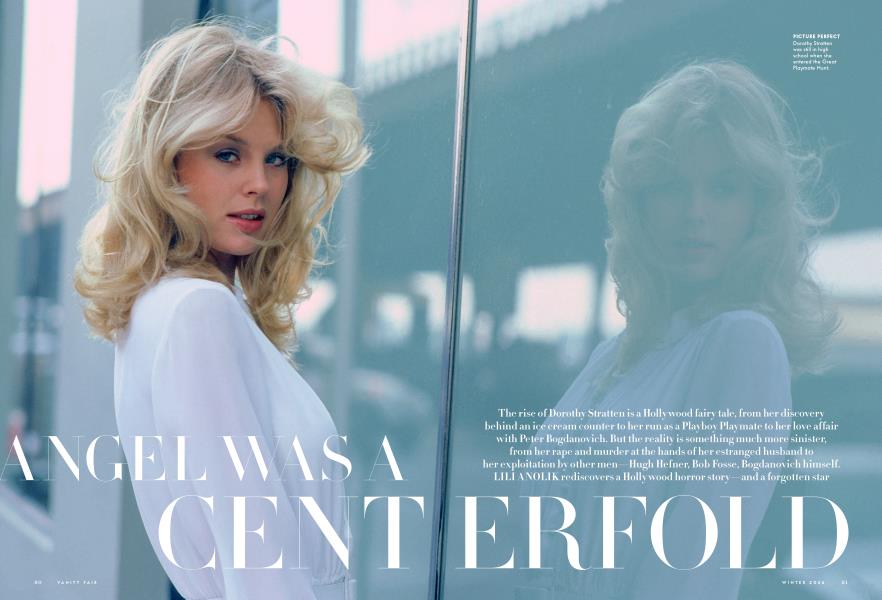
The rise of Dorothy Stratten is a Hollywood fairy tale, from her discovery behind an ice cream counter to her run as a Playboy Playmate to her love affair with Peter Bogdanovich. But the reality is something much more sinister, from her rape and murder at the hands of her estranged husband to her exploitation by other men—Hugh Hefner, Bob Fosse, Bogdanovich himself. LILI ANOLIK rediscovers a Hollywood horror story—and a forgotten star
LILI ANOLIK
THE PINUP AND THE PIMP
Before it was a horror story, it was a fairy tale.
Once upon a time (in 1978) in a Podunk town (Coquitlam, on the outskirts of Vancouver) lived a young girl named Dorothy Hoogstraten. Dorothy, 17, a high school senior, was working her usual shift at a local Dairy Queen when in walked the Big Bad Wolf: Paul Snider, 26, in a floor-length mink, lizard-skin boots, and a Star of David necklace, diamond-encrusted. He was dressed like a pimp because he was a pimp, if an unsuccessful pimp so far. (The year before, he'd moved to LA, got himself a gold limo, a stable of girls, but the girls hadn't made him enough money—one girl, a thief, even cost him money—the reason he'd moved back to Canada.) Still, he had a pimp's appraising eye. And that eye could see past Dorothy's drab uniform and Cindy Brady pigtails, her tall girl's diffidence and her sweet girl's shyness, to the bombshell smoldering underneath.
Snider didn't tell Dorothy he was a pimp; told Dorothy he was a promoter, which he also was. In LA, he'd put on the California Truckin' & Cycle Show at the Convention Center. Photographer Howard Ko by met him while he was tooling around in a van designed by George Barris, creator of the Batmobile, spreading the word about the Truckin' show. (His gimmick: staging a Farrah Fawcett look-alike contest and a bikini contest.) "Paul said he invented the bikini contest," recalls Koby. "It was very big in those days. An event would happen, and the promoterwould advertise, 'We're going to have a wet T-shirt contest, so all you babes come with T-shirts and we're going to throw water on you.' I don't have to tell you what water does to a T-shirt. Paul's shows were popular, but they didn't make money. He spent a lot of the money on himself—that was the problem. He loved cars and he dressed to the hilt. "
Snider wooed Dorothy: bought her flowers, sang to her, took her to prom. He was always trying to get her clothes off. So he could have sex with her, naturally; but really so he could photograph her. Playboy had announced its Great Playmate Hunt, a contest to find a centerfold for January 1979, the 25 th anniversary issue. Snider was pushing Dorothy to enter. Dorothy's sister Louise, younger by eight years, remembers the shock of stumbling on a stack of naked Polaroids: "It was so out of character. Because whenever Dorothy took a shower, either she brought her clothes into the bathroom or she came out in a robe. She was so private."
If Dorothy was ambivalent about the camera, the camera was not ambivalent about Dorothy. Itwas gaga for her. In her test shots, she conveyed a mixture of innocence and eroticism; purity but with intimations of depravity, an arousing purity. In other words, she was Playboy's type—a virgin just waiting to be defiled. One problem: her (under) age. In Vancouver the age of majority was 19; Dorothy was 18.
Snider worked hard to persuade her mother, Nelly (her father, Simon, had long been out of the picture), to sign a release. When he failed, he signed it for Nelly—a forgery—sent it to Playboy. Hugh Hefner, the magazine's founder and publisher, was knocked out by what he saw. On August 13, 1978, he flew Dorothy to LA.
Though Dorothy wasn't the winner of the contest, she was the runner-up. And Snider saw to it that her star only rose from there. A recollection of Louise's: "We were watching The Sonny & Cher Show at their place, and Paul said, 'I'm Sonny and Dorothy's Cher.' " He oversaw all aspects of her life. Even her name was subject to his tinkering, Hoogstraten soon swapped for the more marquee-friendly Stratten. "Everything she did had to go through Paul," says Koby. "He was just controlling her, how she dressed, controlling her every move." And her every bite. Another recollection of Louise's: "It's my 12th birthday. Dorothy's at the house. We're having dinner, and there's cake. All of a sudden, a car pulls up, and before I know it, she's shoving her piece of cake in front of me. Paul had come unexpectedly."
Snider's methods were dubious; his results were not. In short succession, Dorothy landed Playmate of the Month (August 1979); a lead role in the BDSM thriller Autumn Born (she played a spoiled-rottenrich girl, spending much of the movie in her undies, handcuffed to a bed and getting spanked), in the sci-fi romp Galaxina (she played a sex-doll-looking android in a skintight spacesuit and wedge heels); Playmate of the Year (1980); and an invitation to The Tonight Show (she got Johnny to crack a smile). In the midst of all this, she married Snider—reluctantly—in Vegas. ("I owe it to him," she told a Playboy photo editor. "I was a nobody when he found me.") Always, always she sent what money she could to her mother.
In March 1980, Dorothy, now 20, headed to New York to begin filming with Peter Bogdanovich, 40. She'd met the celebrated director at the Playboy Mansion. He was immediately struck by her refinement, her delicacy, and, of course, her beauty. The two fell in love and he wrote her into his next picture, They AU Laughed, a romantic comedy. She'd be starring alongside Audrey Hepburn, Ben Gazzara, John Ritter, and Colleen Camp.
"DOROTHY WAS IMPORTANT BECAUSE HEFNER IS REGARDED BY HOLLYWOOD AS AN INTERLOPER. THEY'LL COME TO HIS PARTIES AND PLAY HIS GAMES. BUT THEY WON'T GIVE HIM RESPECT. ONE OF THE WAYS HE CAN GAIN LEGITIMACY IS TO BE A STAR MAKER.''
Dorothy checked into her hotel, the Wyndham, though only to keep up appearances. She was staying with Bogdanovich at his hotel, the Plaza, a "Do not disturb" on the phone. Snider was already spiraling: He'd been working with the founders of beefcake dance troupe Chippendales but was getting squeezed out for sloppy business practices (a female mud-wrestling contest he'd staged lost money); his access to the mansion was diminishing (Hefner didn't like him oozing his sleaze over the girls); coke (he was snorting a lot of it). When he couldn't reach Dorothy, he spiraled faster. She was his ticket to ride. No way was he letting her go without a fight. As Dorothy's mother sensed. "It was our mother's premonition, as if she'd had a dream," says Louise. "She kept saying to my sister, 'Protect your face.' "
Snider hired a private detective to spy on Dorothy, find out if she was cheating on him with Bogdanovich. (A doleful irony: They All Laughed is about a trio of private detectives, one played by Ritter, made to look as much like Bogdanovich as possible, down to the horn-rimmed glasses. Ritter's character has been hired to spy on Dorothy's character by her jealous husband who believes she's cheating on him.) After the movie wrapped, Dorothy, having sent Snider a letter asking for a separation, moved into Bogdanovich's Bel-Air house.
On August 13, Dorothy visited a lawyer, and, while declaring her intention to end the marriage to Snider, declared, too, her intention to take care of Snider financially. ("I'd like to remain his friend," she told the lawyer.) On August 14, sometime around 12 p.m., she stopped by Snider's West LA rental, the one they used to share, with $ 1,100 in her purse, a good-faith payment presumably. Over the course of the afternoon, Snider raped her; shot her in the face; raped her dead body; shot himself in the head.
It'd been exactly two years and one day since Dorothy left Canada.
Like I said, a fairy tale. But a fairy tale for grown-ups and a fairy tale at odds with itself. There's a tension between the fairy tale's tellers (of which there are a profusion) and the fairy tale's main characters. Dorothy Straiten and Paul Snider are, in the view of the tellers, adequate to headline a children's fairy tale; inadequate to headline an adult's as they can barely muster two dimensions never mind three. She, the heroine, is as preternaturally beautiful as she is pathologically pure-hearted: virtue incarnate. He, the villain, is a slimeball-cum-greaseball-cum-cornball: vice incarnate. They're symbols rather than people, the Pinup and the Pimp. And so the instinct of the tellers is to push to the wings these cardboard cutout leads, pull to center stage the fully rounded supporting players, complicated and contradictory men who inspire the greatest dramatic and psychological interest.
THE ALL-AMERICAN PORNOGRAPHER
The first teller is journalist Teresa Carpenter. Carpenter's piece, "Death of a Playmate," appears not quite three months after the rape-murder-rape-suicide, in the November 5,1980, issue of The Village Voice. The closing lines: "As for Paul Snider, his body was returned to Vancouver in permanent exile from Hollywood.... His sin, his unforgivable sin, was being small-time." Too small-time for Hollywood. And too small-time for Carpenter. Snider, in her estimation, is such a snake-eyed scumbag—low even for a lowlife; a bottom-feeder with no bottom—that he almost isn't worthy of blame. Of course she does blame him—how could she not?—but she also blames Hefner and Bogdanovich because, as she sees it, they are Snider. Snider if Snider were worthy. Snider if Snider were big-time.
"In the end Dorothy Stratten was less memorable for herself than for the yearnings she evoked," Carpenter concludes. (See what I mean? Carpenter is shitcanning Dorothy as the star of her own story.) "In Snider a lust for the score; in Hefner a longing for a star; in Bogdanovich a desire for the eternal ingenue." In short, Snider might have been a pornographer and pimp, but so, too, were Hefner and Bogdanovich.
That someone viewed Hefner as a pornographer shouldn't have come as a shock to him, and yet I suspect it did. Pornographers, after all, were furtive little men, guilt-ridden and bound by loneliness. And Hefner was expansive, social, forthright—a national institution—not to mention a very likable guy, and as close to middle-class respectability as a person who wore pajamas instead of clothes and regularly participated in orgies could be.
Sexual emancipator was how Hefner viewed Hefner. "I played some significant part in changing the social-sexual values of our time," he said, and on more than one occasion. Hefner also viewed Hefner as a civil rights warrior, a defender of the First Amendment, and an unlikely feminist. ("I was a feminist before there was such a thing as feminism.")
Moreover, Hefner's pornography wasn't. "Hef made pornography nice," says Miki Garcia, Miss January 1973 and director of Playmate Promotions from 1976 to 1982. "He made pornography that you could put on the coffee table. In fact, you didn't use the word pornography at Playboy. You called it art." Dorothy certainly called it art. "That's how Dorothy sold it to our mother," says Louise. "She told our mother that she wasn't selling her body, that she was selling her beauty, that the photos were art."
Pornography, art; tomato, tomahto. Only, at the end of the day, tomato. Garcia: "It was pornography. Soft pornography, but pornography."
So, Carpenter could make the pornography charge stick. What about the pimp? Yes, if indirectly. "Hef had all these beautifulwomen, and he controlled them," says Garcia, He controlled them through the contracts he had them sign. Basically Playboy was the old studio system. With Dorothy, she'd signed the Playmate of the Month contract and the Playmate of the Year contract. She was totally under his thumb." And not so indirectly. Again, Garcia: "Playboy Model Agency was run by Valerie Cragin, and Valerie Cragin had the disposition of a pimp. People can say that's a harsh word, but that's my observation. The Playmates had no one really to fend for them but Valerie Cragin, and she did whatever Hef wanted. Nobody in Hollywood thought it was a true agency. In Hollywood it was a joke."
So, to a degree, was Hefner. A beggar as well, no matter that he was a king everywhere else. Hollywood turned him into a beggar. Worse, Hollywood turned him into a host. That's what he was at the Mansion in Holmby Hills—the host with the most, the host with too much. "The Mansion was a truly weird world," says writer Richard Rhodes, then a contributing editor at Playboy. "He had a giant harem going. There was an endless stream of young women." Which meant an endless stream of men, some very famous. "Once Dorothy took me to a party at the Mansion," says Louise. "James Caan was there, Robert Blake, O. J. Simpson, Jim Brown, Bill Cosby." Quite a lineup. In a few years: Caan will be accused of punching, choking, and threatening to kill a woman; Blake will be tried for murdering a woman; Simpson will be tried for murdering a woman; Brown will be charged with assaulting a woman; and Cosby will be convicted of drugging and molesting a woman. (Caan will settle; Blake will be acquitted; Simpson will be acquitted; Brown's charges will be dismissed; and Cosby's conviction will be overturned.) "Hef really catered to celebrities, celebrities of all sorts—sports, intellectual, Hollywood," says Garcia. "He loved them. And he provided them with booze, drugs, anything they wanted. And, of course, there were always new Playmates."
Hefner's professional power in Hollywood was even more limited than his social. Hollywood was a company town, and he wasn't a company man, much as he tried to be. "He was in love with the idea of Hollywood," says Garcia. "He was a film buff, had movie night every weekend. And he acted like a director. That's why he was directing things in the bedroom, making sex tapes of the Playmates. So, yes, Hef wanted to be accepted by the Hollywood-ites, but he just wasn't." His forays into moviemaking went nowhere. He execufive-produced Roman Polanski's Macbeth (1971), Arthur Hiller's The Crazy World of Julius Vrooder (1974), both busts.
WAS THE LAST PICTURE SHOWK SMASH BECAUSE OF ITS EMOTIONAL INTELLIGENCE, ITS ATMOSPHERIC NUANCE, OR BECAUSE IT FEATURED A NUMBER OF YOUNG WOMEN TOPLESS?
What's surprising, though, is that his forays into movie star making went nowhere too. The maiden issue of Playboy, December 1953, had on its cover Marilyn Monroe and the words: "FIRST TIME in any magazine FULL COLOR the famous MARILYN MONROE NUDE." But Monroe was already a movie star by then. (The photos were taken back in 1949, when she was a struggling contract player.) "Playboy, contrary to the perception of aspiring starlets, is not a natural conduit to stardom," Carpenter points out, and rightly. There was Jayne Mansfield (Miss February 1955) and Stella Stevens (Miss January 1960), only they were the rare exceptions. Carpenter then quotes a Playboy employee: "Dorothy was important because Hefner is regarded by Hollywood as an interloper. They'll come to his parties and play his games. But they won't give him respect. One of the ways he can gain legitimacy is to be a star maker."
Hefner understood that Dorothy was in possession of the elusive It. "Some people have the quality," he said. "That magic she had." As Snider used Dorothy as an open sesame to the closed world of Playboy, so Hefner planned to use Dorothy as the open sesame to the closedworld of major motion pictures. "Hefwas looking at Dorothy, thinking, She's going to put Playboy on the map in Hollywood," says Garcia. "He believed she was going to become a big star. Peter Bogdanovich was hanging around the Mansion in those days [Hefner was executive-producing Bogdanovich's 1979 movie, Saint Jack\. Hef saw Peter as the perfect person to make it happen for her."
THE LAST (DIRTY) PICTURE SHOW
Tn the 1970s, a particular type of director—the auteur director—became as big a star as the movie stars he directed. These directors weren't craftsmen (how directors in previous generations thought of themselves) but artists; weren't making entertainment (how directors in previous generations thought of their work) but art. And audiences were along for the ride. Movies were the hottest pop-culture phenomenon going, hotter even than rock and roll. Among the ranks of the auteur directors: Robert Altman, Francis Ford Coppola, Martin Scorsese, Hal Ashby, and Peter Bogdanovich.
Bogdanovich's breakthrough came in 1971 with The Last Picture Show, an ensemble drama about growing up in a small Texas town, sensitively told and luminously shot. The lead actors, Jeff Bridges and Timothy Bottoms, were little known. The lead actress, Cybill Shepherd, was not an actress, was a model, and unknown, brand-new to the screen. She'd been discovered by Polly Platt, Bogdanovich's wife and collaborator, Platt spotting her on the cover of Glamour magazine while in the grocery store checkout line. (During filming, Bogdanovich would leave Platt, 31, just after she'd given birth to their second daughter, for Shepherd, 20.) The Last Picture Show was a sensation commercially—one of the top-10-grossing movies of the year—as well as critically, receiving eight Academy Award nominations, including best picture and best director.
Nobody in his right mind would call Bogdanovich a pornographer. Except he made movies, and movies were a keyhole through which voyeurs could peep. (Was The Last Picture Show a smash because of its emotional intelligence, its atmospheric nuance, or because it featured a number of young women topless?) What's more, he made movies in Hollywood, and Hollywood was a place where women routinely bartered their bodies for a chance at stardom. (As Monroe once said, "I spent a great deal of time on my knees.") In brief, exploitation was built into the medium.
CONTINUED ON PAGE 114
CONTINUED FROM PAGE 87
Nobody in his right mind would call Bogdanovich a pimp. He was good with women and good to women, his treatment of Platt notwithstanding. Actually, his treatment of Platt semiwithstanding. Their personal relationship ended after The Last Picture Show, but their working relationship endured. She was production designer on his next two movies, What's Up, Doc? (1972) and Paper Moon (1973). The Last Picture Show would win Cloris Leachman an Oscar for best supporting actress. Paper Moon would do the same for Tatum O'Neal. "Peter was different from most men," says Colleen Camp. "He wanted women to work. Iwas his girlfriend and I broke up with him and he still created a part tailor-made for me in They All Laughed. "
So, to repeat: Nobody in his right mind would call Bogdanovich a pimp. Except, also to repeat: He made movies. Was, in fact, a director of movies, and inherent in that word—director— is power, authority, control. When a director cast his female lead, wasn't he choosing a woman he believed conformed or could be coaxed into conforming to his dream? That was the dynamic between Bogdanovich and Shepherd—Pygmalion and Galatea. David Newman recalled going to visit Bogdanovich, encountering Shepherd: "She came out of the bedroom, sat on Peter's lap. Peter goes, 'Hi, honey,' nuzzling, [as] I sat there.... She said, Tm going off to UCLA to see—' She opened the schedule. '...There's an Allan Dwan at three o'clock, and at five-thirty, should I stay and see that Frank Borzage?'... He'd go out of the room, and she'd roll her eyes, and go, 'He just wants me to know everything about the movies.'... She was being tutored to be a Peter Bogdanovich girlfriend."
When Bogdanovich got together with Dorothy in early 1980, he'd hit the skids. There'd been four flops in a row, two of which starred Shepherd, who'd dumped him for a parts manager at a car dealership in Memphis. It was a fresh decade, though, and he was looking for a fresh start, a fresh leading lady, discovery, muse, hope.
Carpenter's piece was highly influential. Because it was first. Because it won a Pulitzer. (By default, after Janet Cooke's sob-story story about an eight-year-old Black dope fiend—"Don't nobody here hardly ever smoke no herb"— for The Washington Post was revealed as bogus.) And because it delivered a moral that readers already knew by heart: Hollywood is no place for virtuous young ladies. (Regular people love to disapprove of the show business people they can't get enough of.) Hefner's and Bogdanovich's response was identical: incredulity and horror followed by the need to get the true version—that is, the Hefner version and the Bogdanovich version—out there and fast.
The supporting players in the fairy tale were about to become the tellers of the fairy tale.
Hefner commissioned an article for the May 1981 issue of his magazine. "Richard Rhodes and the editors of Playboy, " read the byline. "The deal was Hefner wanted to edit and contribute to the story," says Rhodes, "and I was wary of that. He would call me up at two in the morning. So, I was writing the story with him looking over my shoulder. And I had made an agreement with Arthur Kretchmer [Rhodes's editor] that if Hefner interfered sufficiently and edited the story sufficiently, they'd take my name off it. We finally compromised on 'by Richard Rhodes and the editors of Playboy. ' "
A few months later, in the fall of '81, Bogdanovich sold a proposal for a memoir about his time with Dorothy. "It's a story which must be told," he said to a reporter, "and I'll tell it."
But Carpenter wasn't passing the microphone just yet. She'd sold the rights to "Death of a Playmate" to Hollywood. (Perhaps not the only Dorothy-related rights sold to Hollywood. The private detective Snider hired to tail Dorothy and Bogdanovich, Marc Goldstein, had, according to a suit filed by Bogdanovich and the Stratten estate, stolen Dorothy's diaries and other personal effects, sold them to a studio. Goldstein claimed no probable cause; the suit was dismissed. Goldstein, however, was named "technical adviser" on the 1981 NBC TV movie Death of a Centerfold.) For the privilege of retelling her magazine piece in movie form, Carpenter was reportedly paid $130,000. As Hefner wryly noted: "So much for the exploitation of Dorothy Stratten."
IT'S SHOWTIME!
he adaption would be called Star 80, a reference to the vanity plate on the Mercedes Snider bought Dorothy with her money. (According to Louise, Snider's family harassed Dorothy's mother, insisting she give them the Mercedes, claiming it was their rightful property. Their reasoning: Snider was still legally Dorothy's husband; Dorothy died before Snider—because he shot her first, himself second—and therefore her assets went to him; and then, when he died, to them.) Bob Fosse would write and direct.
Fosse, a supporting player, even if he was entering the fairy tale when it was already over. Fosse, yet another complicated and contradictory man. Fosse, the final teller.
Fosse was a Hollywood figure via Broadway. A dancer and choreographer by training, he'd been the dominantdomineering too—force in American stage musicals starting in the mid-'50s, his influence so pervasive as to be all but invisible. By the late '60s, he was choreographing movies, which is to say, directing movies. In 1973, the year after Bogdanovich was nominated for an Academy Award for The Last Picture Show, Fosse won an Academy Award for Cabaret. (In 1973, he also won a Tony, for Pippin, and an Emmy, for Liza With a Z.) He'd directed two movies since, 1974'sLe/zny and 1979's All that Jazz; earned two best picture nominations since as well.
In terms of rank, scope, and scale, Fosse was every bit the equal of Hefner and Bogdanovich. And he had an enormous aesthetic advantage over both: Canny self-loathing was his bread and butter. You could tell his dirty secrets but there wouldn't be much point, as he'd already told them himself.
Fosse's subjects ranged, only not really. Really he had a single subject, and that subject was an idea: Life's a cabaret, old chum, and a crummy one. That's what Lenny, a biopic of comedian Lenny Bruce, is obliquely about. That's what All That Jazz, a fictional (barely) biopic of Bob Fosse, is blatantly about: An amphetamine-addicted choreographer-director, Joe Gideon, is putting on a musical (as Fosse did with Chicago), while cutting a movie on a comedian (as Fosse did with LennyY and propositioning any likely woman who crosses his path (as Fosse did with any likely woman who crossed his path).
Fosse saw everything through the smeared lens of gutter showbiz, which is what he grew up in. He started dancing professionally as a kid. Was, by 13, working the vaudeville circuit, and that meant the burlesque houses. "Burlesque," to the 21st-century ear, sounds old-timey and tame, nudity but coy nudity—Sally Rand and her ostrich feathers—only the places where young Fosse was doing his buck-andwing weren't in the least coy. Were crude, leering, blunt; low-dive, bump-and-grind, tits-and-ass toilets. (If he'd come of age in the late '70s rather thanthe early'40s, he'd have emceed a couple of Farrah Fawcett look-alike contests, hosed down a bevy of girls in T-shirts.) It's a world that disgusted him yet thrilled him too. The smell of theatrical rot got him high. He warmed to the glow of the dead twinkle in a stripper's eye.
Fosse understood that for Star 80 to work required performers who grasped instinctively the tawdry-corrupt milieu in which Dorothy and Snider moved, who knew that milieu in their bones because they'd taken it in with their mother's milk. And so, for his leads: show business babies.
As Dorothy, Fosse cast Mariel Hemingway, granddaughter of Ernest Hemingway, who'd shot himself the year she was born. Ernest Hemingway was, of course, a literary figure, not a show business figure, only he was a celebrity literary figure—America's Big Writer—and therefore a show business figure. "You come from this sick family," Fosse said when he wanted to goad her. "It was a way to make me feel that I came from such damage," she says. "There was the fame and the greatness, but [also] the seedy underbelly of something I wasn't even old enough to really understand. "
Only Hemingway wasn't who Fosse had in mind initially. His first thought was another show business baby, Melanie Griffith, daughter of Tippi Hedren, the last of the cool Hitchcock blondes. The one Hitchcock made from scratchwhen he spotted her in a commercial for a diet drink, signed her to a contract, oversaw her voice, her makeup, her clothes, then announced her as the lead in The Birds (1963). He fell under the spell of his own creation. Once that creation rebuffed him, though, love turned to hate. In the movie's climactic scene, he had trainers hurl live birds at her for days. She nearly lost an eye. (A no-coincidence coincidence: Cast as Dorothy in Death of a Centerfold, the NBC made-for-TV movie—the one onwhichMarc Goldstein served as technical adviser—was Jamie Lee Curtis, daughter of an earlier cool Hitchcock blonde, Psycho's Janet Leigh.)
Hemingway and Griffith had something else in common. Both first came to public notice playing nymphets. In Woody Allen's 1979 comedy Manhattan, Hemingway is Tracy, the girlfriend of Allen's character and only 17, though a worldly 17. "You've had three affairs before me?" Allen's character says to Tracy, marveling. "When I was your age, I was still being tucked in by my grandparents." In Manhattan's final scene, Tracy leaves Allen's character to go to London to study. (The final scene in the real-life Manhattan: Allen tries to convince Hemingway—like Tracy, 17; unlike Tracy, a virgin—to do the opposite: go to Paris with him to not study. "I knew Woody liked me," says Hemingway, "and I really hoped that I could just go to Paris with him and be his friend. But it dawned on me: I'm not going to get my own room. Okay, so I don't go. My parents were practically packing my bag. I'm like, 'Oh, come on, step it up, you're not being parents!' ") In Arthur Penn's 1975 neo-noir Night Moves, Griffith is Delly Grastner, a 16-year-old runaway with a little girl's voice and a grown woman's body—on full display in an underwater nude scene—intent on seducing Gene Hackman, 43 and paunchy.
Griffith's breakthrough would come a year after Star 80, when she played a variation on Dorothy—Holly Body, an adult actress—in Body Double, directed by a variation on Hitchcock, Brian De Palma, the self-declared true heir to Hitchcock. (Food for thought: It was due in no small part to Hefner and Playboy that the daughters of the two cool Hitchcock blondes—always immaculately made up, always noh me tangere—were getting naked and violated onscreen. Hefner and Playboy had changed the culture, remade it in their image so that Janet Leigh redux might play a brutalized centerfold; Tippi Hedren redux might play a nearly brutalized XXX star. Pornographic movies were now Hollywood movies.)
To secure the role of Dorothy, Hemingway would agree to breast implants. She would not, however, agree to sex with Fosse. "I said to him, T can't. I can't. I can't be naked every day, and also then go home with you.' I said, 'That will fuck me up so badly I will probably want to kill myself.' " Or to sex for Fosse. Fosse thought Robert De Niro would make the perfect Snider. De Niro, though, wouldn't even read the script. So Fosse asked Hemingway, on whom he suspected De Niro had a crush, to offer herself to the actor as an inducement. She declined. ("[Fosse] was like, 'You're a painin-the-ass, you're a cocktease.' ")
De Niro out, Fosse cast Eric Roberts as Snider. Roberts was also a show business baby: His parents ran an acting school; his sister was (or soon would be) Julia Roberts, the biggest female movie star of her generation.
To suggest that Star 80 is about anyone other than Dorothy would be madness—she is Star 80—yet somehow Star 80 is about someone other than Dorothy. A pull quote from a profile of Fosse in the November 13,1983, edition of the LA Times: "Peter [Bogdanovich] didn't like the idea of my filming the story. He said I didn't know the true story, which was correct. But I pointed out that I was making a movie about Paul Snider."
Iwas making a movie about Paul Snider. A startling enough admission. But what Fosse was really admitting was even more startling: Iwas making a movie about Bob Fosse.
Roberts, on the moment the light bulb went off: "Iwas having trouble with a scene and said, 'Cut.' You don't say, 'Cut,' on a Fosse movie unless you're Fosse. He said, 'What are you doing?' I said, 'I'm fucking up.' He goes, 'Goddamn it, come here.' I walk over to him, and I'm in my underwear, barefoot, and my skinny little legs, looking at the crew and feeling stupid. I said, 'What's up?' He said, 'Look at me.' He got right in my face. 'Look at me.' I said, T am looking at you.' He said, 'You're playing me if I weren't successful. Do you understand?' I got it. I just got it. I knew what he was after. Paul was the song-and-dance man, but with a con. From that moment on, I studied Bob's every movement, every mannerism. And, if you ask me, my Paul Snider is more Bob Fosse than Roy Scheider's Bob Fosse in All That Jazz."
Roberts is right: Star 80 is another version ofAll That Jazz; is another Fosse autobiography. "I think the manipulative Machiavellian side of Paul resonated with Bob because I think Bob recognized that in himself," says Hemingway. And Fosse emphasized Snider's Fosse-like qualities, playing up Snider's creative side. His Snider strums the guitar, takes arty nudes, and fashions flowers out ofwood. Hemingway: "Bob felt more like a Paul, obviously, than a Dorothy. I'm the less interesting character in the movie."
Because Fosse made her character the less interesting character in the movie. The real Dorothy was creative too. She was a compulsive writer of poetry. And when Snider was cooking up ideas for Chippendales, it was Dorothy who said that they should outfit the male dancers in bow ties and cuffs, what the Bunny servers wore at the Playboy Clubs. ("She ran it past Hef and he gave it his blessing," says Louise.) The look would become world-famous. Why didn't Fosse include either of these tidbits? Why portray Dorothy as a doe-eyed ding-a-ling; as not just naive but dumb? Was he afraid smarts or toughness would jeopardize her status as blameless victim? Make people think she had it coming? Yet by denying her her smarts, by denying her her toughness, he kills all interest in her. (Another kind of murder.)
Maybe the real question iswhy was Fosse so hell-bent on identifying with Snider in the first place? Sam Wasson, writer of Fosse, the definitive Fosse biography, says this: "I think what Fosse's saying when he says, 'You're me if I weren't successful,' is, T, too, would have done anything to be a success in show business, even murder.' "
There Fosse goes again: blabbing his dirty secrets.
During filming, Fosse became fixated on getting the minutiae right, the nitty-gritty particulars. He hired as a technical adviser Cis Rundle, Hefner's social secretary. (It was Rundle who took the call at the Mansion about Dorothy, told Hefner. "It's frozen in my mind because he was in the game room by the pinball machine, the one with his face on it, and a girl was standing next to him when I said, 'It's Dorothy, she's dead.' Everything got really quiet. Then this girl said, 'Does that meanwe're not going in the Jacuzzi?' I took her arm and pulled her away. I said, 'No, you're not going in the Jacuzzi.' ") Rundle made sure, for example, that when Cliff Robertson, Star 80's Hefner, was walking around with a Pepsi, that Pepsi was in a bottle. ("Hef never drank a can of Pepsi in his life.")
And Fosse would sit in a screening room with a 14-year-old Louise. He wanted notes from someone in Dorothy's family. "My mom couldn't do it, it was too upsetting for her," says Louise. "So I did it. Thank God for therapy."
The shoot was agony, largely because everyone knew where the story was going. "Bob shot in order," says Roberts. "He wanted to have death be the end because you can't really come back and do earlier scenes after you play that and feel it. [Instead] I felt everything all day, every day. I was a basket case."
Fosse insisted, too, on filming at the real locations whenever he could. "Everyplace in that movie is where it happened in reality," says Roberts. "It's like a docudrama."
Fosse wasn't trying to re-create the past—docudrama's goal—so much as resurrect the past. "Bob had a chair on set with Dorothy's name on it," says Rundle. "It's like she was there. Itwaslike a séance." And, as the dreaded bloodbath of a finale got closer and closer, he turned to Roberts and said, "He's going to do it. He's going to kill her, and I don't know how to stop him. "
Of course Fosse couldn't stop Snider, but that he imagined he could means he'd accomplished what he set out to accomplish: make the past present. In his mind, Dorothy's rape and murder wasn't fading into history, over and done with; was imminent, inevitable. And that is, I suspect, how he wanted it. He demanded that Roberts spend the night with him at Dorothy and Snider's house, the crime scene—"The blood was still seeping through the ceiling," says Rundle—before those last days of shooting. "The crudest thing Fosse could've done to me," according to Roberts. And he took away, without warning, the protective belt Roberts wore for his nude scene with Hemingway. Which iswhy, when Wasson referred to Star 80 as "a snuff movie," I nodded in surprised agreement. A snuff movie is, in a way, the ultimate Hollywood movie because it's the Hollywood movie taken to its furthest limit. Or its logical conclusion. (That the peroxided glamour of a Dorothy—or of a Marilyn—was always shading into the waxy sheen of a corpse is easy to see in retrospect.) Kiss kiss bang bang indeed.
Star 80 is the ultimate Hollywood movie in another sense. Hollywood's most cherished belief about itself is that it's a magical place, a place where a regular (if fabulously good-looking) person might find himself or herself tapped by the wand of a fairy godmother in the guise of a casting agent or producer, transformed into a star. Getting discovered, it's called. But to get discovered is also to get exposed. Lana Turner at Schwab's drugstore is the press release; Dorothy Stratten at the Dairy Queen is the autopsy report.
Star 80 was grueling to make, grueling to watch. No one could question the integrity of Fosse's vision. The show business world he depictedwas pure slime, and viewers—the few there were—dripped by the final reel. "Bob Fosse's Star 80 is about the degradation of everything and everybody," wrote Pauline Kael in The New Yorker, the opening line of a pan that could just as easily have been the opening line of a rave. What made the movie loathsome was also what made it unforgettable.
In Hollywood, Star 80 wasn't treated as a failure; was treated as an atrocity. To be associated with it was to be contaminated. And the effect it had on its principals was nothing short of ruinous. Fosse would be dead four years after its premiere. His heart attacked him just as Joe Gideon's heart attacked Joe Gideon: too many amphetamines ("He was totally addicted," says Rundle, "it killed him") and too much work (Broadway work—he never directed another movie). "I think it was the end of my career," says Hemingway, an overstatement, maybe, but not a wild one. And Roberts was so good as Snider that he was too good. "Everybody decided I was that crazy mofo. Iwas typecast as a psychopath for years. It haunted me."
RATS SPELLED BACKWARD
More tellings told, more tellers ruined:
In 1984, Bogdanovich published The Killing of the Unicorn: Dorothy Stratten 1960-1980. In his version of the fairy tale, he's the courtly lover; Dorothy the courtly lovee ("an angel in the shape of Aphrodite"); Hefner the evil flesh merchant. ("If the shadowy Hefner-side of the pyramid had never existed, Dorothy would not have died. She could have dealt with Paul Snider, a small-town pimp who first spotted and sold her, but she could not handle the slick professional machinery of the Playboy sex factory.")
The book was an act of tribute to Dorothy but also an act of revenge on Hefner. Hefner's response was what you'd imagine. "Hefner and Bogdanovich, they went to war," says Garcia. "Bogdanovich indicted him with that book. Hef could not stand that. And of course, he had spies out, private eyes going. He did whatever he could to pull Bogdanovich down. And he really did break Bogdanovich. He had information on Bogdanovich. And, well, Bogdanovich made poor choices, very poor choices."
On April 1,1985, Hefner held a press conference at the Mansion, where he accused Bogdanovich of seducing Dorothy's mother, Nelly, breaking up Nelly's marriage; of seducing Dorothy's sister, Louise, and for the first time when Louise was just 13; and of subjecting Louise to plastic surgery so that she might look more like his dead beloved.
Colleen Camp pooh-poohs the accusations: "Peter thought that because Dorothy had died tragically, he was responsible for her whole family. He had Nelly and Louise living with him in Bel-Air. He was getting them French lessons, okay? I said to him, 'Peter, this is not a good idea. This does not look good.' But he felt they needed to be taken care of, and he was oblivious as to how it looked. Peter thought he was in a Greek myth. One day, he turned to me and said, Tm destined to be with Louise. I'm going to marry her when she's 18. ' And, look, there's no possible way in a billion years that Peter was sleeping with Nelly. I know his type. And, yes, he did get Louise surgery but not a nose job or anything. It was dental surgery. Her jaw was out of alignment."
A few days after Hefner's press conference, Louise hied a lawsuit against Hefner for slander, libel, and invasion of privacy. Six months later, she dropped the suit. Around the same time, Bogdanovich issued an apology. "All of us who loved Dorothy, and I know Hugh Hefner was one of these, have been through the roughest of times...." He didn't have the energy to take on Hefner. Or the money. (In 1981, Fox, the studio set to distribute They All Laughed, shelved the movie due to poor test screenings. Unable to let it languish—let Dorothy languish—he'd bought it himself, distributed it himself. He'd paid $5 million, made less than $ 1 million.) Or even the heart. (Deep down, he must've known that he was only blaming Hefner so that he didn't have to blame himself.) By the end of 1985, he'd be forced to declare bankruptcy. In 1988, he'd marry Louise, 20, the same age that Shepherd was when he fell in love with her; that Dorothy was when he fell in love with her. At parties he'd say to people, "Remember me? I used to be Peter Bogdanovich."
Hefner was the winner of the war, but he was the loser too. Because to achieve victory he'd trashed the reputation of a grieving mother and a teenage girl, not a good look, as he well knew. ("Just so bad-taste Hollywood," he told Rolling Stone.) Besides, itwas time for him to lay low: Reagan was in office; Meese was forming a commission; and the Moral Majority was dogging his every move. At the decade's end, he'd stop being a playboy, become a married man. And his new wife, Kimberley Conrad, a Playmate—what else?—would persuade him to trade in his satin sheets for cotton ones, institute a "no nude swimming" policy at the pool. "There go the '70s," as Garry Trudeau said in his comic strip, Doonesbury.
And what, finally, of Dorothy?
She is the obj e ct of de sire who is the subject of all these articles and books and films but is, in the end, a mystery. Not one of the portraits captures her, and that's because her portraitists, though highly skilled, are highly compromised. They're pursuing their own agendas: Teresa Carpenter to dismiss her; Hugh Hefner to commodify her; Peter Bogdanovich to idealize her; Bob Fosse to victimize her. And how can they see her clearly when they only see what they want to see?
What might someone with unimpaired vision see when looking at Dorothy? Quentin Tarantino, in his podcast, The Video Archives, talks about watching footage of Dorothy taken at the Playboy Playmate of the Year ceremony, held just months before she died. "We see a completely different Dorothy Stratten," he says. "One, she's completely over Snider. She's repelled and putting up with him.... What's surprising is she's over Playboy too. You see that she has no problem with Playboy. She has no problem with Hefner.... She's very grateful for everything that Playboy did to put her in the situation that it did, but she's over it.... This is Stratten's exit from both Paul Snider and Playboy itself. That speech [she gives] is her goodbye. That person has never been dramatized in any of these stories at all. Actually, it took my breath away to see such a strong Dorothy Stratten with such an interior life."
In telling after telling, Dorothy is presented as the docile marionette ofwhatever man's pulling her strings at the moment. Except that reading of Dorothy doesn't square with the evidence. Dorothy always got what she needed from her men: Snider got her out of one-horse-town Canada and Dairy Queen, into bright-lights-big-city LA and in front of Hefner; Hefner got her to the top of the Playboy food chain and in front of Bogdanovich; Bogdanovich got her into a movie that bombed at the time yet is now considered a classic (Tarantino put it sixth on his list of favorite movies for Sight and Sound), and thus got her immortality. This isn't to suggest that Dorothy was some secret femme fatale mastermind, but rather a real woman living in the real world, adjusting and adapting as necessary. That, in two years, she went from nudie-cutie anonymity to the cusp of mainstream movie stardom was neither accident nor luck. One shrewd move after another is what itwas. The sole mistake she made was underestimating the desperation and lunacy of Paul Snider.
A detail that could be filed under "romantic," could be filed under "creepy": Dorothy's final resting place is the Pierce Brothers Westwood Village Memorial Park and Mortuary; resting alongside her, Peter Bogdanovich, who died in 2022. "There's no way Dorothy loved Peter the way Peter loved Dorothy," says Miki Garcia. "He was obsessed with her. Dorothy was so nice, and so kind, and so compassionate—so likable. But she had ambition. She wanted to break into movies. She knew he was a great director." Garcia sighs, shakes her head. "Now he's buried right next to her."
A detail that could only be filed under "creepy": Marilyn Monroe's final resting place is also the Pierce Brothers Westwood Village Memorial Park and Mortuary; resting alongside her, Hefner, who died in 2 017. Garcia, after a heavier sigh, "And we've got Hefner all cozied up to Marilyn." Marilyn didn't know Hefner, certainly didn't pose for Hefner. He bought the nudes of her from someone who wasn't her, published them in Playboy without asking her. ("I even had to buy a copy of the magazine to see myself in it," she said.) He imposed himself on her in life. And, by purchasing the crypt next to hers, he'd continue to impose himself on her in death.
Hollywood won't leave these women alone. Snuff isn't enough. Necrophilia isn't enough. They're hounded into the hereafter.
Only Roberts seemed to understand what had been done to Dorothy and what Dorothy was due. "Fosse knew how to get a performance out of an actor, and he got it out of Eric," says Cis Rundle. "I helped Eric through the whole shoot because he was so into character. He's going to be violent and threatening and scary because Paul's mind was that way. I mean, Eric was Paul. He was nuts. It was tough to be around him. But when the movie wrapped, he was so broken. He wanted to go to the cemetery where Dorothy was buried, so I took him. He laid on Dorothy's grave for almost two hours. He sobbed and sobbed and sobbed, sobbed like a baby. Then he took his SAG card out of his wallet, and tore it up, and the wind blew the pieces all over her grave."
One of the few grace notes in Dorothy's story, and the only apology Hollywood ever gave her.
RIP, Dorothy.


Subscribers have complete access to the archive.
Sign In Not a Subscriber?Join Now


